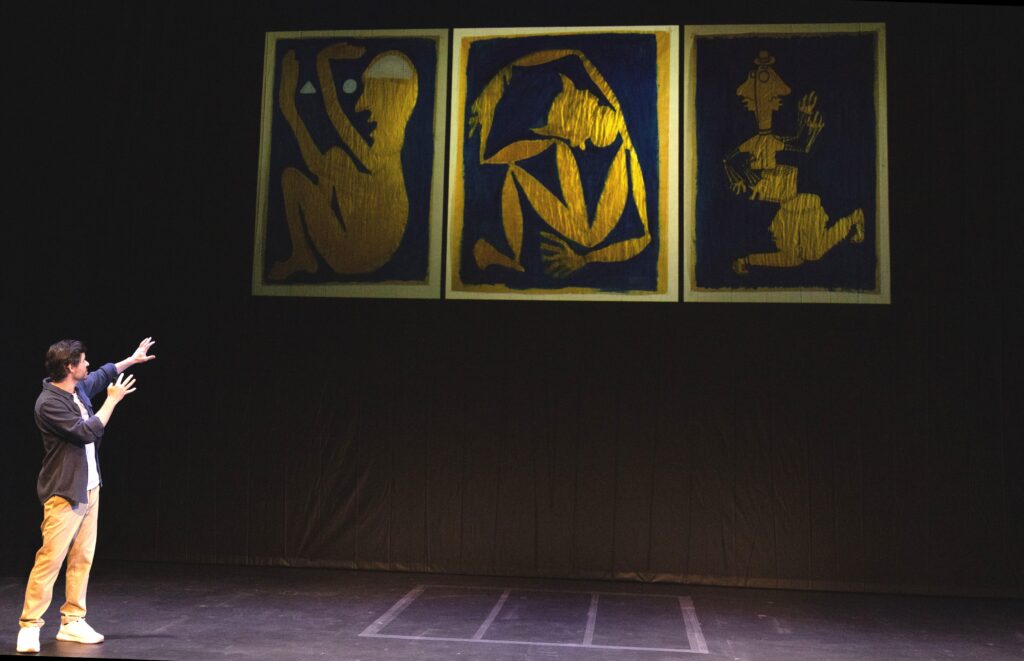
Sam Kissajukian in performance of 300 Paintings. Credit: Evgenia Eliseeva
Presented by American Repertory Theater
Written and Performed by Sam Kissajukian
Produced by Sally Horchow and Matt Ross in association with Octopus Theatricals
Now – Oct. 25, 2025
Farkas Hall
12 Holyoke Street
Cambridge, MA 02138
Running Time: 90 minutes, no intermission
Critique by Diana Lu
CAMBRIDGE, Mass. — Watching 300 Paintings feels a bit like being dropped straight into the mind of Sam Kissajukian, mid-manic episode—but with comfy seats, visual aids, and killer comedic timing. For 80 minutes straight, the comedian-turned-painter commands the stage with no script; his first 300 paintings flash on the black screen behind him. The result is a hilarious, high-energy, and surprisingly insightful comedic monologue that explores the fine line between genius and madness, connection and isolation, and what gets assigned as worthy in this late-stage capitalist world of unprecedented wealth disparity—a world obsessed with packaging everything, including ourselves, into “brands,” “content,” “product.”
The premise is wild yet oddly relatable: Sam got burnt out after putting 10 years of his life into a high-stress, low-wage job (stand-up comedy) where he wasn’t allowed to bring his whole self to work. So he quit… and then locked himself in an abandoned cake factory with no sunlight or human contact. Sam experienced what would later be understood as a six-month-long manic episode, during which he produced 300 paintings and dozens of ingenious and mad inventions that traced the shifts in his psyche. Before completely spiraling into psychosis, Sam uncovers the profound in the chaos—insight, connection, and a new creative identity. 300 Paintings follows his journey through that period, month by month, painting by painting, VC pitch by VC pitch.
Though Sam says he quit stand-up, this show is really a stand-up special in a one-man play’s clothing. 300 Paintings could easily be a Netflix special, and I expect he’ll get to that sooner rather than later. The surrealist humor, meandering yet punchy pacing, and deep vulnerability of the show were so on point that sometimes it felt like I was watching an extended live version of Mr. Show or Rick and Morty. Other times, it felt like I was watching a comic book villain use his powers for good. Sam deftly employs his sharp wit to deflate himself while showcasing his most narcissistic manic moments.
The punchlines also soften some of life’s hard truths without pulling any punches. The fact that he got MULTIPLE venture capitalists to hear out—much less offer funding for—his one-invention-a-day ideas says as much about the absurd state of business as it does about Sam’s brilliance of mind. He also studied mechanical engineering, and we get the sense that he could have become a billionaire entrepreneur if he had chosen that life. But instead, he paints, dunks on big business, and dips into serious discourse about who gets to say what is creative genius and what is garbage taped to a bare wall? Who gets to accumulate and throw around money like feed pellets to starved pullets? Who gets to assign what is sane about your identity and what is diseased?
I particularly appreciate the way 300 Paintings portrays mental illness. There’s no “and then I got better” tied-in-a-bow ending. In fact, there’s no ending at all. The monologue seamlessly transforms into an art exhibit and Q&A session with Sam. He embraces his bipolar diagnosis in a realistic and affirming way—it’s so intrinsic to his life, his sense of self, and his creativity that there is no separation. Instead, he models his identity as a three-state system: manic, depressed, and stable. Each state is a valid and authentic expression of his being. There is familiarity and comfort in even the most unhinged highs and lows of his mind. He describes his paintings as touchpoints from within each state, and seeing them gave me a whole-body sense of the lived experience of bipolar.
Sam’s 300 paintings are breathtaking—both on their own and as his supporting characters. Shown all together, slide after slide and exhibited after the show, you really see the movement between his three states and the maturation of his self-knowledge through his artwork, which ranges from chaotic to geometric, to visual comedic roasts, to sweepingly emotive and hauntingly beautiful. There’s a sense of rawness and organic development that connects the viewer with the artist through time. It’s something rare and profoundly human in our era of AI-generated hotel lobby art. The show itself was uniquely satisfying and memorable—one of my favorite experiences of visual or performance art in a long time.