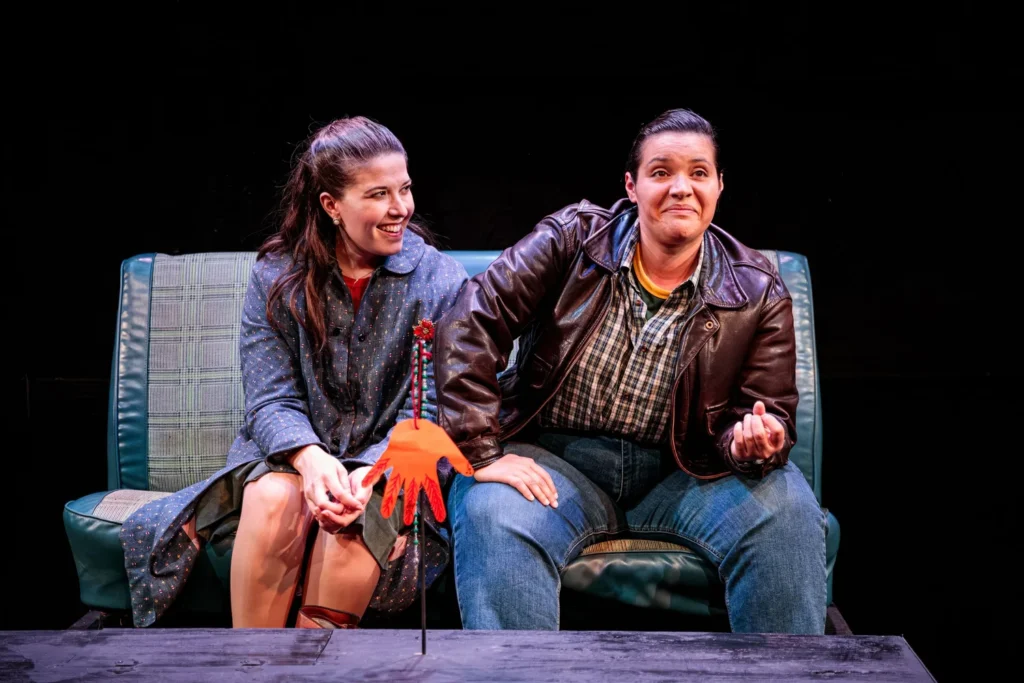
Forseth and Alvarez; Photo by Benjamin Rose Photography.
Presented by Boston Playwrights’ Theatre
by KJ Moran Velz
Directed by Elaine Vaan Hogue
Digital Playbill
October 9-26, 2025
Boston Playwrights’ Theatre
949 Commonwealth Avenue
Boston, MA 02215
Content transparency: Mother Mary contains scenes of sexual intimacy and references to abortion. For more: https://www.bostonplaywrights.org/ct/mother-mary
This critique contains light spoilers.
BOSTON — Mary, known then by her Hebrew name Miriam, Mother of Yeshua, was a Jewish woman of color knocked up with a baby she didn’t want and set to marry a man she didn’t know (Biblically or platonically) in the Ancient Middle East. We’re told Yusuf married her anyway. Then they immigrated to Jerusalem, where Miriam delivered her son in a barn surrounded by pooping farm animals. If you replace Jerusalem with Southie and the donkey with a taxi, you get a summary of Mother Mary. Sort of.
This summary borrows from the play’s summary on the BPT website. Mother Mary is based loosely on the Biblical myth of Mary, Jesus, and Joseph. Taxi driver Jo Cruz (Adriana Alvarez) knows the streets of 1968’s Southie like the back of her hand, but no road map can prepare her for meeting Mary O’Sullivan (Tara Forseth), a Catholic school teacher with a boyfriend and a very strict mother. Despite rising tensions between their Puerto Rican and Irish communities, Jo and Mary find themselves in an unexpectedly close friendship…or is it something more? But their growing connection takes a turn when Mary asks Jo to take her on a risky road trip during a snowstorm from which there’s no going back.
Mother Mary is a romantic, queer buddy comedy told by two actors playing four parts. Alvarez and Forseth nestle into their roles as Jo and Mary with humanity and compassion while also playing their characters’ mothers with dignity. Considering the great psychological divides between even the most loving of mothers and daughters, I can’t imagine embodying both, frequently in the same scene, was easy. Mother Mary ends happily, but it takes a scenic route to reach that end.
Speaking of scenic ends, my spouse and I have been talking about the poetic accuracy of Jo and Mary’s intimacy scenes since we got home on Sunday afternoon. The staging by intimacy director Jessica Scout Malone captures the awkward sexiness of queer relations. It’s efficient and realistic: Two enthusiastically consenting adults, who actually like each other and want their partner to feel loved, share their emotions and their bodies with giggles and a few tears. It’s over in about 15 minutes. They cuddle; they fall asleep. Everybody gets their cookies. While playwright Velz doesn’t give the characters the most ideal of circumstances for their lovemaking, those who’ve been there know you use the setting you have.
Velz and Director Hogue put a feminist cherry on the conjugal sundae: Jo and Mary aren’t performing hetero-gaze lust. Instead, Malone and Hogue show the characters communicating queer love without pretense. They are equal partners in their 15-minute joy. The scene portrays the acceptance we all crave, and it’s a recognizable situation for many fumbling couples – the front seat of a taxi notwithstanding. It’s refreshing to such a normal depiction of queer, only-sexy-to-the-sex-havers love.
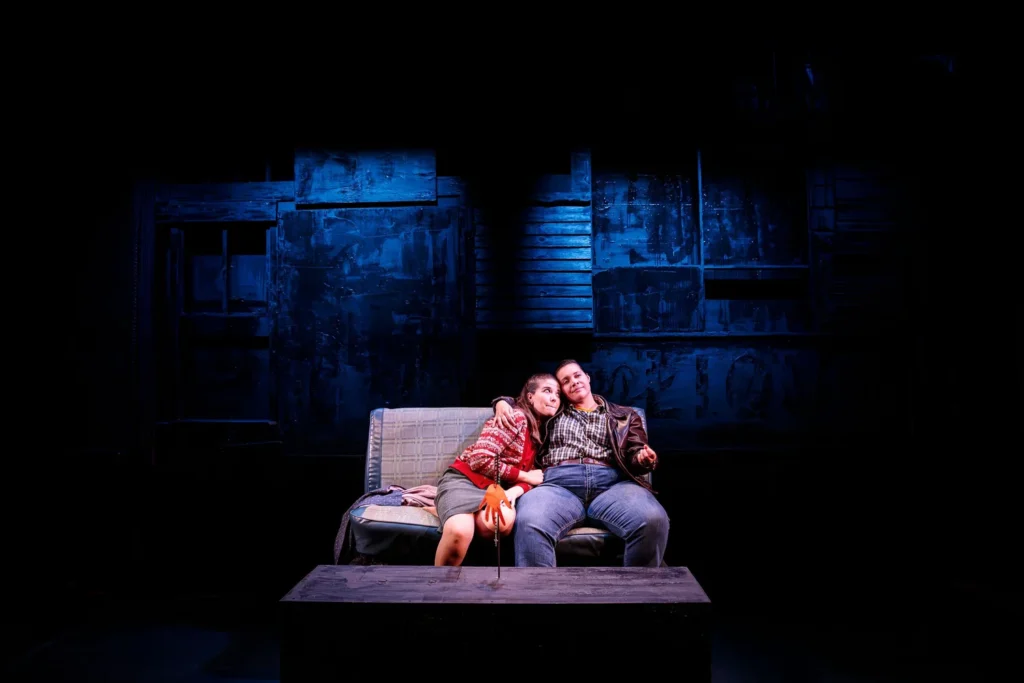
Forseth and Alvarez; Photo by Benjamin Rose Photography.
Playwright KJ Moran Velz references the 1952 novel by Patricia Highsmith, The Price of Salt, several times in Mother Mary. This novel (which I highly recommend as companion novel to this play) is notable for its happy ending for the leading ladies, Therese and Carol. Readers of the 1950s expected homosexuals to die for leading lives of what they deemed deviant behavior. Highsmith refused to kill her characters, and thus birthed hope for generations of young queers seeking acceptance.
Mother Mary like The Price of Salt gives its characters a happier ending. I imagine some young queers may find Mother Mary’s stakes confusing. It was 1968, and the bar for lesbians living a happy life was in Hell. These days, two young butches can stroll hand-in-hand down the aisles of their local pharmacy without harassment. It wasn’t so long ago when my spouse and I felt unsafe walking from MIT to Central Square in broad daylight, much less sweetly smooching near the prescription counter in CVS. It’s important to know where we come from and to notice all of the civil rights wins and losses as we age. When your community elders tell you they’re afraid, Mother Mary points to why. We can’t go back.
Since you’re here, Mother Mary features the stories of the children of immigrants. ICE is systemically rounding up all immigrants for detainment. People like Jo and Mary risk unlawful deportation. You should know, all immigrants have rights in the U.S.
Per the ACLU: Regardless of a person’s immigration status, everyone is granted certain rights and protections under the U.S. Constitution. These rights include, but are not limited to:
The right to due process
The right to legal representation
The right against unreasonable search and seizure
The right not to be arrested or detained without a valid reason
The right to record interactions with law enforcement
Here are two sites with more information on protecting you, your loved ones, and their community.
https://www.aclu.org/issues/immigrants-rights
https://www.nilc.org/resources/everyone-has-certain-basic-rights/