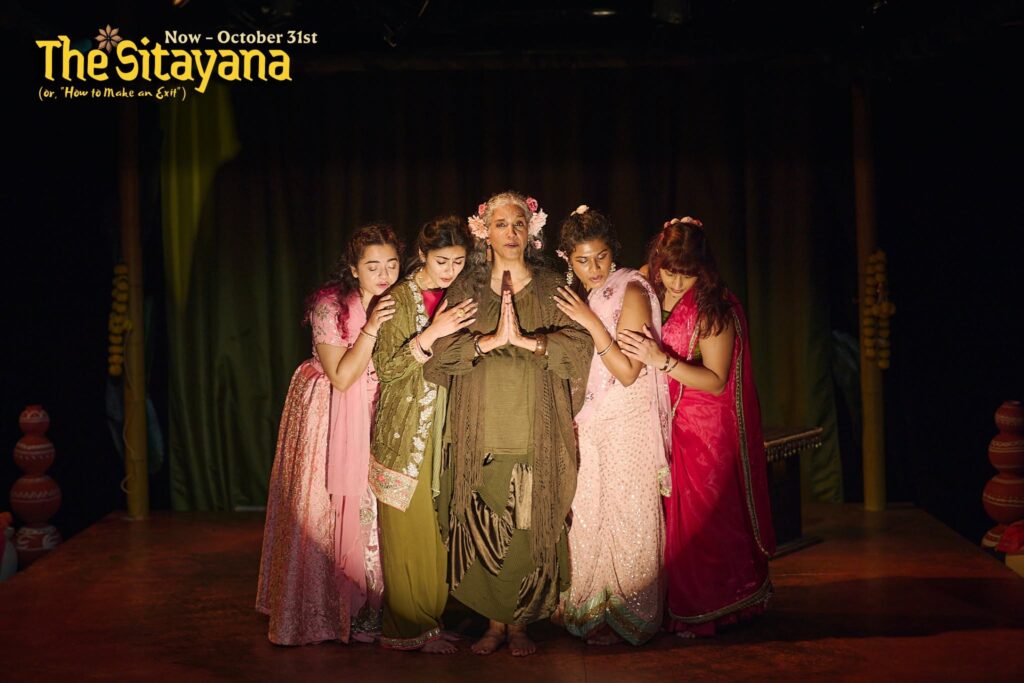
The ensemble. Photo by Ken Yotsukura.
Presented by Chuang Stage Theatre Company
Written by Lavina Jadhwani
Directed by Tushar Mathew
Live Tabla Music by Om Hegde
October 14 – October 31, 2026
Boston Center for the Arts, Black Box Theatre
Critique by Kitty Drexel
65 minutes (plus or minus) with no intermission.
TL;DR: Regardless of your religion or culture: It doesn’t matter how strung his bow is. Dump him if he shoots it with everyone but you.
BOSTON — Lavina Jadhwani’s feminist play The Sitayana reimagines the ancient Sanskrit epic poem The Ramayana from the perspective of Rama’s defamed but forgiving wife, Sita. Tushar Mathew’s production for Chuang Stage was a narrative ritual told through an ensemble of women. On a gorgeous stage decked in oranges, reds and yellows designed by Jayoung Hong and lit by designer Ashley Ting Yung, Sita’s story unfolded before us. It was wonderful: intersectional, feminist, sacred.
The Sitayana begins with Sita, avatar of the goddess Lakshmi, at the age of 16. She has sprung from the earth and eagerly awaits new adventures. Alas, she must wait until she is married to begin them. The hero Rama, avatar of the god Vishnu, earns marriage to Sita through a contest of strength by stringing the mighty bow of Lord Shiva (Westerners may recognize a similar show of strength from Homer’s The Odyssey). Rama was so strong, he broke the bow in half. Sita marries Rama and looks forward to a long, happy life with him and their many babies. Little did she know that her dreams were to be repeatedly thwarted by none other than Rama himself.
The play continues with a brief but romantic wedding ceremony from Sita’s perspective. The set’s red and orange gauze curtains twinkled with tiny lights. Music from Om Hegde on the tabla added to the environment by replicating the sounds of the wedding pyre’s sacred flames. Only two years later, Rama and Sita are exiled to the forest… with Rama’s brother Lakshman (because Rama can’t ever be alone with Sita for some reason). Lakshman leaves his new wife, Sita’s sister Urmila, behind. (These men are weird.)
Then, Sita is abducted by Shurpanakha, the demon Ravana’s sister, who is still in love with Sita. This is the kidnapping that causes the war immortalized in The Ramayana. Rama fights a mighty battle to win Sita back. He has an opportunity to rescue Sita but doesn’t. Later, when the war is won, rather than express joy at recovering her, Rama accuses Sita of being “unfaithful” with Ravana, her kidnapper and possible rapist. How convenient for the victim-blaming gaslighter.
By this point in The Sitayana, we began to feel like maybe Rama’s many feats are not actually for Sita’s benefit. Not when Rama’s so busy performing masculinity for other men… Playwright Jadhwani never uses “incel” in her play. She doesn’t have to. Egotistical, insecure male toxicity is recognizable across the centuries. What we now call incel culture was once called male heroics. In The Ramayana it’s Rama. There’s also Odysseus (Greek, not American), Thor, Sundiata Keita, Jesus, the Prophet Muhammad (blessings be upon him), and so on. So, in Jadhwani’s retelling, when Rama displays traits modern audiences associate with incel culture and toxic masculinity, we identify it with basement-dwelling podcasters who must pay women to appear in their videos.
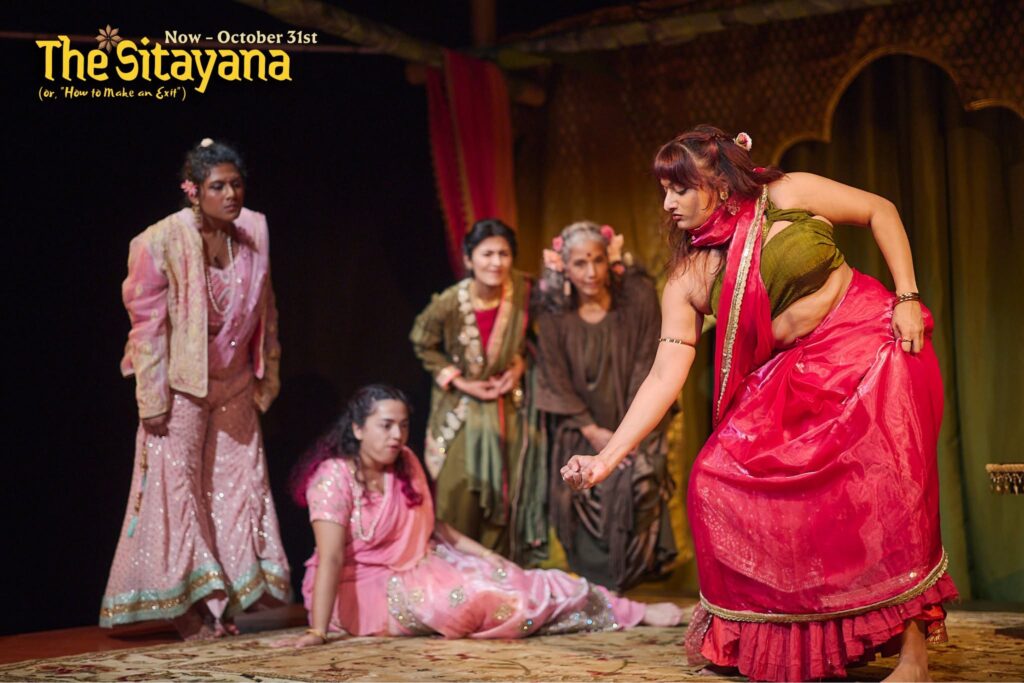
Photo by Ken Yotsukura.
Further, we can also deduce from Jadhwani’s script that some things are universal despite the passage of time: The ideal Woman can be a Goddess among women, but an insecure God among Men is just some guy. No amount of a woman’s self-pretzeling to become the ideal woman will convince that guy to be a better husband. If he wanted to, he would.
That’s too much examination of perma-online bro culture and not enough discussion of this gorgeous production. Getting back to The Sitayana…
Tushar Mathew’s production for Chuang Stage incorporated five avatars of Sita at various ages: Sita at 16 (Riya Ramaswamy), 18 (Audrey Seraphin), 20 (Vidisha Agarwalla), 32 (Ann Varghese) and 46 (Vijaya Sundaram). Under Mathew’s direction, the avatars danced through the production while playing demons, gods, and everyone inbetween. They were accompanied by Hegde’s musicianship on the tabla.
As previously stated, it was a beautiful production about the decades-long growth of one woman from childhood into adult autonomy. The ensemble members worked seamlessly to create Sita’s tale for us by incorporating dance, narration, and lyrical explanation of Hindu wedding practices. It was part theatre experience and part joyful celebration of life.
The Sitayana ends as it began: With Sita. We learn of her many abuses at the hands of her insecure, egotistical, unworthy husband Rama from her perspective. She was a curious girl, a dutiful wife who loved her emotionally absent husband, a stranger in a strange land, a devoted mother, and finally a woman who’d had enough of her husband’s bullshit. She compromised for decades until she tasted luxurious freedom in a home absent of men. Even when Rama promised to take her back one last time, Sita chose isolation because Rama could not compete with the peace she found without him. From my queer-as-heck seat in the audience, my immediate take away was this: Straight women love men. They want to marry them and have their many, many babies. If men want this too, then men have to hate women less, or women will walk away without looking back.
“Why men great ‘til they gotta be great?”
Lizzo, “Truth Hurts”




Leave a Reply
You must be logged in to post a comment.