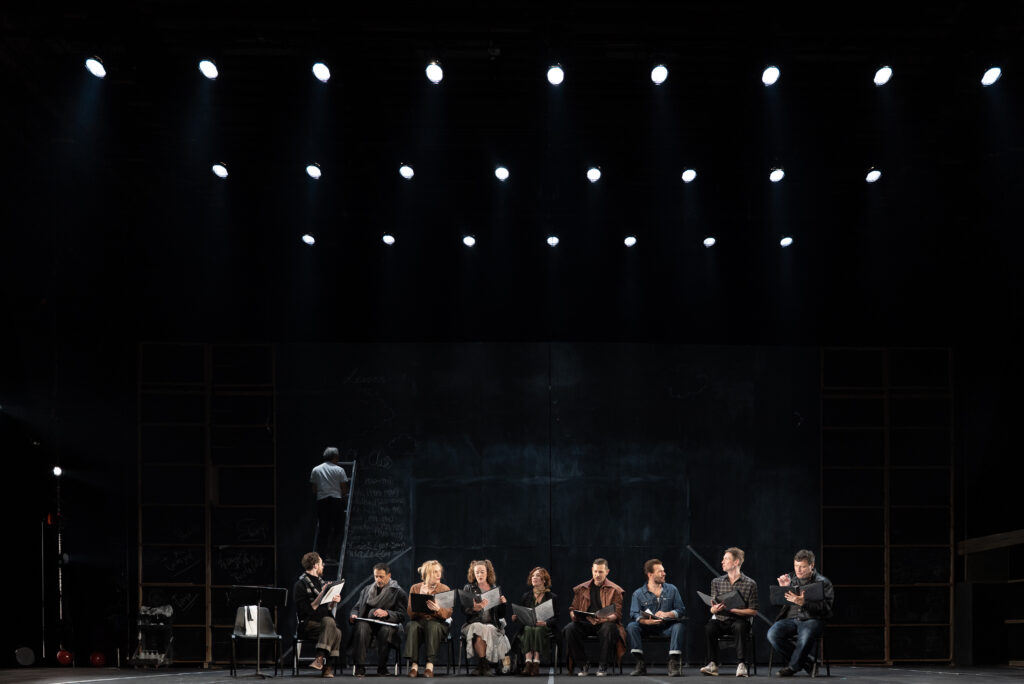
The Cast of “Our Class.” Photo by Pavel Antonov.
Presented by Arlekin Players Theatre
By Tadeusz Słobodzianek
Adapted by Norman Allen
Directed by Igor Golyak
Scenic & Prop Design by Jan Pappelbaum
Costume Design by Sasha Ageeva
Lighting Design by Jeff Adelberg
Sound Design by Ben Williams
Music composed by Anna Drubich
Projection Design by Eric Dunlap & Igor Golyak with Andreea Mincic
Chalk Drawings Design by Andreea Mincic
Choreography by Or Schraiber
Dramaturgy by Dr. Rachel Merrill Moss
Stage violence and intimacy choreography by Leana Gardella (2024 New York production)
Featuring: Gigi Watson, Gene Ravvin, Kirill Rubtsov, Deborah Martin, Jeremy Beazlie, Zach Fike Hodges, Chulpan Khamatova, Richard Topol, Ilia Volok, Ryan Czerwonko
June 18 – June 22, 2025
Calderwood Pavilion
Boston Center for the Arts
527 Tremont Street
Boston, MA 02116
Duration: 2 hours 50 minutes with one intermission
Suitable for ages 16+
Critique by Kitty Drexel
BOSTON — Our Class is about the slow radicalization of Polish catholics against their Jewish friends and neighbors in the years before and during the Holocaust (1918-2021). It is violent, angry, and expertly crafted by the Arlekin Players. While the historical events depicted and themes explored look similar to ongoing news events, Our Class is about the 1940s Russian occupation of Poland and not current international crises: the christian nationalization of the United States and retreat from its status as a world superpower, Russia’s war on Ukraine, or even Israel’s bombing of Iran. Performances at the Boston Center for the Arts Calderwood Pavilion run through June 22.
Off of 2024’s award-winning production of The Dybbuk, Arlekin presents another triumph in Our Class. This production worked out its technical and stagecraft kinks in New York during its run at the Brooklyn Academy of Music, because, from its horizontal staging to its multidisciplinary incorporation of projection and live-camera video, it is spotless. Its Boston run brings new cast members and new opportunities for accolades.
Our Class tells the emotionally accurate stories of people surviving genocide. The summary from the Arlekin press release says, “Friends. Enemies. Classmates. Based on a true story. Ten classmates — five Jewish and five Catholic Poles — grow up as friends and neighbors, then face the awakening of hatred, with life and death consequences. Inspired by real-life events surrounding a 1941 pogrom in a small Polish village, this shocking, timely story follows their lives from childhood through eight decades in a new contemporary production of Tadeusz Słobodzianek’s masterpiece from Ukrainian-born Jewish director Igor Golyak.”
Do be certain. This production is a bitch to get through; it is nearly three hours long and forces us to face our uncomfortable past and present. It contains meta-theatrical elements and repeatedly breaks the fourth wall. And, it is a masterpiece of direction, acting, and stagecraft.
Without preamble: This production features senseless, preventable, violent death and vindictive rape. Director Golyak and New York violence and intimacy choreographer Leana Gardella do not stage the play’s violence graphically. We are lucky that the actors in these scenes perform approximations of violence. Props are used to depict murders instead of guns or other tools. Clothing stays on during sexual assaults; enough distance is maintained between actors to make clear the rapes are a simulation and intentionally fake.
Considering the topic and themes of this play, the stagings are tastefully done. Arlekin Players is appealing to our empathy to tell this story by avoiding unnecessary cruelty to their cast. These approximated interactions show us the character’s experiences and how they feel about them without (re)traumatizing the audience. Still, assault survivors should plan their evening and care routines accordingly.
As a survivor of abuse, I was more alarmed by the actors’ scaling of ladders than I was by the depicted assaults. Our Class’ violence is contextual. I am strongly averse to heights. No trigger warning could’ve prevented my fear for the perfectly fine cast members’ safety as they climbed ladders onstage. My fear remains illogical. I’m not going to take it personally that others are doing what it takes to deliver a “heights = higher mind” metaphor.
There is one 15-20 minute intermission. As the audience is milling about the theatre or performing their ablutions elsewhere, the cast and crew clean up chalk dust and collect props from the show’s first half. Attention-paying attendees may see actors hug and kiss their castmates. They pat each other’s backs as they gathered items into bins and rolled full bins offstage. It reminded us that Our Class is pretend. The actors are colleagues. Kindness and respect are part of the gig. Every job, no matter your field, is a gig.
The story of Our Class may feel vaguely familiar to some audience members. It shares a few plot points with Everything Is Illuminated, Jonathan Safran Foer’s novel about a young man’s journey through Ukraine to find the woman who saved his grandfather from the Nazis. In the novel, Nazis annihilate the young man’s grandfather’s Jewish village. Without spoiling too much about the play, the characters in Our Class are also swept up Soviet and Nazi occupations. Horrifying things happen to their Jewish friends and neighbors.
Everything Is Illuminated and Our Class feel similar because sociopaths are evil, but they aren’t creative. History shows us that empowered sociopaths recycle their practices over and again. It’s why we can diagnose cults with warning signs, and how historians classify fascist regimes. Same tactics, new era. We keep telling new stories with similar plots because humanity keeps birthing new fascists. The theatre keeps telling those stories until totalitarianist authoritarians are a stereotype of the past.
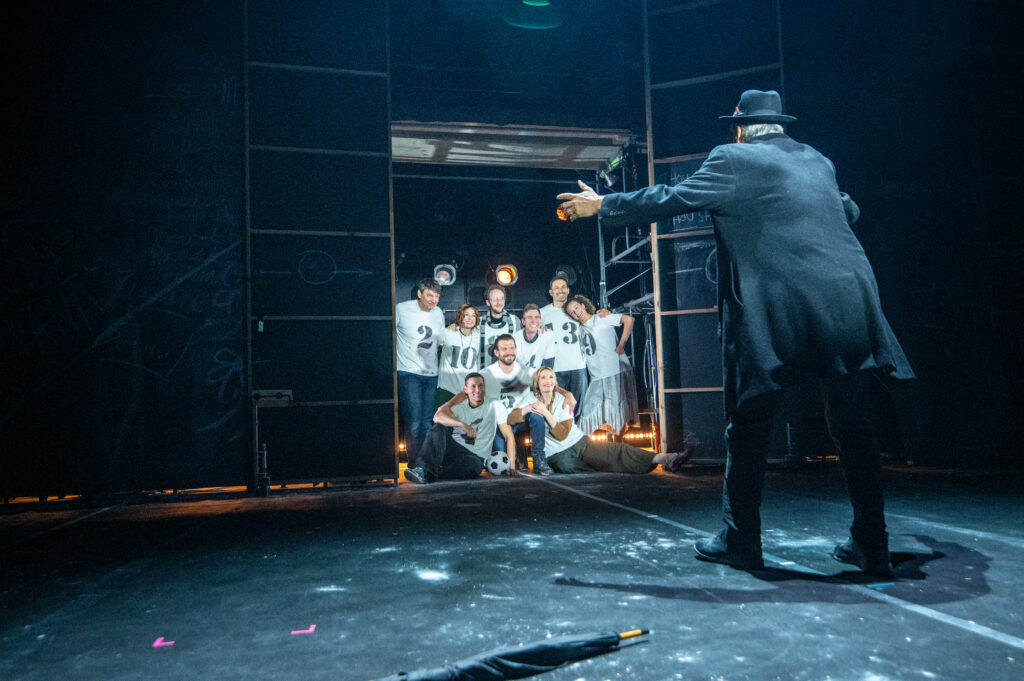
The Cast. Photo by Irina Danilova.
This article would be easier to write if Nazis didn’t occupy the White House, if Ukrainian President Volodymyr Zelenskyy’s last visit to the U.S. didn’t prominently feature a presidential and vice-presidential tantrum. The beauty of Arlekin’s Our Class reminds me of the constant ugliness offstage. How do we, as North Americans, celebrate a play about Eastern European historical tragedies when we’re experiencing similar tragedies now? We can’t pretend we aren’t part of the problem in our homeland, can we? We are afraid, and our political means of fighting back are being systematically disassembled in Congress, law by law.
I’m finishing this article as an act of service to my theatre community on Juneteenth 2025, a day of North American freedom and celebration. It’s 90 degrees out at 2:17 PM. As I type, C-Span reports that the White House has a full day of fascist acts ahead of it: FOTUS will receive an intelligence briefing and participate in a swearing-in ceremony for the U.S. ambassador to Ireland. He will not observe Juneteenth.
No shit, Sherlock.
The only thing we can depend upon is change. One day, America will eradicate its infestation of fascists. Lenin went into a coma. Republican* Senator Joseph McCarthy, who was obsessed with the non-threat of communism, fell out of favor and died of liver failure at 47. The sociopaths who commit atrocities and live to keep their secrets won’t recognize their part in things. Maybe survivors will have justice. Maybe not. Regardless, we’ll have new problems, because greedy humans love a scapegoat more than they love peace. Hooray.
*Y’all’s obsession with being on the wrong side of history is weird.