Jan 20

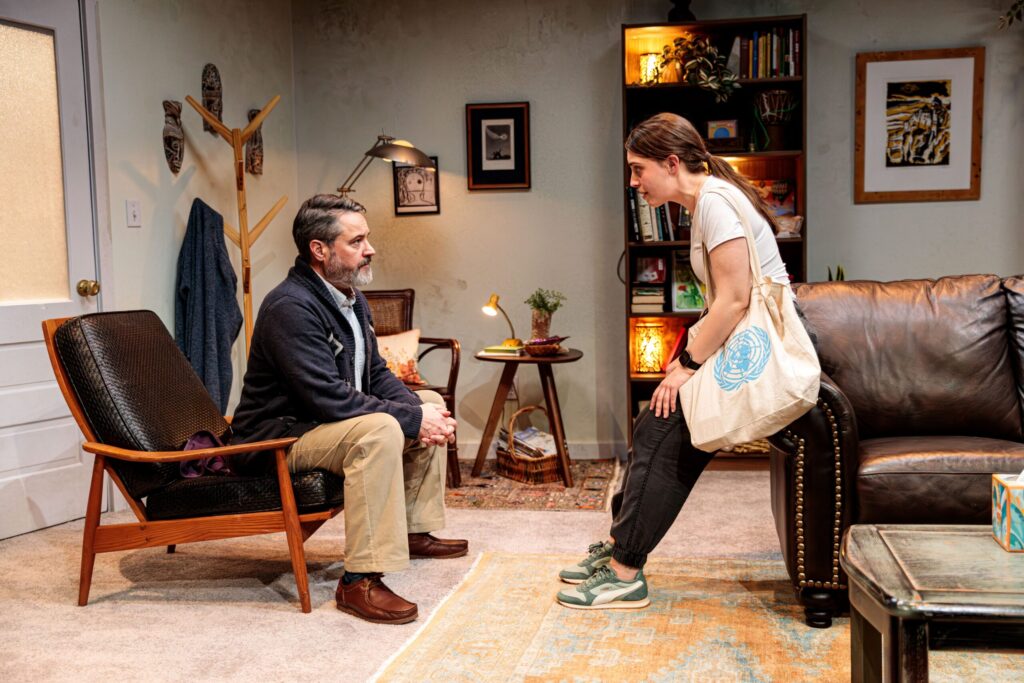
The Invisible Work of Holding It Together in “Job”

Credit: Benjamin Rose Photography

Presented by Speakeasy Stage Company
By Max Wolf Friedrich
Directed by Marianna Bassham

Jan 16 – Feb 7, 2026
Stanford Calderwood Pavilion at the Boston Center for the Arts
539 Tremont St
Boston, MA 02116

Critique by Helen Ganley

Approximate run time: 1 hour 20 minutes with no intermission.

This production contains strong language, gun use, and discussions of trauma, violence, and abuse. Distressing sounds are used and were ethically sourced. Strobing effects and red and green flashing lights are also used.

BOSTON — “Everyone needs therapy.” As a 24-year-old woman living in Boston, it’s a phrase you hear tossed around constantly. It might be invoked while unpacking a friend’s toxic ex, a coworker’s strained family dynamics, or a roommate’s own internal battles. The phrase carries an easy confidence that there is a place for these stories to go, a person trained to receive them, and a clean separation between the one who speaks and the one who listens.

Job unsettles that assumption. Its patient is a content moderator, professionally tasked with absorbing the internet’s most disturbing images so others don’t have to encounter them. If therapy depends on the idea that pain can be transferred without consequence, Job asks what happens when both people in the room are already doing that work for a living. What begins as a therapeutic exchange becomes a hall of mirrors, where emotional labor reflects endlessly back on itself. Continue reading
Oct 13

Between the Diet Coke Button and the Nuclear Codes: ASP’s “Macbeth”

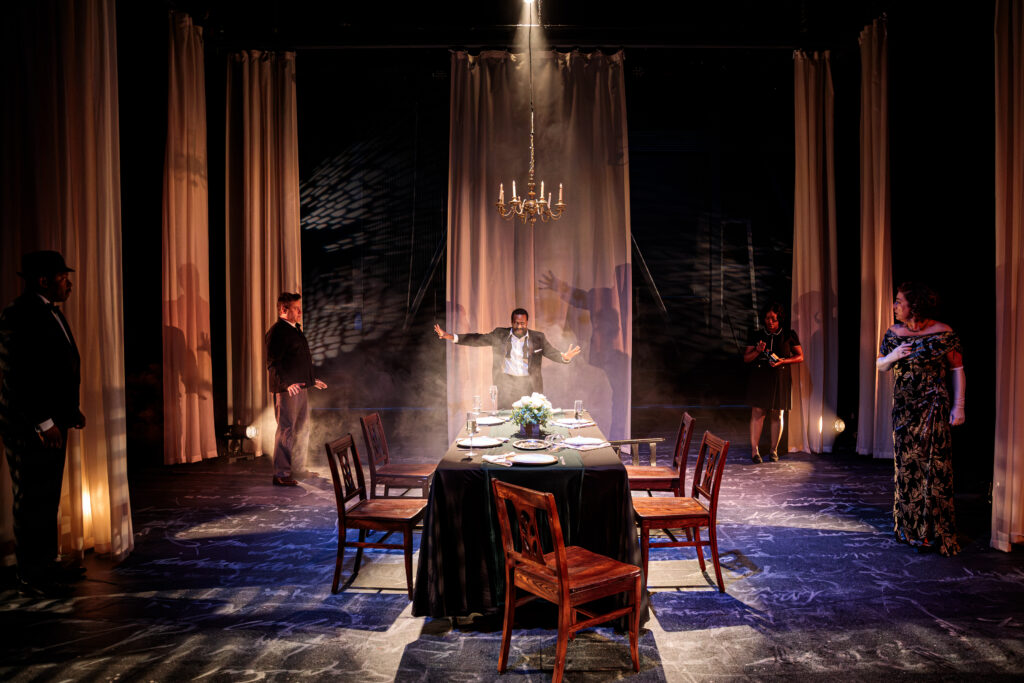
Omar Robinson (center) with Brian Demar Jones, Dennis Trainor Jr., Claire Mitchell, and Brooke Hardman (2025). Photo by Benjamin Rose Photography.

Presented by Actors’ Shakespeare Project
by William Shakespeare
Directed by Christopher V. Edwards
Digital Playbill

Oct. 2-26, 2025
The Dorothy and Charles Mosesian Center for the Arts
321 Arsenal Street
Watertown, MA 02472

Content Warning: This production employs the use of water-based haze, stage cigarettes, flashing lights, strobe effects, and gunshots. 

RUN TIME: Approx. two hours and twenty-five minutes, including one intermission.

Warning: This critique includes light production spoilers. 

WATERTOWN, Mass — It’s been a busy quarter season for Macbeth performances: Commonwealth Shakespeare Company’s Stage2 student players performed Mackers in May; Cambridge’s Dream Role Players performed it in Longfellow Park last August; Boston Lyric Opera performed it at Emerson Colonial Theatre last weekend. Actors’ Shakespeare Project’s production is at the Mosesian Center for the Arts in a vastly nontraditional production through October 26.  

ASP’s Artistic Director Edwards interprets Macbeth as a 1960s psychological and physical nightmare horrorscape in which fascistic tyranny, state-sanctioned drug abuse, bipartisan gaslighting and lies are de facto political tactics. In this version (as in our current White House), the psychological horrors outweigh the physical violence. Set in the U.S. immediately after the Cold War, title character Macbeth (Omar Robinson, unhinged and unbothered), Banquo (Jesse Hinson), Macduff (Brian Demar Jones), Ross (Jennie Israel), Malcolm (Chingwe Padraig Sullivan), Fleance (Vince Nguyen) and King Duncan (Dennis Trainor) are celebrating a battle win despite their personal tragendies. Amidst their revels, three psychological terrorists/witches (Jade Guerra, Amanda Esmie, Claire Mitchell) indoctrinate Lady Macbeth (Brooke Hardman) and Lord Macbeth into regicide through mind control manipulation and hallucinogenic drugs.    Continue reading