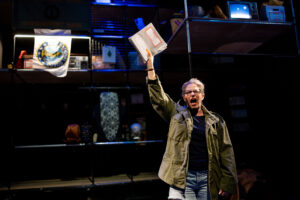
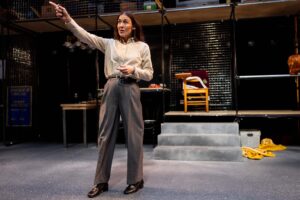
Gibel & Warren; Photo by Nile Scott Studios.
Presented by Central Square Theater
A Rolling World Premiere with Trinity Rep and Northern Stage
By Deborah Salem Smith & Charlie Thurston
Directed by Curt Columbus
October 29 – November 22, 2026
Central Square Theater
Cambridge, MA 02139
Critique by Kitty Drexel
Run time: approximately 90 minutes, no intermission.
TL;DR: Docu-theatre play, The Getaway Driver, gives equal weight to the stories of Katherine Ann Power and Clare Schroeder. It’s a tear-jerker.
CAMBRIDGE, Mass. — Central Square presents The Getaway Driver now through Nov. 26 as part of a rolling world premier with Trinity Repertory Theatre and Northern Stage in VT. It is the latest docu-theatre drama by the co-writing duo, Deborah Salem Smith and Charlie Thurston. They previously wrote and produced with Trinity Rep another docu-drama, 2025’s Someone Will Remember Us, a play commemorating the experiences of immigrant and native Rhode Islanders’ experiences during the Iraq War.
Just as Someone Will Remember Us plucked the heartstrings of audiences in 2025, The Getaway Driver commands its audiences to see the humanity of all parties in a conflict. This time, Smith and Thurston scoured sources to reveal the story of Katherine Ann Power (Rebecca Gibel): high school valedictorian, college student, mother, award-winning chef, former Ten Most Wanted Fugitive and American ex-con who was convicted of the 1970 robbing of a State Street Bank in Brighton, MA and her involvement in the concurrent murder of Boston Patrolman Walter Schroeder.
Smith and Thurston collected TV news clips and interviews, newspaper articles and other abundant print media sources to write this play. As they were sourcing Power’s perspective, they were collecting similar material on Power’s antagonist (and the play’s equal protagonist), Clare Schroeder (Rachael Warren, who also appeared in 2025’s Someone Will Remember Us), a Boston Police Officer and the grieving daughter of Patrolman Walter Schroeder. Because Smith and Thurston paint such humanistic portraits of both women, neither Power nor Clare Schroeder should be painted as a villain. Their parallel stories show us that the lives of young people are fraught with impossible decisions and unexpected consequences.
Power says she became a freedom fighting vigilante after the assassinations of MLK, Jr and Bobby Kennedy. Nixon dove head first into the Vietnam War. He, like our current President, entered into unlawful conflict with Cambodia. In the show, we learn that Power felt she needed to do something. Like many impulsive young persons experiencing rageful political impotence for the first time, Power acted outside of reason and the law. Thanks to the bold, confident skills of actor Rebecca Gibel, the audience understands Power’s explanation (told through monologues) for her actions. That doesn’t justify them in the eyes of the law. But it may justify them to more radical members of a Cambridge audience.
Schroeder was 17 when Power was 21 and running from justice. While Power was hiding from the police with her co-conspirators, Schroeder was telling her brothers and sisters that their father had been shot. When Power assumed the false name, Alice Metzinger, Schroeder was piecing together the shards of a life broken by her father’s murder: Her mom caring for a 11-month-old baby and umpteen sons and daughters in their large Catholic family. Despite this great tragedy, Schroeder graduated from college, attended police academy and proudly became the first female officer in Waltham, MA. Warren plays Schroeder with composure, respect, and a wicked Massachusetts accent.
Gibel is convincing in her role, but Warren is devastating. She puts a face and real-life trauma to the story behind a cop shot in the line of duty. By giving us a face and a story, she highlights the sociopathy behind cold-blooded murder. Perhaps Power was merely the getaway driver; and Schroeder was destined to live with the consequences.
Fortunately, Gibel and Warren work so well together, play so perfectly off each other that we can offer both characters our compassion. Gibel held the stage while Power was the story’s focus. She ceded it gently when it was time for Warren to share Schroeder’s perspective. Through their work together, we see that many things can be true at the same time: Power felt she had to fight for the U.S. (ignoring her co-conspirators’ red flags along the way). It is important to fight for what is right (but not like this). Schroeder was determined to see justice for her father. She did see justice. In an intense scene during which the actresses share the stage, we see Power and Schroeder come to an accord of sorts. It’s sensitivity and expression of shared humanity is beautiful.
The Getaway Driver has something for everyone. It has local history for the history buffs. It has strong performances for the acting buffs. It has design prowess in the form of layering costume and scenic magic by An-lin Dauber, scenic and costume designer, alongside the lighting designs by Christina Watanabe and sound designs by co-designers DJ Potts and Kaileykielle Hoga.
Speaking of magic, there’s nothing more magical than the persistence of the human spirit. My date and I cried a lot during this production. As my mother used to say, it is a three-hanky show. Co-writers Deborah Salem Smith & Charlie Thurston compact years worth of story into 90-minutes for the stage. It skips a lot of history. But that’s what the theatre does: summarizes to tell humanity’s stories. The Getaway Driver does exactly that. You’ll cry into three tissues before the show is done.




Leave a Reply
You must be logged in to post a comment.