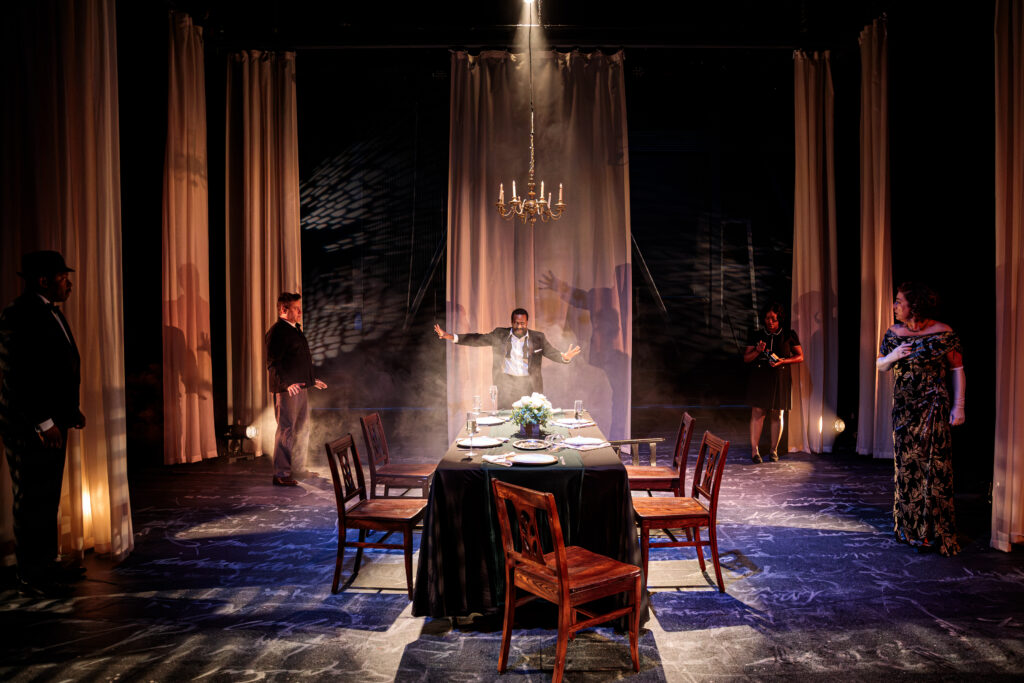
Omar Robinson (center) with Brian Demar Jones, Dennis Trainor Jr., Claire Mitchell, and Brooke Hardman (2025). Photo by Benjamin Rose Photography.
Presented by Actors’ Shakespeare Project
by William Shakespeare
Directed by Christopher V. Edwards
Digital Playbill
Oct. 2-26, 2025
The Dorothy and Charles Mosesian Center for the Arts
321 Arsenal Street
Watertown, MA 02472
Content Warning: This production employs the use of water-based haze, stage cigarettes, flashing lights, strobe effects, and gunshots.
RUN TIME: Approx. two hours and twenty-five minutes, including one intermission.
Warning: This critique includes light production spoilers.
WATERTOWN, Mass — It’s been a busy quarter season for Macbeth performances: Commonwealth Shakespeare Company’s Stage2 student players performed Mackers in May; Cambridge’s Dream Role Players performed it in Longfellow Park last August; Boston Lyric Opera performed it at Emerson Colonial Theatre last weekend. Actors’ Shakespeare Project’s production is at the Mosesian Center for the Arts in a vastly nontraditional production through October 26.
ASP’s Artistic Director Edwards interprets Macbeth as a 1960s psychological and physical nightmare horrorscape in which fascistic tyranny, state-sanctioned drug abuse, bipartisan gaslighting and lies are de facto political tactics. In this version (as in our current White House), the psychological horrors outweigh the physical violence. Set in the U.S. immediately after the Cold War, title character Macbeth (Omar Robinson, unhinged and unbothered), Banquo (Jesse Hinson), Macduff (Brian Demar Jones), Ross (Jennie Israel), Malcolm (Chingwe Padraig Sullivan), Fleance (Vince Nguyen) and King Duncan (Dennis Trainor) are celebrating a battle win despite their personal tragendies. Amidst their revels, three psychological terrorists/witches (Jade Guerra, Amanda Esmie, Claire Mitchell) indoctrinate Lady Macbeth (Brooke Hardman) and Lord Macbeth into regicide through mind control manipulation and hallucinogenic drugs.
This is a Macbeth for these unsettling times of federally sanctioned arson and chronic misinformation. It parallels our current political theater with only a modicum of hyperbole: Scottish Lords and one overachieving Lady (#WomenInMaleDominatedFields), drunk on power and bloated with paranoid hubris, fight themselves and each other for power while three Weird Lab Assistants watch. A full summary for Macbeth from the Folger Shakespeare Library is HERE.
As the play opens, Edwards reveals to us that Lady Macbeth is grieving the death of her young daughter, who we learn about through projections by Sue Rees. Our Lady is an unwell woman, and her community, just like all of Western society, unreasonably expects her to pretend she is fine when she is observably not.
At this time of federal funding cuts to pediatric cancer grants and lies about Tylenol leading to autism*, this added dimension to Lady Mack’s character development hits us hard. Brooke Hardman navigates the depths of a mother’s tragedy and the perversity of society’s unreasonable expectations with aplomb. We recognize her mental struggles; we see her bounce between emotional extremes – at first, weeping openly, and then, smiling as she reaches to shake a political rival’s hand. Many women in the audience will see the code-switching skills women develop to move within a man’s world.
That we see so much of Lady Macbeth’s struggle with mental stability and then her descent into madness alongside Macbeth shows us that Hardman, Edwards, and Robinson as Macbeth see our Lady as much of a three-dimensional person as her husband. If the events of Macbeth are a government conspiracy, then the predatory operatives in charge took advantage of Lady Macbeth’s grief to force her into regicide with their tactics. The power couple became the brainwashed Manchurian Candidates their government wishes to see.
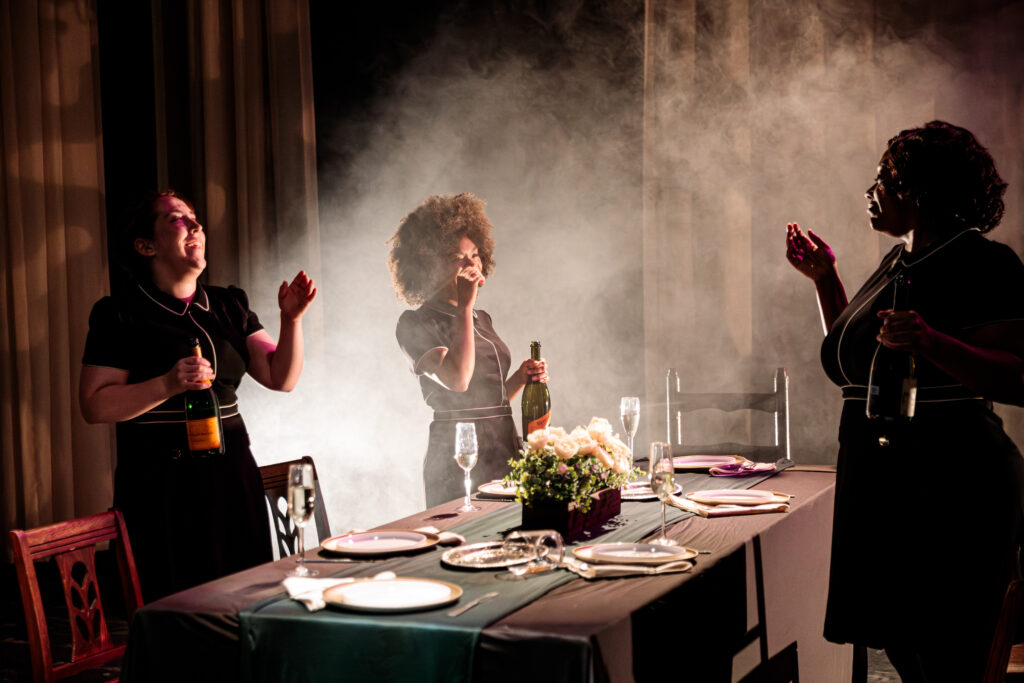
Claire Mitchell, Amanda Esmie Reynolds, and Jade Guerra (2025). Photo by Benjamin Rose Photography.
Juxtaposing their blind descent, the Porter (Dennis Trainor Jr.) delivers a rousing albeit deeply depressing modernized speech which gives voice to the suffering 99%. It’s a wild take on Shakespeare’s original text that includes mention of the Epstein Files, the Wounded Knee Massacre, and the evils of fascist podcasters. Through knock-knock jokes, we’re made to interact with the Porter’s speech. Trainor Jr. forced guffaws from his audience when we’d rather be cringing at our nation’s ongoing disgrace. It felt like tough love. If only all tough love were packaged so eloquently. This is how we resist fascism.
Statistically speaking, it’s a high likelihood that Trump voters were seated in the audience. By interacting with him, Trainor Jr. was demanding those voters take the smallest accountability for their vote. In addition to public shaming, there are other ways of taking responsibility. One of our only opportunities to express our opinions to politicians is through voting. We get a chance to correct history on November 4. Head to the polls, friends.
While Macbeth had some high highs, such as Elmer Martinez’s Aladdin Sane lighting design, it also had some odd lows from the cast. Leads Robinson, Hinson, and Hardman usher the audience into their unreality of the Weird Sisters and apparitions. Most of the cast meet them there. Some of the actors look like they’re in a different show, an alternative, low-energy production of Macbeth that we aren’t privy to. The actors say the right words at the right time, but they aren’t all working on the same level. It’s off-putting to watch, especially when this production breaks the fourth wall so frequently, and the actors’ bios are so rich.
Apropos of nothing: Kudos to costume designer Marissa Wolf for dressing Lady Macbeth so well. That banquet dress is gorgeous on Hardman! The smock dresses on the Weird Nurses look comfortable and like they have pockets. Murderous mental illness never looked so good.
Acting aside, audience members should please be advised that Macbeth depicts the violent use of shock therapy, not the quirky movie by Rocky Horror’s Richard O’Brien, but the practice known as Electroconvulsive therapy (ETC). We don’t see the modern practice in use, but the antiquated torture originally developed in 1927 to treat mental illness by passing high doses of electric current through a patient’s brain. It was originally performed without anesthesia. Although ETC is still practiced today under more civilized conditions, its depiction may exacerbate existing trauma.
For more information about this production, attendees should read Edwards’ “Director’s Note” in the playbill. He references several dramaturgical sources that will help attendees understand the performance.
Other Important Terms to Know:
- Timothy Leary – Harvard Professor and infamous leading figure in 1960s counterculture and culture of psychedelic drugs.
- MK-Ultra – The Central Intelligence Agency’s (CIA) illegal Cold War mind-control program which searched for a truth serum for wartime use.
- The Vietnam War – Indirectly referenced in Mackers. (1954–75), a protracted conflict that pitted the communist government of North Vietnam and its allies in South Vietnam, known as the Viet Cong, against the government of South Vietnam and its principal ally, the United States.
- ETC or electroshock therapy – Oi.
- Prolonged Grief Disorder in Parents – PGD consists of intense and persistent grief symptoms with associated with problems in functioning.
*Autism is caused by autistic people having procreative sex. If Tylenol or vaccines actually caused autism, the U.S. railway would rival Switzerland’s for its efficiency, and Wikipedia would be overwhelmed with reliable sourcing and citations.