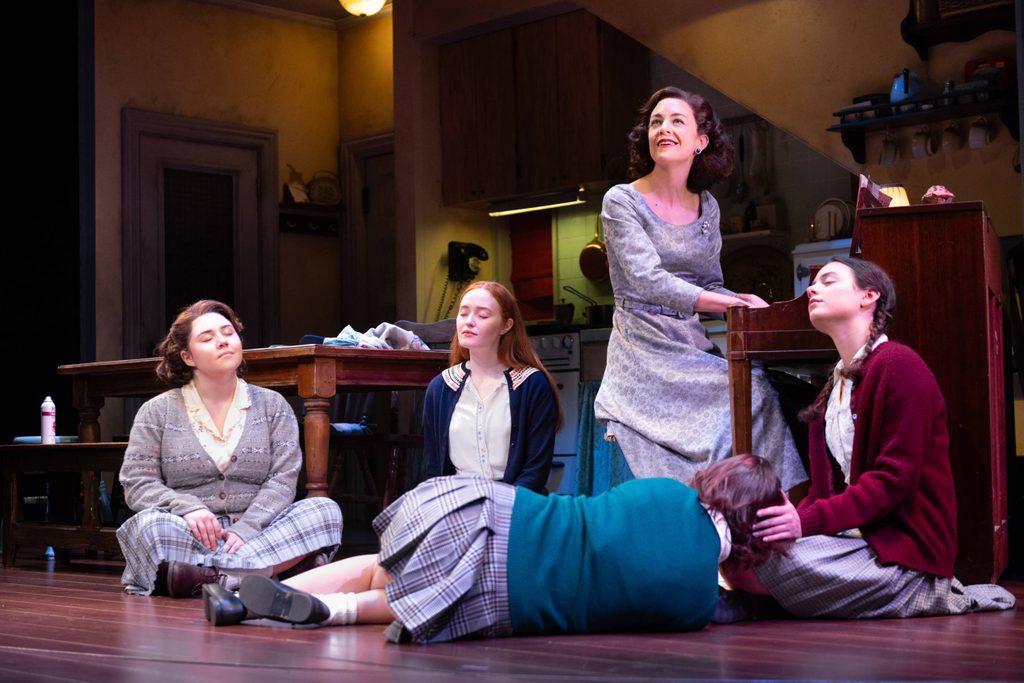
Meghan Carey, Kate Fitzgerald, Alison Jean White, Chloé Kolbenhyer, Nicole Mulready (on floor); photo by Liza Voll.
Presented by The Huntington in association with Berkeley Repertory Theatre
Written by Jez Butterworth
Directed by Huntington Artistic Director Loretta Greco
Music direction by Daniel Rodriguez
September 12 – October 12, 2025
The Huntington Theater
264 Huntington Avenue
Boston, MA 02115
Critique by Kitty Drexel
Please note: Herbal cigarettes and smoke/haze are used in this production. You may want to take an antihistamine or wear a mask if you suffer from allergies.
This critique contains plot spoilers. Read at your own risk.
BOSTON — The Huntington’s production of The Hills of California, newly staged by Artistic Director Loretta Greco and currently running through October 12 at the Huntington Theater in Boston, is beautifully staged, beautifully sung, and beautifully acted. It is technically perfect. Unfortunately, playwright Jez Butterworth traumatizes his female characters while prioritizing their relationships with men instead of giving them backstories or personalities. He objectifies them as underage entertainment instead of as human entertainers. It’s too bad, because he is thisclose to letting them be real people.
Summary: Three out of four adult Webb sisters’ (Amanda Kristin Nichols as Gloria, Aimee Doherty as Ruby, Karen Killeen as Jillian) homecoming to the seaside guest house where they grew up. As girls (Kate Fitzgerald as Young Joan, Meghan Carey as Young Gloria, Chloé Kolbenheyer as Young Ruby, Nicole Mulready as Young Jillian), their fierce and ambitious mother Veronica (Allison Jean White) trained them for a singing career à la The Andrews Sisters. Now adults, the sisters must reconsider the choices their mother made, the nostalgic call of youthful harmonies, and the unbreakable bonds of family while they wait for their prodigal sister Joan to come home. Trigger warnings: Pedophilia, sexual coersion and abuse, forced abortion, eof-of-life care of an elder, alcoholism, alleged drug abuse, hackneyed playwriting.
Butterworth, like so many men writing female characters, defines the women and girls in The Hills of California by the trauma they’ve experienced at the hands of men rather than their life experiences up to the point when the show opens. When the show opens, we meet Jill, Ruby, and Gloria as they gather to mourn the painful death of their mother, Veronica. Watching Veronica die is excruciating for them. The fourth sister, Joan, is missing; she’s too busy being famous in California. We’re told she hasn’t been home since that tragic night decades ago. Each sister is too weighed down by their extensive pain and the trauma to discuss any other aspect of their life: cousins, neighborhood gossip, vacations, their children’s schooling, job searches, church sermons, music on the radio, prices at the grocery, and their husbands’ receding hairlines. Nothing.
When Butterworth isn’t defining them by their trauma, he’s defining them by their relationships with men: Jillian is an unmarried virgin who stayed at home to care for their mother (as if that stopped generations of women before her from getting their needs met. Even in a stereotype, Butterworth is stereotyping Jillian.). Gloria is a mean wife and mean mother with anger issues who yells a lot because she’s so very mean. Ruby is a nice wife and mother without anger issues. Joan was a boy-chasing girl who grew into a drunken Jezebel because of her abuse. After all the drinking and sputtering about how mean Gloria is and how whorey Joan is, Butterworth tells us more about the town’s shuttered businesses than he does about his play’s womenfolk.
Butterworth also defines their mother Veronica by her lack of a romantic relationship. Her husband died in the war. He was lost at sea. She spins a new story about her missing husband, their missing father, as if her lack of a husband is the most important detail she’ll share about herself.
These working-class sisters sang in a quartet together (Brilliantly, the cast members portraying both adults and children sing tight harmonies like they’ve been singing together longer than this one show. More on this later.). Their mother cared for them while managing their careers despite managing a guesthouse on the edge of bankruptcy. All five travelled together and met all manner of people. But what movie did they see last? What is their favorite song, color, dress, or class in school? Do they have chores in the guesthouse? Who are their friends? Heck, do they like their costumes? Even as adults, we have no idea whether these characters still sing or if they have jobs outside of motherhood. We see them singing while reminiscing, but we don’t know how this effects them psychologically. These characters should have rich inner and outer lives that we hear about, but we know virtually nothing about them.
Anyone who knows women and likes them knows that their relationships with men are the least interesting things about them. Defining women by their trauma is boring and a sign of a tired imagination. Fortunately, Greco and her cast do some mighty heavy lifting to flesh out Butterworth’s two-dimensional characters. Allison Jean White imbues Veronica with cunning and resilience. Later, she channels Goldie Hawn as a charismatic but self-depracating Joan.
In the little time and opportunity they have, the young sisters forge relationships that we see expressed physically: one rests their head in another’s lap; they brush shoulders and fix hair; they get into each other’s space and bicker like sisters do. When they sing, they breathe together and blend their voices with ease. They dance together like friends.
The adult sisters bicker with a keen understanding of which buttons to push and barely caged violence. These sisters touch much less, but they share space like they’ve known each other for decades. Butterworth’s themes lack depth. He gave them dialogue, but he didn’t give them humanity. The actors did.
Other observations in no particular order:
The scenic design by Andrew Boyce and Se Hyun Oh is truly breathtaking. As in, the curtain went up, and there was an audible gasp from the audience. Boyce and Oh built a life-sized, three-story house in the Huntington Theater. Then they made it rotate. It’s incredible and terrifying. I do not know how the cast manages the stairs or their third-floor entrances.
Music director (and local favorite) Daniel Rodriguez and choreographer Misha Shields bring the shows musical numbers like “Boogie Woogie Bugle Boy” and the guesthouse’s theme song to life.
The article “Sense of Play: The Dramas of Jez Butterworth” by dramaturg Kyle C Frisina is elegantly written. It informs the reader of important facts regarding Butterworth and his working-class characters while providing helpful insights that add to the play-watching experience. Indeed, all of the articles in the playbill are well-written.
Were The Hills of California produced by any other company in Boston, it would not be the success it is. This play with music in Greco’s hands is a triumph of ingenuity. Butterworth’s play requires dramatic and technical expertise and The Huntington meets its requirements in spades. But. That doesn’t make the script better than it is.
Congrats to our Boston local actors on their great work! It is always good to see local talent treading the boards and proving that one can see exceptionally talented performers making expert theatre without leaving Massachusetts.