
Photo credit: Apollinaire Theatre Company
Presented by Apollinaire Theatre Company
By Henrik Ibsen
Adapted by ATC from the translation by Edmund Gosse and William Archer
Directed by Danielle Fauteux Jacques
Feb. 21 – March 16, 2025
Chelsea Theatre Works
189 Winnisimmet Street
Chelsea, MA 02150
Run time is 1 hour 45 minutes
Trigger warning: Gun shots, gun violence, death by suicide, mentions of murder
CHELSEA, Mass. — Apollinaire Theatre Company takes extra care with its dramaturgy. The company immediately welcomes its patrons into the world of their show from the moment we enter their space. Earlier this season, The Antelope Party had internet memes and ponies. Every Brilliant Thing had sticky note lists. For Hedda Gabler now up at Chelsea Theatre Works through March 16, dried flowers adorn the walls of the lobby. Candles glow in corners. The theatre itself is as dark as a tomb. A single bright stage light shines into the audience and onto the floor like a portent of scarring things to come.
Nearly every surface of Joseph Lark-Riley’s lush set design seats a collection of cut or drying flowers. A few bouquets are vibrant and full of life. Most of them are dried out and hung upside down. A brown, upright piano stands upstage center; it has seen better days. Giant flowers have been painted on the stage floor. They swirl beneath the legs of fading couches and stuffed chairs. This drawing room resembles Rachel Ruysch’s “Still Life With Flowers On a Marble Slab (1716)”: morbidly beautiful and falsely cheerful. More candles flicker onstage. If the set design means to prepare us for the events of Hedda Gabler, we’d best buckle up for a bumpy night.
In Hedda Gabler, Henrik Ibsen shows us the character of a sadistic woman who is as beautiful as she is psychotic. The play follows her manipulations of the good, bad, and marginal people around her. The title character Hedda Tesman (née Gabler) is incompatibly married to a kind, penniless scholar who is oblivious to his wife’s penchant for cruelty. Intelligent, accomplished Hedda (Parker Jennings) and her husband George Tesman (Conall Sahler) have just returned from a six-month working honeymoon. Mr. Tesman was collecting notes for a book; Hedda was preparing for motherhood. The Tesmans appear to be happy. Appearances are deceiving.
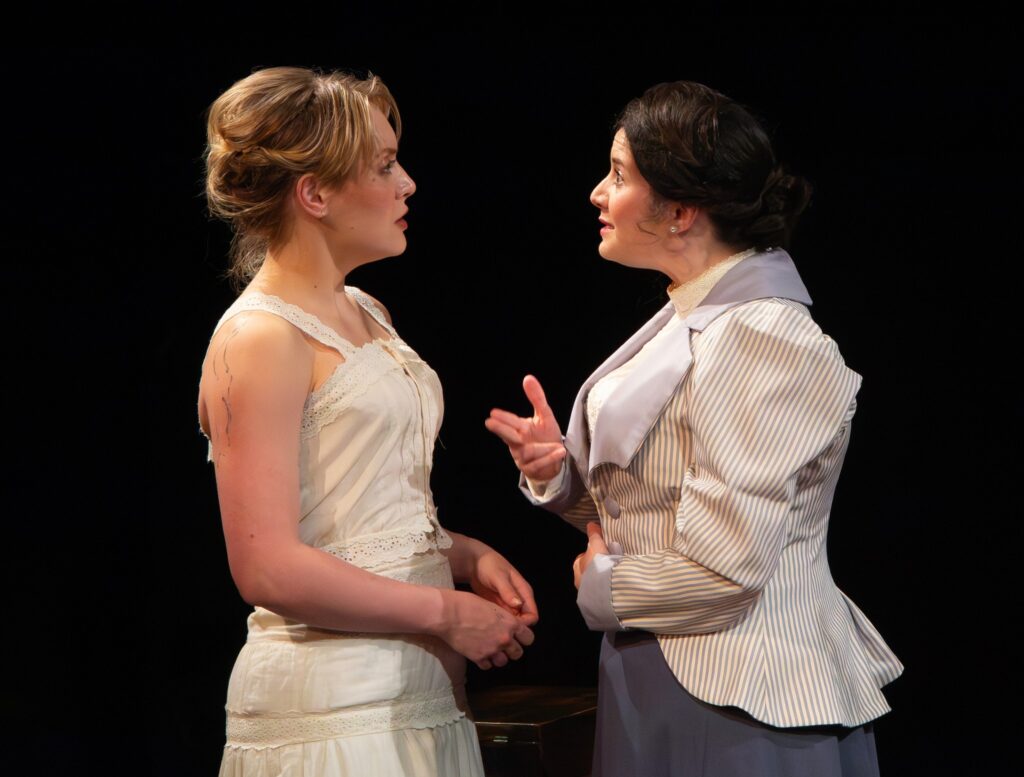
Hedda and Thea. Photo credit: Apollinaire Theatre Company
When the play opens, George’s aunt Julianna (an elegant Paola Ferrer) visits the Tesman’s home to see how the baby-making is going. George assures her his book will be great. Julianna is financing the Tesmans’ lifestyle while George waits to hear if he’s received a professorship at the university. When she enters, Hedda ridicules Aunt Julianna’s new hat. Thus, we watch Hedda begin to create discontent in the people nearest to her. Hedda isn’t content pursuing the idle hobbies of a middle-class woman. The only cure for her boredom is the unbridled psychological torment of her inferiors. But, Hedda is trapped in her home with no money to receive guests; she cannot leave her home unaccompanied. So, Hedda decides to make victims of her guests instead. The consequences of her selfish actions affect everyone to a dastardly effect.

Brack, Lovborg, Berta. Photo credit: Apollinaire Theatre Company.
We watch Hedda lay into her school acquaintance and George’s ex-girlfriend, Thea Elvsted (Kimberly Blaise MacCormack) tells the Tesmans that Eilert Lövborg (Joshua Lee Robinson), an equally as impoverished scholar and George’s schoolmate, has returned. Lövborg has published a successful book and is George’s competition for the professorship. Hedda and George would be lost if it weren’t for their neighbor Judge Brack (Cristhian Mancinas-García), a scurrilous man who has more than a mere neighbor’s intentions on Hedda. Ann Carpenter plays Hedda’s steadfast maid, Berta.
In four acts, Hedda Gabler is a five-sided love polygon under which we view the corruption hiding beneath fashionable society’s thin veil of morality. (How I long for the days when the rich at least pretended to hide their immorality! *audible sigh*) Director Danielle Fauteux Jacques creates contrast between the play’s corrupt characters, Hedda & Brack, its oblivious characters, George, Julianna & Berta, and its troubled but otherwise good characters, Thea & Lövborg. The actors play up their characters’ differences on stage so the audience must see the wrongness of Hedda and Brack’s corrupt behavior. Jacques has her cast sit around the perimeter of the stage when they are not on stage. The actors are forced to witness Hedda’s despicable actions even as their characters turn away, and we watch them watching.

Julianna and George. Photo credit: Apollinaire Theatre Company.
We and they watch helplessly – or conspiratorially? – as Hedda alleviates her boredom through others’ pain and eventually becomes Brack’s toy in return. Jennings as Hedda is unscrupulous. Mancinas-García as Brack is creepy as fuck. Together, they exude an attractive but dangerous energy that pulls the audience in even as it repels us. Hedda and Brack would be a perfect couple if only they were capable of love for another human. Jennings and Mancinas-García, who worked together creating Apollinaire’s Every Brilliant Thing last winter, are perfectly paired. They find comedy in Hedda Gabler’s most serious moments and lasciviousness in unsavory ones.
Meanwhile, their castmates are left to contemplate their characters’ morality within their cluelessness: sincerely writing books, earnestly falling in love, and buying silly hats. Is society to blame for not sniffing out and eradicating malfeasance where it hides? (Yes.) We honestly believe the poor dears do not suspect a thing.
Appollinaire’s Hedda Gabler is performed in a tight 105 minutes with no intermission. Get your drink before the show. You may want something to sip slowly as this play’s despicable characters try to destroy each other.