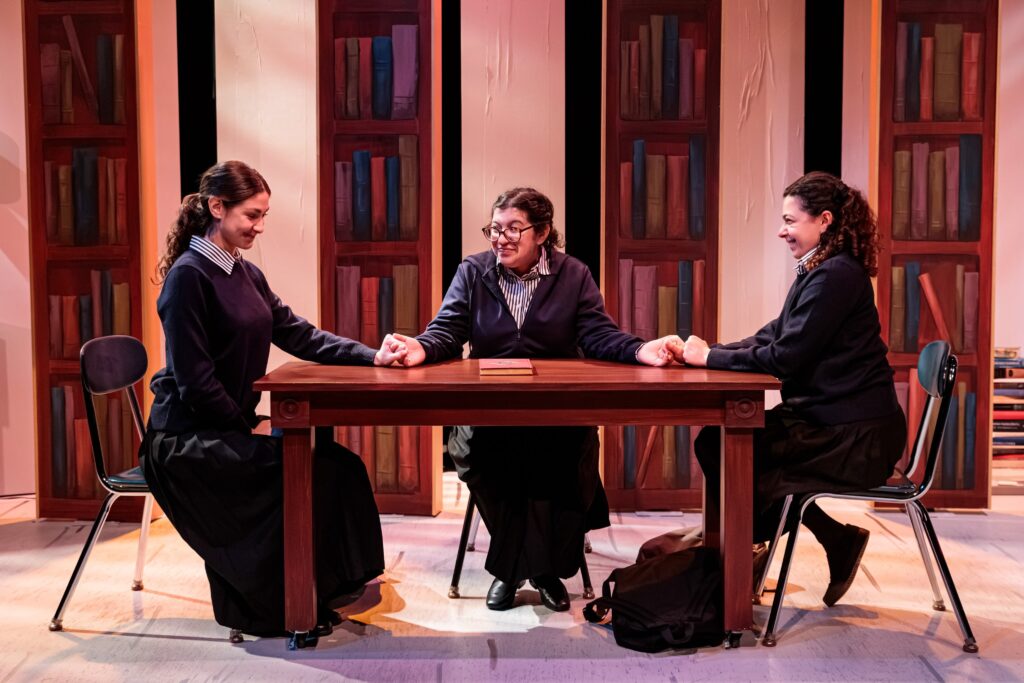
Segal, Wildstein and Blumenthal. Photo by Benjamin Rose Photography.
Presented by Boston Playwrights’ Theatre
by Rachel Beth Greene
Directed by Josh Glenn-Kayden
November 12 – 22, 2026
Snodgrass Stage
949 Commonwealth Avenue
Boston, MA 02215
Online Playbill
Content warning: Depictions of religious oppression, antisemitism, and misogyny. Contains a description of a sexual assault.
Critique by Kitty Drexel
TL;DR: jessica of venice is a coming-of-rage play. Believe teenage girls. Let them live.
BOSTON — Hell hath no fury like a teenager scorned. In jessica of venice, a modern adaptation of The Merchant of Venice, playwright Rachel Beth Greene takes a look at the female coming-of-rage experience. It runs at Boston Playwrights’ Theatre now through November 22.
In Greene’s play, three friends, Shaina (Lindsey Wildstein), Aliza (Margo Segal), and Hannah (Ella Blumenthal) hide from their teachers in a secret library nestled within their Jewish Orthodox day school. They discover a banned copy of The Merchant of Venice, begin to read it, and become fascinated with Jessica, Shylock’s rebellious runaway daughter. Shaina becomes obsessed with Jessica and dreams of running away. Then, Shaina finds herself enamored with Logan (Gavin Mariani, who plays the golden retriever boyfriend effortlessly),a christian boy in her Driver’s Ed class. Logan teaches Shaina secular slang and the joys of hemp. Shaina teaches Logan how to live more slowly.
While Shaina is exploring life outside her isolated religious community, her mother, Rivka (Jessica Golden) also dreams of change. She and her husband, Schlomo (Dave Rabinow, who plays Schlomo with such sincerity, it triggered all of my feminist reflexes) are going through a rough patch. Rivka needs space. Schlomo refuses and cites god’s law as his reason. Shaina and Rivka parallel each other as they seek small freedoms from the religious laws and social rules that cause their misery. Unfortunately, they must rely on themselves to find that freedom. Luke Avilez Meisel plays Rabbi Farkas and Mr. Burski.
No matter your culture, creed, or community, teenagers face the same uphill battle for relevancy and autonomy. In jessica in venice, we watch adults admonish Shaina, Aliza, and Hannah for taking up too much physical and psychic space. Even though they already have no money, no power, and no voice in a world that neglects and abuses them, the girls are expected to diminish themselves further to appease a society that’s terrified of their autonomy.
They’re told: Don’t be too nice, but don’t be mean. Dress modestly, but don’t be a prude. Ask questions, but not if it upsets your elders. Be smart but not smarter than boys. Always, ALWAYS make sure boys feel secure in their boy-ness. Men can’t (won’t) control themselves, even though they make and enforce the rules. Sweetie, smile.
Also, and I must stress the utmost significance of this next rule: Never, ever let the men know how much work goes into pretzeling yourself into their ideal girl. Our work must be invisible lest it upset them. Somehow, even as little girls, femmes are responsible for the actions and feelings of men.
It sucks being a girl. It sucks so hard that Shakespeare captured the experience over 500 years ago. Except, Shakespeare got it wrong. In The Merchant of Venice (1596-1598), the play’s minor but pivotal character, Jessica, forsakes her father, her Judaism, and her community for the love of a man (and freedom from her father’s house). She elopes with Lorenzo, a penniless christian. Later, she’s used as bait to connive Shylock out of his “evil,” non-Christian ways. (Many elements of this classic play aged like milk in the summer sun.)
Shakespearean scholars are cruel to Jessica in their examinations. They call her selfish and immoral for taking her father’s money and running. Scholars don’t understand that Jessica has no other options. She can’t stay because she’ll be a victim of a villain’s toxic home, but she can’t leave because she’ll dishonor her father, the villain. All of her options are bad. That’s not a societal flaw. It’s a feature used to keep women and girls at the mercy of the men who own love them.
jessica of venice tackles Jessica’s misadventures and teenagers’ universal fight for social independence through the lens of Jewish orthodoxy. Greene shows us the Torah’s stringent rules for women and girls: hyper-controlled dress, social and private behaviors, and community. Then, Greene shows us the toll these rules take, the sacrifices they must make in their religion’s name, while the males who enforce the rules all but ignore their females’ pain.

Golden and Rabinow. Photo by Benjamin Rose Photography
While I don’t know what it is to be raised in a Hasidic household, I do know what it is to be held to rigid, impoverishing standards. I grew up Catholic in a house run by a covert narcissist who wielded our religion’s tenets like a weapon. I remember being warned by my mother about dressing modestly because I would be blamed for violence against me. She grew quiet, a defense mechanism she shares with Rivka, when I rightly argued that boys and men should control themselves. It makes me wonder now what happened to my Mumma that she felt compelled to say this to me.
My Mom, like Rivka, knew certain truths about the world that I and Shaina could not understand: A man who feeds you can also starve you; Always have your own money that he knows nothing about; Following men’s rules will not save you from the men who break them or their friends who will sacrifice you to protect each other.
Life is marginally better for girls now than it was for me in the 90s, but not by much. Thank the many-headed gods that most of us seek equity and not vengeance for our injustices.
I write all this to prove that Greene finds universality in writing so specifically about Jewish Orthodoxy. It speaks directly to the femme, masc or non-binary experience within high-control religions. The play does so because it is well-written. jessica of venice runs a tights hour and 45 minutes. Each of those minutes is packed with character development and story arching. Yet. As it exists currently, I’d be remiss in my duties if I didn’t suggest ideas for consideration.
Shaina is played to rebelliously inquisitive perfection by Wildstein. Her third act break down scene is punk as hell. It’s the most badass thing I’ve seen all year for its vulnerability and its believability. Her tantruming opens a window to the cis and trans female experience. I wish I could’ve been so bold as a teenager.
The play keeps a tight focus on Shaina while also catching some dire moments within Rivka’s bleak hellscape. While Greene is showing us Shaina’s forceful grabs at freedom, Greene neglects Rivka. I posit that we either need to see more about Rivka or less. By running, Shaina is avoiding Rivka’s fate. Women know what that means. The audience’s men don’t. They have centuries of misogyny to unlearn (if they even bother). I argue that they’ll only learn if we show them more of what’s at stake. This could mean extending the play and adding an intermission. I believe jessica of venice is captivating enough that audiences won’t mind.
BTDubs, Jessica Golden as Rivka is heartbreaking. Golden gives this depressing character dignity despite Rivka’s immense unhappiness. It reminds us that a woman’s silence in the face of oppression doesn’t equal her agreement. Survivors of abuse – what Rivka experiences is financial abuse and neglect – try to leave their abusers an average of seven times before they get out.
Lastly, bravi tutti for the rapid, in-character scene changes. Y’all kept the pace going. We love to see it.
It’s not a stretch to compare jessica in venice to Kimberly Belflower’s John Proctor is the Villain. It examines similar themes through the eyes of teen girls, gives them agency, and asks its audience to grant them authority in their own lives. It still requires some development, but it’ll get there.




Leave a Reply
You must be logged in to post a comment.