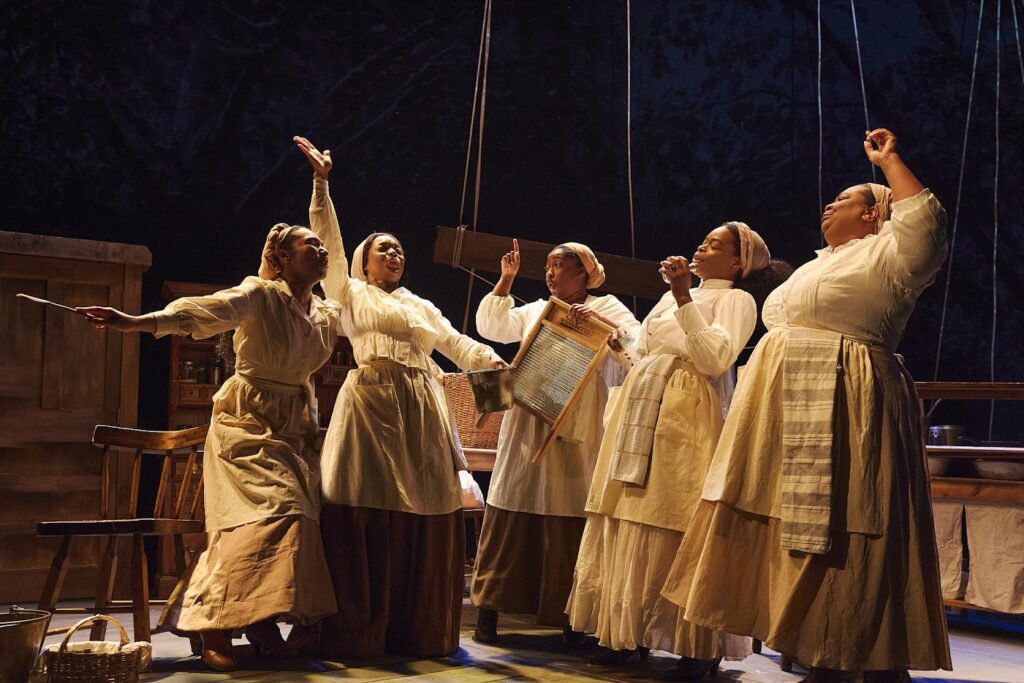
Kiera Prusmack, Lindsey McWhorter, Jada Saintlouis, Marhadoo Effeh, MaConnia Chesser. Photo by Ken Yotsukura.
Presented by The Front Porch Arts Collective
By Kelundra Smith
Directed by Tasia A Jones
Ooct. 31 – Nov. 22, 2026
Stanford Calderwood Pavilion at the BCA
Boston, MA 02116
Critique by Kitty Drexel
TL;DR: The Porch’s The Wash had a bad night. It is still a great production. Link to purchase the playscript is below.
“What doesn’t come out in the wash comes out in the rinse.” – A Southern folk proverb
Proverbs 31:18: “She sees that her trading is profitable, and her lamp does not go out at night.”
BOSTON — Playwright Kelundra Smith’s website succinctly summarizes the story of The Wash, presented by the Front Porch Arts Collective and currently running at the BCA in Boston: Inspired by the true story of the Atlanta washerwomen’s strike of 1881, The Wash tells us about the first successful interracial, organized labor strike of the post-Civil War era. Aunties Anna (Lindsey McWhorter), Jeanie (Maconnia Chesser), and their charges Thomasine (Marhadoo Effeh), Jewel (Kiera Prusmack), and Charity (Jada Saintlouis) work 18-hour days washing wealthy people’s dirty laundry.
The site continues, “Fed up with being paid in rice, beans, and hand-me-downs, the women go on strike, demanding $1 per dozen pounds of wash. Growing from a few dozen women holding the line to more than 3,000 on strike in a few short weeks, they make international headlines and the consequences of their resistance come right to their front door. The Wash offers an intimate and often funny look at ordinary women who fought the system– and won.” The character Mozelle (Eliza Fichter) represents the white washerwomen who joined the strike in solidarity.
The Wash passes the Bechdel Test with flying colors. Between loads of laundry and fighting for their Constitutionally protected civil rights, the women discuss the ups and downs of their lives. The laundry business operates out of Auntie Anna’s home. It is a space free from men and their expectations, so Anna, Jeanie and the other washerwomen are at liberty to discuss topics that historically have made and continue to make men squeamish: domestic violence, miscarriages, healthy sexual appetites, white gentrification, spousal financial abuse and its prevention, the risks inherent to working in a sundown county as a Black woman, etc. And, when the women aren’t sharing survival tactics, they gossip, dream out loud, and boast about their babies.
On Friday night, the audience was small and relatively quiet. Our energy was subdued. As a result, it felt like the cast had to work extra hard in their performances. It felt like they were having an off night. It happens.
Regardless, The Wash is still a great production. McWhorter and Chesser found energy within themselves (because they couldn’t pull it from us) and delivered top-notch performances. We knew who they were and what they wanted. We sympathized with them and celebrated their wins as they came. On a better night, every cast member would match their energy and drive.
Quadruple threat McWhorter also choreographed The Wash’s dance sequences. Her choreography expressed the backbreaking work of pre-machine laundering. The actors showed us, each in their own ways, how the work wore their bodies down. One ensemble dance sequence with humming introduced the audience to the characters’ hard work. Cast members whirled and twirled to the rhythm of interpretive laundry washing between scenes. Their spines bowed, and their arms shook. They grunted while stirring boiling wash water with long paddles and hanging long swathes of fabric on a drying line. These sequences were just as effective at convincing us of the physical cost of their work, while Director Jones’ direction convinced us of strike’s mental toll.
When the women are reveling in their successes later in the play, their bodies are allowed to be still. They cannot stop their work altogether, but they are allowed to take celebratory holiday. Their work clothing is replaced with colorful wax print skirts and jackets implemented by Athena Parkman, costume designer, and Zoe Sundra, associate costume designer. The washerwomen realize themselves in front of our very eyes.
Speaking of eyes, did you know you can purchase your very own copy of The Wash at Kelundra.com?
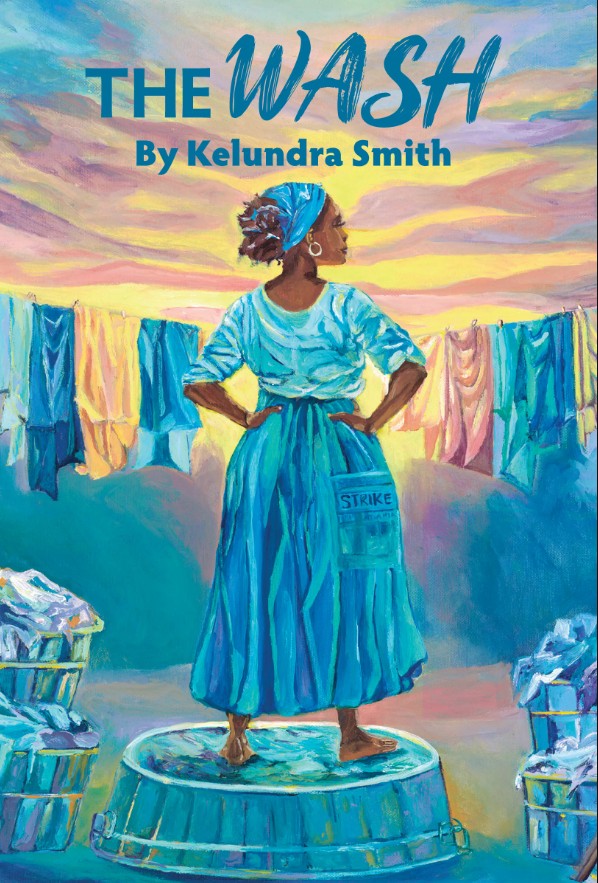 The first edition paperback by End of the Rainbow Publications features a blue, yellow, and white cover art by Tiffany LaTrice. Inside this edition, additional renderings of the washerwomen’s tools and clean laundry rest between scenes.
The book includes history and credits from the Atlanta, St. Louis, Chicago, and off-Broadway productions. Immediately following, a “Playwright Introduction” by Smith informs the readers of Smith’s inspiration for the play. It gives us insight into her process and details her compassion for the women leading the 1881 Atlanta Washerwomen’s Strike.
Production descriptions and details such as a note about how laundry was historically washed and delivered end the book’s front matter. From these instructions, it is easy to see why a household would outsource the work. The actors of The Porch’s production under Tasia A. Jones’ direction show us how grueling laundry washing used to be. I was sweating just watching them from the audience. Please note: Nowhere in the laundry instructions does it advise clients to stiff their laundresses. Georgia’s white population figured that out all on their own.
The play encompasses the rest of the book. The Wash would make any library better for its inclusion.




Leave a Reply
You must be logged in to post a comment.