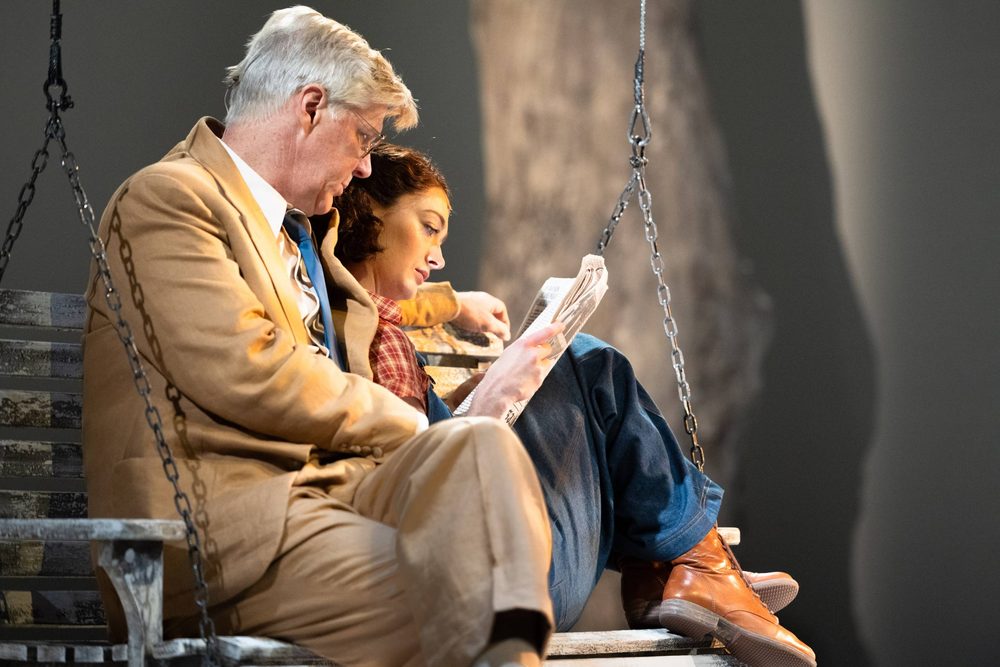
Karl Kenzler, Karen Killeen; photo by Liza Voll.
Presented by The Huntington
By Aaron Sorkin
Based on the Pulitzer Prize-winning book by Harper Lee
Directed by Huntington Artistic Director Loretta Greco
Music and vocals by Ashley Frith
October 8 – November 8, 2026
The Huntington Theatre
264 Huntington Ave. Boston, MA 02115
TL;DR: The “TKAM” play is different from the novel. The Huntington’s production is great! Hire disabled actors to play disabled characters.
Content Advisories: Explicit racial slurs, theatrical haze, and sound of a gunshot. This link for more→.
Run Time: Schedule 3 and a half hours from arrival to exit.
BOSTON — Apropos of nothing, let’s dig in.
Harper Lee’s To Kill a Mockingbird is playing at the Huntington Theatre in Boston. In it, three children tell the story of Atticus Finch, Tom Robinson and a township’s failure of justice for a Black man. The 14th Amendment of the Constitution guarantees due process, not justice.
The Huntington’s summary of Harper Lee’s To Kill a Mockingbird is HERE.
The BBC has a comprehensive examination of Harper Lee’s novel with illustrations HERE.
For those wondering, this adaptation of the novel differs in several important ways. First, the story is told through three narrators: child and adult Scout (Karen Killeen), her brother Jem (Benjamin Izaak), and their new friend Dill (Andrew Stevens), instead of one, Scout. The play occurs over one summer instead of the book’s multiple seasons. We don’t see Miss Maudie’s house burn down or the destruction of the mad dog. Boo Radley (a solemn Jesse Hinson) remains, but his interactions with the children are reduced.
One of the best changes Sorkin made was developing the characters of Tom Robinson (Rafael Jordan), a kind Black farm laborer, and Calpurnia (Patrice Jean-Baptiste), the Finches’ house matron and second mother to Scout and Jem. The play still concentrates on Atticus Finch (Karl Kenzler, with dignity, grace and quiet strength) while also expanding the novel’s conversations on poverty and race. Sorkin gives his audiences the benefit of the doubt that they can handle a mature, more nuanced conversation about systemic oppression, white fragility, and historic hate.
Listen to this pretty lady. She sounds like summer.
Alas, Sorkin’s could have been clearer with the play’s central theme. This adaptation comes short of communicating one vital statement from the novel: Don’t kill mockingbirds. Atticus Finch tells Scout, Jem and Dill not to shoot mockingbirds, because they harm no one (unlike other predatory birds which harass other birds and eat farmers’ crops – crops that the local farmers depend on to survive). Further, mockingbirds sing for everyone’s pleasure. That’s why it would be a sin to shoot them. He extends this to human beings he associates with mockingbird-like qualities: Tom Robinson and Boo Radley. This is where the novel gets its name.
For more information, look to the fine dramaturgy from Charles Haugland. Give Haugland’s playbill articles, “Continuing the Fight: Radical Justice and the ACLU,” about The Huntington’s partnership with the famous freedom fighting legal organization represented by Traci Griffith, racial justice director, and “Telling the Story: Harper Lee and Aaron Sorkin,” about the transition from Lee’s novel to Sorkin’s script, a read. He directly captures the messages and themes central to the play. Supplemental dramaturgy is also available towards the bottom of the Huntington’s Harper Lee’s To Kill a Mockingbird page.
I preface my next topic with this: The Huntington’s production is excellent. From its Boston-based ensemble of local actors by Brett Duffy to its truly epic ham costumes by Celeste Jennings, this production exemplifies everything that’s right with Boston’s regional theatre. You don’t have to visit New York to find excellent, ground-breaking theatre.
Onward: Lee’s novel, To Kill A Mockingbird, includes a disabled character, Tom Robinson. He is accused of beating and sexually assaulting Mayella Ewell (Jackie Scholl, who delivers a devastating performance as a racist survivor of incest with misplaced rage). In Sorkin’s play, Robinson is also disabled. Robinson’s character arc and the play’s events hinge upon his disability.
The Huntington’s production (and the hosting theatres before it) did not cast a disabled actor to play this disabled character. This is deeply disappointing. It’s especially so considering The Huntington hosted a production of Teenage Dick in 2021. It was chock-a-block brimming with disability representation. The disabled community calls this action “cripping up,” a term coined by playwright Katie O’Reilly. We compare it to Blackface and white-washing. As my community says, Nothing About Us Without Us.
With great respect to actor Rafael Jordan who gives an impassioned performance as Tom Robinson, a disabled actor should have been cast in this role. Jordan is an excellent actor with brilliant stage presence. It is obvious to anyone who sees this production why he was cast. And yet. Black, disabled actors exist. Black actors with paralysis want to be hired. They are willing to travel to Boston. So, it blows this disabled critic’s mind that a Black, disabled actor wasn’t hired (nor a disability consultant/advocate for that matter).

Rafael Jordan, the cast. Photo by Liza Voll.
It’s personally galling when I, a critic typing one-handed to write this article, shares a disability with the fictional character in question. (In my case, a cotton gin didn’t paralyze me, a male doctor with the medical skills of an unhatched mockingbird did. Aren’t I a lucky bitch?) It stands to reason that, if a Boston theatre critic with a paralyzed left arm can whine about this production from her laptop, then Black, similarly disabled actors all over the U.S. can perform in it. We are legion.
I don’t begrudge Jordan or any of the other cast and crew members this gig. The theatre is already a tragically difficult career path. We all do our best, even this uppity virago with not enough time on her hands.
Rather, I blame leadership. Boston theatre has been actively discussing disability equity since 1990 when the Americans with Disabilities Act was passed. Contracts exist to be negotiated. So, negotiate for disability representation on stage as you would ASL interpretation off it. The disabled community and our advocacy don’t cease to exist just because a dementated, orange would-be dictator* sits in a soiled diaper while cutting the National Endowment for the Arts for fun.
Huntington, your audience is watching.
*We don’t claim him.