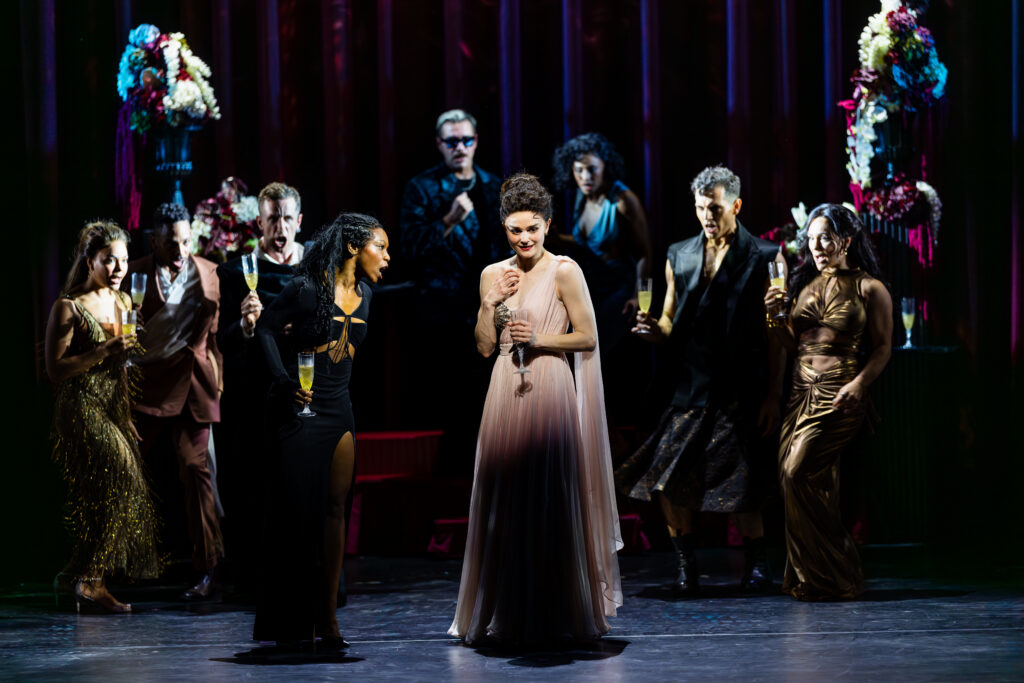
The “Black Swan” gala or the “Phantom” gala? We may never know. Photo Credit: Hawver and Hall.
Presented by American Repertory Theater
Based on the Searchlight Pictures Film “Black Swan,” with story by Andres Heinz
Book by Jen Silverman
Music, Lyrics, and Orchestrations by Dave Malloy
Directed and Choreographed by Sonya Tayeh
May 26 – July 12, 2026
Loeb Drama Center
64 Brattle Street
Cambridge, MA 02138
Content Warnings: This production depicts characters experiencing mental health crises and physical violence/body horror. It contains intense strobe, flashing lights, haze, fog, and loud noises. They are frickin’ cool as heck. The lighting, sound, and illusion design departments know how to throw a creepy party.
Recommended for ages 16+.
Critique by Kitty Drexel
TLDR: Dance = good. Everything else = iffy.
CAMBRIDGE, Mass. — The A.R.T.’s Black Swan is based on the award-winning 2010 Darren Aronofsky film of the same name. It should be noted that the musical is not a strict remake of the film, and the musical makes several swift departures. Patrons can appreciate the musical without intimately knowing its source material. I found a rewatch of the film helpful before attending, as it gave me context for the musical’s more abstract psychological moments. It also reminded me when to expect a potential scare, because I’m an inappropriate giggler. Depending on one’s personal preferences, it may be better to watch the film later.
If you don’t want to watch the movie, you can get by on reading the Wikipedia summary. Writing of which, this article contains spoilers. You have been warned.
A.R.T. brought Director and Choreographer Sonya Tayeh back after choreographing Gatsby for Black Swan. She, Jen Silverman, book, and Dave Malloy, music & lyrics, adapted Aronofsky’s film into something similar but different. It’s like a cousin of the movie instead of a sibling. As a critic who believes that a cover/adaptation/remix/etc. should say something new, not just regurgitate the original, I believe their adaptation succeeds… With some caveats.
But first, a summary. Black Swan reimagines the film of the same name for the large stage. In it, a New York City ballet corps is preparing a new, unconventional production of Swan Lake. Famed choreographer LeRoy (Amber Iman, who is not only an arresting warrior in her role; she also has flawless skin. If you have the right seats, you can see for yourself. Do not touch the Broadway star.) brings a contemporary spin to a classical ballet when the original choreographer drops out. To the consternation of the corps director Jacques (Thom Sesma) and the previously cast, fading star Beth (Tory Trowbridge), LeRoy reauditions every dancer.
LeRoy requires strength and depth from her prima ballerina in her version of Swan Lake. Rising stars Lily (Jada Simone Clark) and shrinking but hopeful violet, Nina (Melanie Moore), find themselves fighting for LeRoy’s attention.
Nina’s infantilizing mother Barbara (Mehry Eslamina, giving Carrie’s Mother a run for her money) has pushed Nina physically and mentally for an opportunity like this since childhood. Nina believes she has the skill necessary to play the role of a lifetime, but she’s beginning to question whether the things she sees and hears are real. She’ll either dig deep within herself to meet the moment, or she’ll crumble under the pressure.
Jen Silverman’s book delves deeper into the characters of Black Swan than the movie could. Dave Malloy’s music samples Tchaikovsky’s 1875 score in new music unlike anything we’ve heard from him before. In addition to these surprises, Black Swan also includes queer coming-of-age themes and faces some hard truths about working as a professional artist: disordered eating, body negativity, burnout, and poverty.
Just as Black Swan the movie was about The Ballet. Black Swan the musical has ballet in it, but its choreography leans heavily into contemporary and modern dance styles. Patrons depending upon ballet for their enjoyment may be disappointed. As previously mentioned, the creators had the opportunity to make something new and they did.
I argue that Sonya Tayeh’s electric modern dance choreography matches the beauty of ballet, albeit in a different direction. Her choreography is highly demanding of her cast, and they more than meet her demands while showing us the toll it takes. We see them use resistance bands and wear recovery shoes between rehearsals. They are incredibly strong – athletic to an Olympian degree – but maintain their human fragility.
[In 2007, I lived on a pond in York, England that had two massive black swans and their bebby cygnets for a year. Black swans are gorgeous but territorial. Their necks are like pythons attached to a muscular round body with wings of pure violence, and wee little orange legs underneath for paddling. Tayeh’s choreography captures the swan’s grace on water and ferocious, whipcord strength. She leaves out their toddling land feetsies.]
Simultaneously, the dancers express grace, flexibility, and poise in their performances while also singing and slinging lines. Their ab muscles must be insane. They communicate more with their bodies during a warm-up exercise across the stage than most folks ever do with their mouths… For two and a half hours. Ballet or not, that’s impressive as Hell.
At the other end of the spectrum, not quite an afterthought but not nearly as central as the production’s dance, are the book, lyrics, and music. Black Swan contains visual, musical, and thematic similarities to ALW’s Phantom of the Opera while also insisting an individuality all its own. From their curly haired, dancing and singing lead to their melodramatic depictions of high classical artforms, both musicals approach mental illness (real and gaslit) from the perspective of the artist. Amber Iman enters as LeRoy looking like Madame Giry on steroids. The casts must hurry through rehearsals to perform a new production. Our lovers have a romantic tête-à-tête on a rooftop. Our Black Swan heroine even has a starry-eyed moment with her god-like mentor on a pillar (Sesma in a codpiece by costume designer Shiona Turini that makes him look like Gene Simmons from KISS).
To give credit to Phantom and its creators, this theatrical powerhouse doesn’t pretend to be anything other than a sensational crowd-pleaser. I stand firmly behind the notion that ALW’s Phantom, while being histrionic fluff, retains high value in people’s hearts and in the marketplace. There is much public good in creating and selling histrionic fluff for entertainment’s sake. Joy is rebellion in action.
Black Swan tries too hard to be serious art we should take seriously for severity’s sake, and to be a chilling melodrama. A mad scene with a chilling surgical prosthetic shocked the audience when it was revealed only to be followed up with a tottering toy soldier dance sequence. The audience’s Ohs at the prosthetic were quickly followed up with giggles. From me. I giggled. A lot. The production is peppered with such inconsistent mood breakers.
Also, there’s a club scene featuring dancers dancing outside of, inside of and on bar tops. No one dances outside of a club unless directed to. That’s Hollywood nonsense. We wait until we’re inside and have ordered drinks to be assholes. You know, like sophisticated adults.
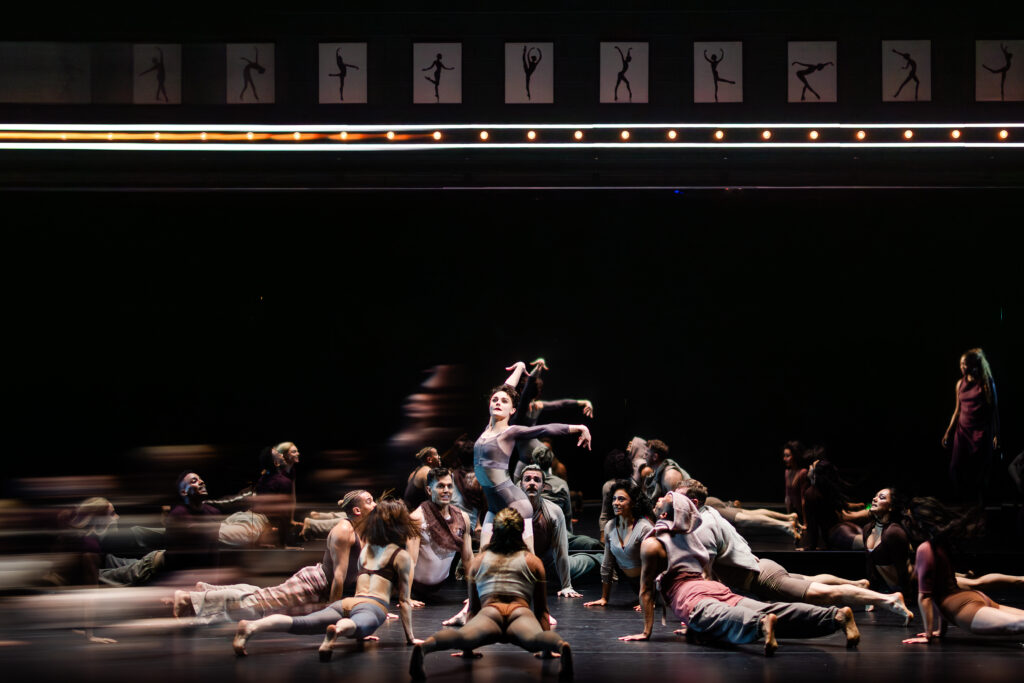
The cast. Photo Credit: Hawver and Hall.
Black Swan might have leaned heavily into the surreal beauty and discomforting body horror that a NYC (or Boston) Ballet dancer faces every day. Instead, the musical’s creators give us milquetoast reenactments from the movie: Nina pulls a single feather from her back. The nail trimming scene is brief and works only because of the actors (Moore and Eslamina) put a lot of trust in each other and their prop. These moments happen and we forget about them immediately because the horror is secondary to the scene and not the reason for the scene.
Pick one: melodrama or psychological horror. Lean into it and milk that choice for all its worth. The audience doesn’t need genre switching whiplash.
Re: The Film’s Lesbionic Elements – Nina and Lily get a fully hinged, poetically interpreted love ballet which, if ever filmed for posterity, I’m going to tell my pre-pubescent nieces is how queer ladies have sex*. But. The love ballet lacks the intensity between noted straight actors Natalie Portman and Mila Kunis in the film. A much shorter, simpler duet between the white and black swans (Moore and Ida Saki, if Lady Gaga were to swan through Lewis Carroll’s Through the Looking-Glass) in Act II contains more sexual chemistry and urgency. Sometimes professional fanfiction improves the original. Sometimes you’re disappointed. Do with this information what you will.
Apropos of nothing, it should be mentioned that there is the potential for patrons to find the depiction of Lily, an earthy, independent Black woman, smacking of racism. Especially when Nina is depicted as a meek, white woman needing protection from the world. For hundreds of years, white folks have been propagandizing Black women as lascivious first and human never. Those same folks depict white women as helpless against the sexuality of Black people.
Silverman has done excellent work at developing Lily into a complex character with depth. I fully believe the creators cast Clark because she was the best person for the role. Clark gives Lily gravitas and humor. She and Melanie Moore dance as if from a dream. It’s wondrous to watch them and then realize these dancers have been dancing for weeks and still have a full weekend of shows to perform. Holy cats.
And, some folks may still perceive this casting choice as racist in these the days of fourth-wave, intersectional feminism. Clark and Moore do a kick-ass job of playing cis women originally written by men, later developed by Silverman who, based on their plays and novels (highly recommend), knows a thing or three about the Patriarchy’s treatment of queer people. And better theoretical feminists than I have examined characterizations of the hypersexual, rebellious Black woman archetype in the media. And many things can be true at the same time. I’m not arguing for production updates. I’m asking patrons to consider the work of artists while examining the role society plays in the treatment of all femmes, especially women and nonbinary folks of color. If equity were simple… We still wouldn’t have it, but we’d have a shorter timeline.
The creators had an opportunity to deliver new, exaggerated psychological and body horrors but didn’t. The show already has content warnings. You might as well take full advantage of them and give us a show worth warning about. Give blood designer Lillis Meeh a challenge they can sink their teeth into. Heh. New York audiences, if the musical makes it to Broadway, will adjust to the horrors.
Unless the creators’ intent was to make Black Swan family-friendly. One can’t make Black Swan family-friendly without neutering it. There is too much talent involved in this musical to neuter it. At least, in theory.
*It’s a thing of beauty. Everyone gets their cookies**, if you know what I mean.
** I mean orgasms.




Leave a Reply
You must be logged in to post a comment.