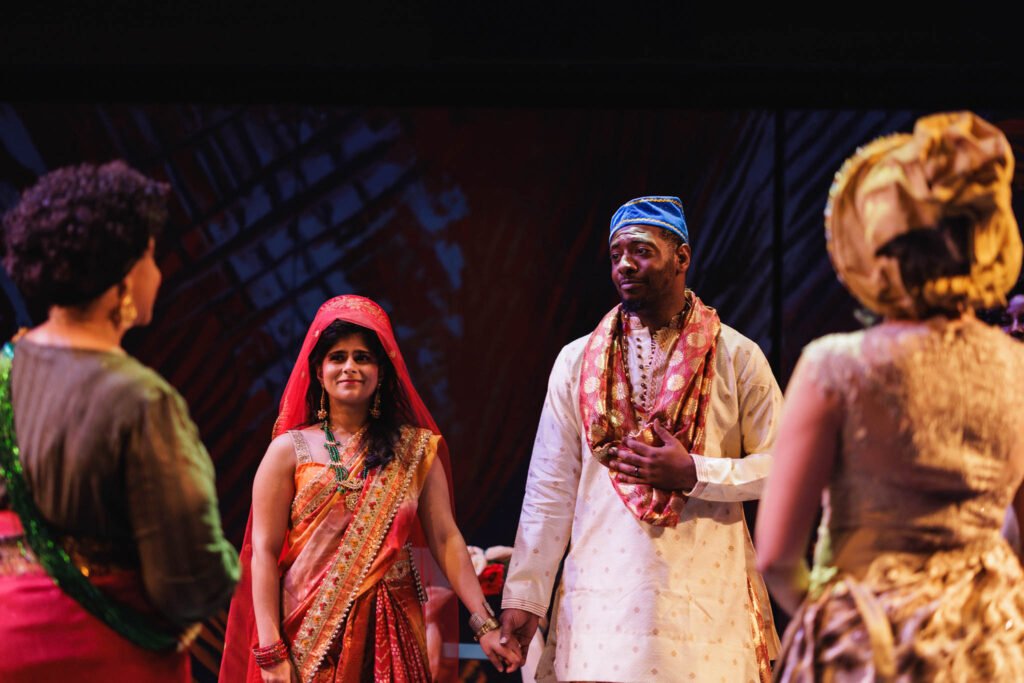
Photo by Ken Yotsukura.
Produced by CHUANG Stage, in partnership with Boston University School of Theatre and Boston Playwrights’ Theatre (with The Huntington)
A World Premiere by Mfoniso Udofia
Directed by Kevin R. Free
September 11 – October 5, 2025
Joan & Edgar Booth Theatre
Boston, MA
Critique by Kitty Drexel
Holy cats, tickets are sold out! Congratulations to the cast, crew and staff of The Ceremony! Break all the legs! A ticket waitlist is HERE.
BOSTON — The saying goes, weddings, funerals, and babies bring out the best and absolute worst in people. Whether fearing change, fearing loss of control, or feeling overwhelmed by all of the pesky details, these three situations stir madness in even the most sensible of people. So, it makes sense that a loving but frequently rocky family dynamic, such as the Ufots’ in Mfoniso Udofia’s Ufot Family Cycle, would experience some instability during wedding planning. The Ceremony, now at BU’s Joan & Edgar Booth Theatre, shows us what happens when a family’s intergenerational secrets threaten a happy couple’s wedding plans.
This is an expanded summary taken from CHUANG Stage’s website: When Abasiama (Cheryl D. Singleton) and Disciple’s (Adrian Roberts) only son, Ekong (Kadahj Bennett) asks Lumanthi Rathi (Mahima Saigal) to be his wife, they accept that their dream wedding might have to go on without either of their fathers present. But when Lumanthi’s dad has a sudden change of heart during Lumanthi’s dress fitting with her Amma (Salma Qarnain) and Auntie Anjali (Natalya Rathnam), Ekong attempts a reconciliation with his estranged father to make the ritual of their wedding ceremony truly whole. It does not go as planned. Fortunately, Ekong and Lumanthi’s family kinkeepers rally around them with sisters Toyoima Ufot (Natalie Jacobs) and Adiaha Ufot (Regine Vital) leading the charge. The Ceremony intertwines Nigerian and Nepali cultural traditions, language, and rituals, and shows us how decentering toxic family members can reveal the family members who accept us for who we are.
As in all of the Ufot Family plays so far, The Ceremony is delightful. Some of Boston’s best actors inhibit their characters with easeful grace. They communicate compassion during the play’s most fraught moments; its celebratory moments radiate Black and Desi joy.
The joy begins for attendees first in the theater’s brightly decorated lobby hung with marigold streamers and accessorized with colorful tables in blues, reds, oranges and yellows. It continues in the show’s aptly named playbill articles. Director Kevin R Free explains his thought process through staging and directing in his “Note from the Director.” Playwright Udofia discusses the influences of Black family representation on the Ufot Family in “Ufot Children & the 90s Black Family Sitcom.” Dramaturgs Haugland and Ramanan discuss Ibibio & Nepali wedding traditions with Ibibio Consultant Emmanuel Sylvester in “Ibibio and Nepali Wedding Traditions.” Each article supports the play in helpful detail with important facts and cultural explanations.
At the beginning of Anna Karenina, Leo Tolstoy wrote, “All happy families are alike; each unhappy family is unhappy in its own way.” That may be true in general, but I’ve got to say that families with a domineering, mentally ill patriarch have a lot in common, too. The Shrestha family’s struggle to appease their cranky patriarch looks like the Ufot family’s struggle to appease their cranky patriarch, which – dang it – looked a lot like my family’s struggle to appease our cranky, white AF patriarch before my wedding 18 blissful years ago: It was a struggle to convince our it that no one needed or wanted his permission to marry. It was a struggle managing his random tantrums because he wasn’t in charge. And, it was a struggle convincing him he had two options: shut up and show up or stay home. (He attended, but it was touch-and-go for a while.) From my seat in the audience for The Ceremony, it felt like my past was unfolding before my eyes. My partner and I laughed a lot, we cringed in sympathy, and we cried for the relationships we’ll never have with family who is best loved from a distance.
The characters, conversations and rituals in The Ceremony are vastly different from the ones in our biracial, queer as hell potluck wedding in a Unitarian Universalist church, but so many of the conversations the show’s characters have resembled the ones we had: How do we decenter a person who sucks all the air out of a room? What secrets are we hiding that might sabotage our relationship later? How do we create the marriage we want to have together? Unhappiness and disease look different in each family, but the intergenerational healing process can feel universal.
To wit, as in Udofia’s play, the family and friends who loved and valued us unconditionally showed up to help us create a ceremony we remember with fondness and to celebrate our union to this day. Ultimately, it was cathartic to hear the characters work out their problems in real time with their patriarchs. Not all weddings resolve so happily, but The Ceremony shows us what is possible.
A Note: Many of The Ceremony’s characters are immigrants. ICE’s unmitigated presence and power in Massachusetts is gaining traction. The Presidential administration is enforcing stricter “immigration enforcement,” says the AP News. Were the Ufot Family Cycle written today, its plays would have vastly different endings. It isn’t enough to feel strongly about ICE’s illegal detainment of legal residents and casual human rights violations; we must act. I urge all readers to vote in every election for candidates who practice empathy and won’t violate the Constitution. Voting is a civil right, your civic duty and one of the only tools we still have to voice our political beliefs. Please vote on November 5.
Information about voting in the November 5 municipal elections is HERE.