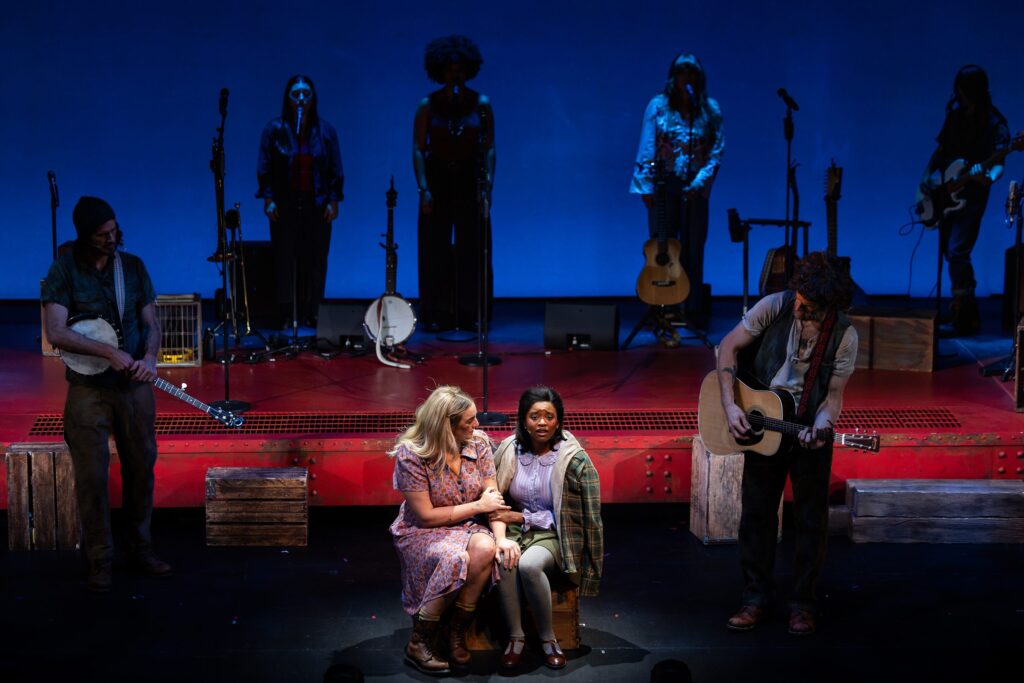
Gracie McGraw, Jackera Davis, and members of the cast in 1972. Photo: Nile Scott Studios
Presented by the American Repertory Theater
Music and Lyrics by Chadwick Stokes
Book by Chadwick Stokes and Jessie Nelson
Created by Chadwick Stokes
Directed by Jessie Nelson
November 1 – December 6, 2026
Farkas Hall
12 Holyoke Street
Cambridge, MA 02138
Critique by Maegan Clearwood
80 minutes with no intermission
1972 contains descriptions of domestic violence and abortions. This production contains loud music and flashing lights. Recommended for ages 14+.
TL;DR: 1972 rocks but, for a musical about abortion, is weighed down by men.
CAMBRIDGE, MA — Not 24 hours after news of the breathtakingly anticipated Blue Wave, I had the privilege of hearing these words belted to the highest heavens by Khaila Wilcoxon:
“It’s your God-given right
It’s your goddamn decision,
Do with it as you like.”
Words that are explicitly, unapologetically about abortion; stripping the act of all taboo; celebrating the women who paved the way to universal, safe access through direct action.
1972 is an odyssey tale, following one woman month after treacherous month after in her life-and-death quest to terminate a pregnancy. She train-hops her way to Chicago and, mid-year, finds refuge with the Jane Collective – but the story actually crescendos in January of 1973, with the passing of Roe v. Wade.
Finally, after teetering on the precipice of hope, the musical bursts with joy at the realized taste of freedom. It is a perfectly timed reflection of our country’s own sense of tentative optimism, giving us permission to relish in this moment and envision a better world, one that once again provides universal avenues to reproductive freedom.
This ecstatic release is made possible by the intricate songwriting of Chadwick Stokes, best known for his work with Boston-based indie bands DISPATCH and State Radio. The score is a patchwork quilt of musical genres, seamlessly overlaying folk, rock, and hippie-dippy grooviness. One metal moment of particular delight: Tommy Ng delivers a brilliant bass solo, followed by a screeching vocal release of heartbreak and rage. There are even glimmers of Dolly Parton woven into the mix, through a smattering of character-establishing ballads.
I have reservations about the book and direction (Jessie Nelson of the musical Waitress, which has fascinating parallels with this piece, also directs), particularly the casting and performance of our viewpoint character. We follow the journey of Hannah, played by Gracie McGraw, who exudes innocent girlishness. Blonde and outfitted in a pink babydoll dress, McGraw tries distractingly hard to be young and naive. I couldn’t help but feel like the creators wanted Hannah to be palatable for a general audience, as if they needed her be a stereotypical “perfect victim” in her journey to make a taboo choice.
It’s my understanding (mostly informed by the National Women’s Law Center and the Chicago Women’s Liberation Union HERSTORY project’s fascinating first-person resources) that the Jane Collective was primarily led by white, middle-class women with the privilege of time and money to volunteer for this ambitious work. Their primary clientele were Black and brown, low-income women, so race and class equality were the subjects of many of the collective’s internal debates.
Nationwide, abortion was (and still is) particularly dangerous for Black and brown women, according to an article by Rachel Benson Gold with the Guttmacher Institute. Gold wrote, “In New York City in the early 1960s, one in four childbirth-related deaths among white women was due to abortion; in comparison, abortion accounted for one in two childbirth-related deaths among nonwhite and Puerto Rican women.”
The decision to follow a white woman detracts from a potentially larger conversation about racial and class disparity, which I wish the creators had been brave enough to tackle.
The musical is also frustratingly bogged down by men. In the first half, Hannah is shepherded along by a trio of train-hoppers (Darren Buck, Will Urmston, and Chadwick Stokes himself). She is a passive character here, spurred on by the men’s words of wisdom rather than finding strength from within. I understand the desire to give Hannah a character arc from fear towards courage, but I wish that this initial stage of her transformation was under the guidance of women.
Luckily, women take over the story in the second half, quite literally switching places with the men to take up more physical space downstage. The Collective is bursting with hope, spearheaded by Wilcoxon’s ferocious performance; the show is worth attending for her alone.
Stokes’ lyrics frequently tell instead of show, and there’s an awkwardly foreshadowed tragedy that takes place midway through the story. I also wish that the word “abortion” was actually said, preferably shouted, aloud to shatter the taboo even further. If my memory fails and the word was mentioned, I wish it had been louder.
Maybe it was the timing of my attendance, maybe it was the intimate concert raucousness, but I was able to look past these flaws and sink into the ecstasy.
Of course, this celebration is just the beginning. To quote Linnea Johnson in the HERSTORY project:
“When Jane finally did disband (late 1973), after abortion was effectively ‘legalized,’ we unconsciously made the same error that the Suffragists had made after Suffrage had been ‘granted’ in the US: we thought we’d won, changed something, that someone somewhere was wising up, seeing the light. But what we did was to remand women back into the realm of male law, male custom, medical custody. Bad idea then as now.”
For now, 1972 lets us relish in the joy, and I’m so, so grateful for it.
Viewers are encouraged to attend Select performances that culminate in Act II: events including talking circles and facilitated conversations with local civic leaders, scholars, and activists. Also of note is a pop-up exhibition on November 10th at the Schlesinger Library at Harvard Radcliffe Institute, featuring primary source materials from its collections related to the history of the Chicago Women’s Liberation Union, the Janes, reproductive rights, and access to abortion in the US in and around 1972.




Leave a Reply
You must be logged in to post a comment.