 Presented by Greater Boston Stage Company
By Weylin Symes
Directed by Weylin Symes and Daniel Begin
Featuring Anna Slate and Charlotte Gray (understudy)
Online Playbill
Oct. 23 – Nov. 8, 2026
GBSC Main Stage
Stoneham, MA 02180
90 minutes with no intermission.
Trigger warnings: Body horror, medical misogyny, surgical gore, spooky basements.
Article by Kitty Drexel
STONEHAM, Mass. — Blackhollow: A Gothic Tale of Possession is horror. It depicts the torture of women. Its male characters call it “science,” but it’s historical torture with lab coats. In this gothic horror, adult men prey upon women and girls because they can. These male scientists see their victims as lab rats. Please, please respect your limits when buying a ticket.
After witnessing her father commit her mother’s violent murder at the breakfast table, Lucy Cull (Anna Slate) is given employment in a 19th-century English criminal asylum. She is 11. Life working at the asylum forces Lucy to grow up quickly. Between the male doctors preying upon naive young women for sport or her malicious coworkers’ undeserved violence, Lucy must rely on her wits to survive.
Eight years after she arrives, Lucy Cull has risen through the ranks and become a respected member of the staff. She is so respected that the new Superintendent, Ashburne (Slate, again), picks Lucy as his assistant. Together, he tells her, they will revolutionize the medical field with his secret experiments. Lucy complies under duress. She becomes an unwilling participant in blood transfusions with an impassive asylum patient, Ida Ripley.
During the transfusions, Ashburne injects Lucy with a narcotic that gives her disturbing visions. The visions don’t stop when the experiment stops. Lovecraftian leviathans interrupt Lucy’s work and threaten her sanity. As the experiments continue, Lucy also discovers a psychic link with Ida. It is a link that will either save them both or destroy the asylum one syringe at a time.
As the audience filters into the theatre, we are introduced to the world of Blackhollow through Katy Monthei’s deceptively simplistic scenic design. Upon closer inspection, the ward’s white walls are grey and blue where the floor meets the wall. Mold grows up the sides of the room like the decay growing into the asylum from its basement surgery rooms. The ceiling has mysterious brown water stains. They could be from years of rain damage, or it could be something more nefarious. The work of Cory Whittemore, lighting design, and David Remedios, sound design, further creepify the world of Blackhollow with eerie overhead lamps and mysterious bumps in the asylum’s ancient basement.
Anna Slate (in a dress out of Jane Eyre by Deirdre Gerrard, costume designer) delivers a tour-de-force performance as Lucy Cull and a bevy of other quirky and pernicious characters. Slate tackles a range of English accents, from Cockney to the King’s English, and character voices (man, woman, upper class, working class, and others) with rigorous skill. Her storytelling is gripping; her stage presence is absorbing; as we follow her narration, we forget she is the only actor on stage in this multicharacter, topsy-turvy gothic horror.
The great character work Slate developed with Directors Symes and Begin make it easy to forget Blackhollow is a one-woman show. She does this by bestowing each character with individual ticks: Ashburn takes deep breaths through his nose before beginning an arrogant speech. Clara uses a higher-pitched Cockney accent and has a bold, sweet demeanor. Matron Tremmel stands like a malignant statue while looking down her nose at the subjects of her ire. Lucy Cull exists around and between these characters as a passive woman who fawns and freezes before ultimately fighting for her freedom.
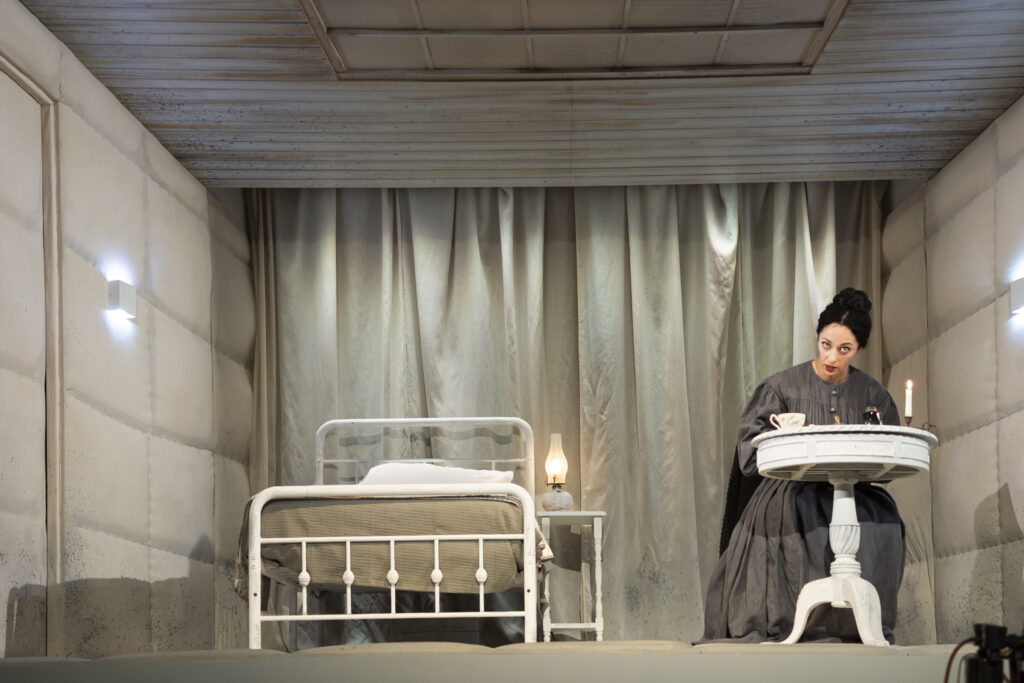 Blackhollow is further heightened by Symes’ colorful descriptions of the asylum and its residents. Superintendent Ashburn isn’t merely a despicable character. Rather, Symes illustrates Ashburne’s depravity with verbal flourishes; Ashburne has overly long fingernails, uses overly flowery words, and walks with a cane he doesn’t need. Here is a man with delusions of grandeur attending what Symes calls an understaffed institution with decaying wards. Symes describes the asylum’s Dr. Craven as a friendly nonce (enough said).
Meanwhile, Symes lets the actions of his sympathetic characters express their personalities; they don’t need illustration: Nurse Grace works in the infirmary. She nurses Lucy Cull back to health. Clara, Lucy’s roommate, acts as Lucy’s refuge and savior between experiments. We don’t know what they look like, but we know the content of their characters.
Speaking of characters and their stories, I don’t usually enjoy media of the horror genre. I make exceptions for feminist horror with revenge elements like this summer’s Paranormal Activity and Teeth the Musical (2024). I’m adding Blackhollow to my list. Everyone loves an underdog. Lucy Cull is as underdoggy as they get: She’s poor; she’s small; she’s powerless. And then, through the use of her intellect, she gets the upper hand. As much as I hate the abuse of women, I love their revenge stories more.
Fiction or not, times have changed very little in 200 years. Whether it’s the systemic scourge of medical misogyny in Western medical practices or the drunken assault of coeds by frat brothers at Cornell and other Universities, men continue to have a rape problem. Fortunately for us, Symes and Begin’s play gives Lucy Cull a happy-ish ending. It’s not the happy ending of due process, but justice is gorily served. It punches up at the abusive men and women who perpetuate the abuse. Everyone who wrongs Lucy gets what’s coming to them. With knives. And psychosis. We love to see it.




Leave a Reply
You must be logged in to post a comment.