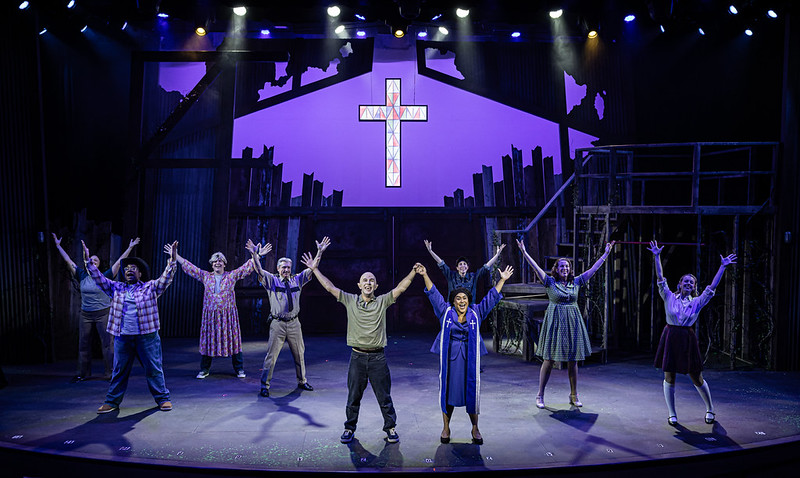
Photo of cast by Jim Sabitus.
Presented by the Umbrella Stage Company
Story and Book by Keythe Farley and Brian Flemming
Music and Lyrics by Laurence O’Keefe
Directed by Jeremy Johnson
Music directed by Jeff Kimball
Choreography by Sara Andreas
September 25 – November 8, 2026
Umbrella Arts
40 Stow St.
Concord, MA 01742
Online playbill
Approximate run-time: 1h 55m, 15m intermission
Critique by Diana Lu
CONCORD, Mass. — Bat Boy: the Musical has the dubious yet rarefied honor of being the worst show I’ve ever seen. This is not altogether bad publicity: it’s managed to stay rent-free in my brain all week. I fully expect to think about this show at least once a month for the rest of my life. Perhaps not my Roman Empire, but certainly my Portuguese, or Dutch East Indies Empire.
Inspired by an infamous 1992 tabloid, this 1997 off-Broadway musical tells the story of a half-human, half-bat child found in a cave. The bat boy (Johnny Shea) is taken in by a village veterinarian’s kindly wife (Amy Barker), who teaches him manners, BBC English, and how to give and receive love. The fanatically religious townsfolk alternately revile and accept the Bat Boy, whose primary conflict is wrestling with his deadly vampiric nature. Mayhem and hilarity ensue.
Johnny Shea’s lead performance was the best thing about the show. He played Edgar the Bat Boy with sincerity and gravitas that grounded the outlandish mess around him. Watching him serve high tea in a British accent while wearing vampire fangs, pointy ears and a bald cap was also the most camp the show managed to muster.
Amy Barker is a stellar actor who played Meredith with tenderness and complexity that made her character’s gradual reveals throughout the second act believable. Maria Silva Norris’s portrayal of Reverend Hightower was as hilarious as her gospel solo was breathtaking.
Cameron McEachern and Sarabeth Spector created a set that coherently morphed from bat cave to church pews to living room to enchanted forest with minimal props. Meagan Bello’s costumes combined with Briana Fallon’s choreography created clear and intentional transitions of the actors from one character to another that became some of the funniest moments of the show.
In general, the cast and crew did the best they could with a difficult book. I also think intentional camp is especially difficult to pull off in theater because the medium is already so…well, theatrical. It’s hard to hit the right balance of exaggeration and seriousness that camp requires when everything already has to be exaggerated to even be readable from the nosebleed seats.
In Bat Boy’s case, the directorial choices often felt too cartoonishly unserious and self-aware to effectively convey a camp aesthetic. My main grievance about this is that it makes the problems with the book more glaring. I won’t even go into the narrative messiness. It’s the asymmetrical treatment of men’s vs. women’s humanity that really bothers me about this show.
Bat Boy is a supernatural metaphor for a lot of painful experiences of queerness, particularly of gay men in the 80s and 90s: AIDS stigma, isolation and othering, institutional persecution. The book was written with the intent to portray these traumas safely filtered through the aesthetized lens of camp, and to its credit, does so effectively.
The female characters, on the other hand, are rendered at best as infrastructure in a man’s story, simultaneously hypervisible as spectacle and invisible as narrative. They are the primary drivers of Edgar’s healing narrative in a naturalized way that erases the labor required for that healing process. And the story just rawdogs the suffering of Meredith, Shelley, and even Mrs. Taylor, often for comedic effect.
A different approach to camp might have allowed this production to make up for some of the compassion the book misses, but it didn’t. This is particularly sad as a failure in artistic direction because there is so much more public awareness of care work and sexual violence today than when Bat Boy was written 30 years ago. I don’t begrudge the writers for having the blind spots they did in 1997. But there is no excuse for a production team that demonstrates zero interest in looking directly at them in 2026.




Leave a Reply
You must be logged in to post a comment.