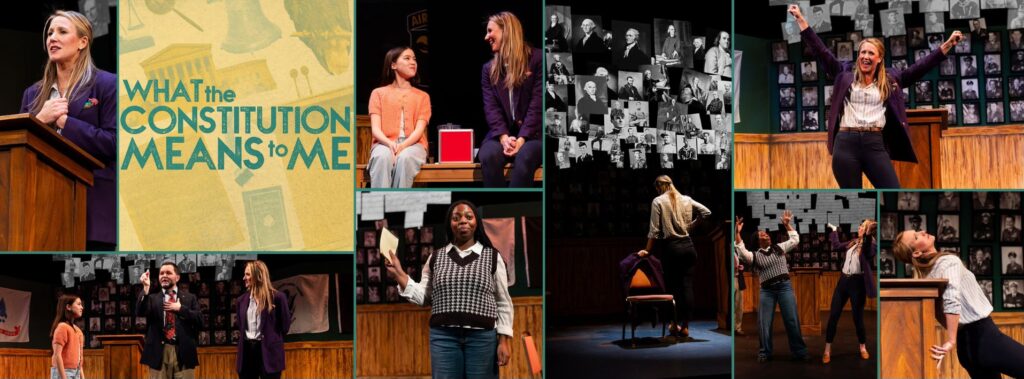
Compilation by Maggie Hall Photography
Presented by Greater Boston Stage Company
By Heidi Schreck
Directed by A. Nora Long
Cast on April 19, 2026 featured: Janis Hudson, Joseph Marrella, and Ayannah Joseph as the teen debater
April 10-26, 2026
GBSC Main Stage
395 Main Street
Stoneham, MA 02180
Digital playbill
Critique by Kitty Drexel
STONEHAM, Mass. — One of my favorite movie quotes is from 1994’s semi-feminist western Bad Girls. It stars Madeleine Stowe, Mary Stuart Masterson, Andie MacDowell, and Drew Barrymore as four former sex workers on the run after escaping prison. Masteron’s character Anita Crown inherited a land claim in Oregon when he died. She attempts to validate the claim with a male lawyer. He tells her that only her (dead) husband can claim the land. The law doesn’t acknowledge a woman’s inheritance.
Famously, Anita replies, “If your laws don’t include me, well then, they just don’t apply to me either.” It’s a quote I wish more women would incorporate into their lives. For the majority of Western and world history, legal documents have excluded women. Embracing intersectional feminism means embracing women’s rights… And wrongs.
This is relevant because, as Heidi Schreck aptly tells us in What the Constitution Means to Me, the Constitution of the United States wasn’t written to include women. Or Black people. Or indigenous Native Americans. Or disabled folks. Or queer people. Or anyone else who didn’t identify as a rich, white, cis, male landowner in 1787. Despite (or maybe because of) this historical fact, Schreck tells us why the Constitution and its 27 amendments held special meaning to her.
With great kindness and sympathy, Heidi Schreck (Janis Hudson) tells us over 90 minutes what the Constitution means to her and why. Schreck’s written voice uses a first-person, creative nonfiction narrative to describe how she debated the Constitution to earn college scholarships. She also tells us how her 15-year-old thoughts affect her today.
In 1989, Schreck was 15, horny, and debating other hormonal teens for the entertainment of geriatric veterans of foreign wars. Schreck’s spoken voice pleads for patience as she explains why Amendments IX (unnamed rights are entitled to protection of the law) and XIV (immigration rights, sections 1-5) make the Constitution sizzle. To do so, she uses stories from her own life, her mother’s, her grandmother’s, and her great-great-grandmother’s of abortion as healthcare, domestic abuse, and battered women syndrome. Her stories emphasize the bravery of the antagonists and explain how the laws that disinclude her foremothers have harmed women in the U.S. for centuries. She does so without pointing fingers at men. It’s quite magnanimous of her.
Greater Boston Stage Company’s production of What the Constitution Means to Me is one of the best I’ve seen. In some ways, it’s better than the 2020 Amazon Prime recording featuring playwright Schreck as herself. Schreck performs beautifully, but a live performance such as Hudson’s is always better than a recording. Even if recorded, Hudson’s performance would stand the test of time as a great one.
Hudson and director Nora Long circumnavigate Schreck’s multipronged coming-of-age tale with respect, dignity, and just enough theatre-kid pizzaz to appeal to most viewers. Hudson prances, weeps, and stalks across the stage in tight, navy pants with enviable energy. Her line delivery is so relatable and honest, her characterization is so welcoming that an audience member might think Hudson was telling her own story, not Scheck’s. And Hudson does it to our faces.
Long and Matthew Brian Cost, lighting designer, quickly obliterate the fourth wall. The performance begins with its lights up. Hudson speaks directly to us from the stage. Lights come down as Hudson/Schreck reenact moments from Schreck’s childhood debates. The lighting tells us when to listen closely and when to engage with our voices. They are subtle but effective.
In a way, it is. Any white woman in the GBSC audience could relate to Schreck’s tale as Hudson tells it. Women couldn’t access birth control until 1965; Roe v Wade was decided in 1973; women couldn’t obtain a credit card until 1974. Life without these freedoms that men take for granted is a recent memory. I am the first woman in my immediate family to access comprehensive healthcare, an education, a career, a partner, and a home without the intercession of a man. I am the freest my ancestors have ever been.
With Roe v Wade’s overturning in 2002, none of us knows how long that will remain true for women. There are global rape academies on the internet. Domestic violence is rampant in every country on the planet. In the U.S., women account for only a small fraction of the perpetrators, and neither nonbinary nor trans folk account for the majority of the cases. A lot of women will attend What the Constitution Means to Me, but the people who need to see it the most are men. Women have fought and died for our human and civil rights. To keep them, we must impress our humanity upon the gatekeepers of those rights. Our future depends on it.




Leave a Reply
You must be logged in to post a comment.