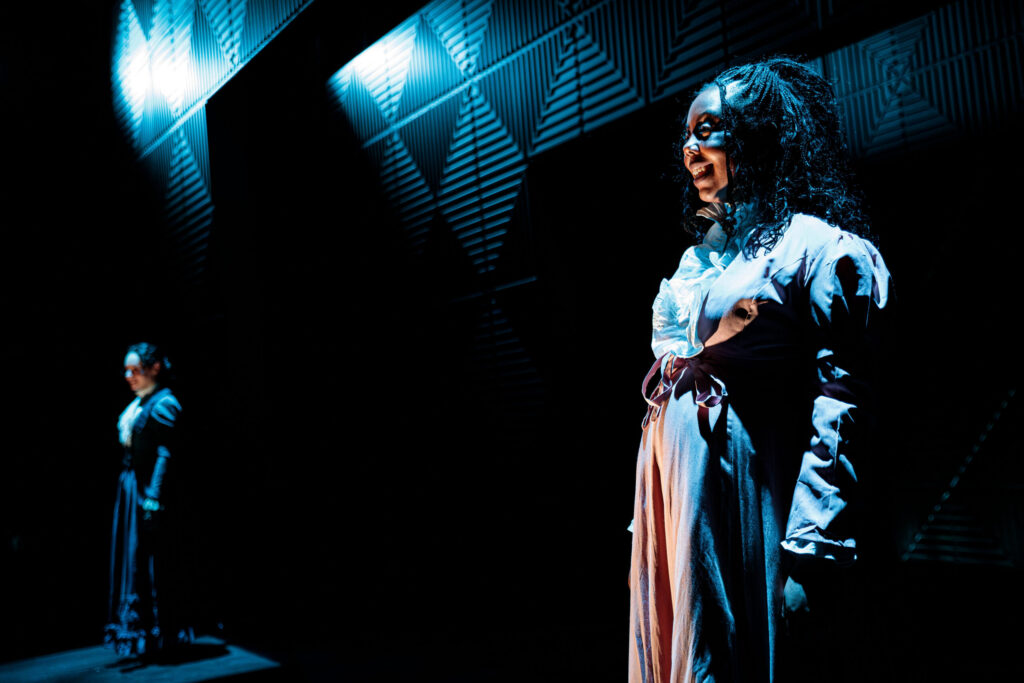
Foreground: Kelsey Fonise; background: Alison Russo; Photo by Benjamin Rose Photography.
Presented by SpeakEasy Stage Company
By Jordan Harrison
Directed by Alex Lonati
Dramaturgy by Reyn Ricafort
Featuring: Alison Russo, Kelsey Fonise, Helen Hy-Yuen Swanson, Catia, Jesse Hinson, Tobias Wilson, John Kuntz, Anderson Stinson III, Harry Baker
March 6 – 28, 2026
Boston Center for the Arts
Calderwood Pavilion
The Roberts Studio Theatre
527 Tremont St.
Boston, MA 02116
Content Warning: This production contains strong language, sexual content, mild violence including limb severing, and potentially distressing themes.
Article by Kitty Drexel
BOSTON — Mary Wollstonecraft Shelley published her most famous novel, Frankenstein, in 1818. Czech writer Karel Čapek published his revolutionary play, R.U.R. (Rossum’s Universal Robots), in 1921. Today, SpeakEasy Stage Company presents The Antiquities, a play about A.I.’s preservation of human existence at the Boston Center for the Arts.
Playwright Čapek anticipated modern A.I. without predicting its foibles or dangers. R.U.R. tells of an inventor, Mr. Rossum, who builds artificial humans to enslave them. Helena, a sympathetic human and love interest, gives Radius, a rebellious robot, access to a human library so he may acquire knowledge. Instead of using knowledge to gain equality, Radius seeks to enslave humans in return. Like one recent study on modern A.I. at Cornell’s Kempner Institute, Rossum’s A.I. robots mutated past rote learning to develop their intelligence beyond their humans’ dictates. Over one hundred years of science fiction media later, including Blade Runner’s Voight-Kampff Test, Jordan Harrison gives us The Antiquities, a play that foretells an era without humans. (Apologies to Charlton Heston.)
In The Antiquities, a team of android-like curators (Alison Russo, Kelsey Fonise, Helen Hy-Yuen Swanson, Catia, Jesse Hinson, Tobias Wilson, John Kuntz, Anderson Stinson III, and Harry Baker) at the Museum of Late Human Antiquities provides insight into the mildly-intelligent, casually queer, psychologically volatile mammal known as Human through its species’ remaining artifacts: Soylent, a clarinet, vinyl records, a t-shirt, and visual records of emotions such as love, annoyance, and grief. We watch the curators reenact human behavior in short vignettes that travel from the humans’ early industrial revolution to its technological plateau and back. Note that the curators’ knowledge of humanity is limited. Our guides parse humanity together from what humans left behind, what we got right about living, and what we got disastrously wrong.
For folks who’ve attended many of SpeakEasy’s shows in the past, this play is a swift departure from the shows of SpeakEasy’s recent past. This is not a judgment but an observation. As my charismatic date on Sunday said, it’s a play one might find on the stage of Central Square Theater instead. SpeakEasy Stage could be compared to worse companies than the acclaimed Cambridge theatre. Change happens. I, for one, welcome our new android overlords.
That being stated, while I love science fiction theatre, I didn’t love The Antiquities. I didn’t dislike it either. (My charismatic date enjoyed it very much.) Theatre told through short vignettes is not my bag, but I can appreciate the hard work the cast, designers, and creative crew put into The Antiquities regardless. For example, Alex Lonati’s direction reveals the cast as creepy as Hell cyborgs. Their uncanny valley smiles and geometric inter-scene staging dutifully reminded me that all was not right in the Museum of Late Human Antiquities. Alison Russo’s curator voice put shivers down my spine. The cast’s work melded perfectly, perhaps too perfectly, with Anna Drummond’s subtle soundscape of computer glitches and binaural beats. If this is something you enjoy or don’t mind as much as I do, this show could be for you.
Despite loud protests from invested billionaires, A.I. is not for everyone. If you need to be caught up before the performance, Reyn Ricafort’s dramaturgy gives patrons a helpful primer. This section provides further reading for the curious reader. MIT News publishes articles for the intermediate to advanced reader.
Whether it’s here to stay or it’s another bubble waiting to burst, A.I. and related technology now dominate the theatre. It’s advancing faster than we can acclimate to it. You might as well enjoy some of it before the robots uproot us as masters of the universe and beyond. The Antiquities runs now through March 28.