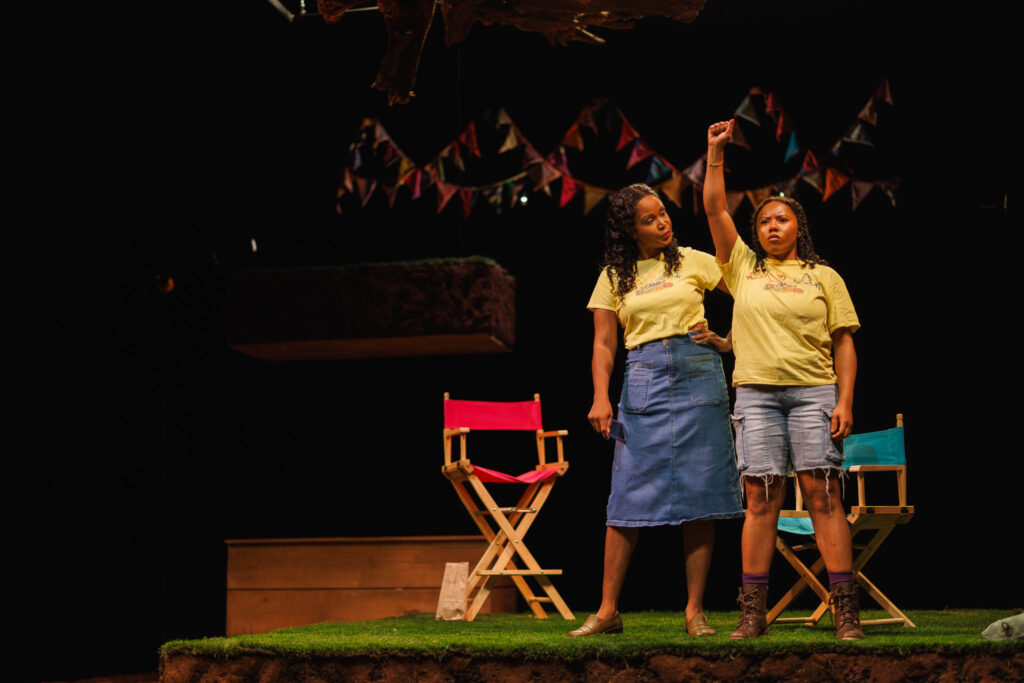
Yetunde Felix-Ukwu and Victoria Omoregie. Photo by Ken Yotsukura Photography.
Presented by Company One, a co-production with Woolly Mammoth Theatre Company
By Nia Akilah Robinson
Directed by Mina Morita
Dramaturgy by Sonia Fernandez
Jan 9 – Jan 31, 2026
The Modern Theatre at Suffolk University
525 Washington Street
Boston, MA 02111
Critique by Kitty Drexel
Approximate run time: 1 hour 30 minutes with no intermission.
Seating is general admission.
This play includes strong language and the use of flashing lights.
BOSTON — For theatre folks, nothing puts current events into perspective like a play. America feels like it’s on fire, but it always has been. The Great Privation (How to flip ten cents into a dollar), now running at Suffolk University’s Modern Theatre through Jan. 31, shows us how to find joy with our loved ones during our darkest moments; times and practices may change, but people do not; and, we may not get the closure we want, we get the closure we get. If you need a short break from the news to redirect your intentions, check out Company One’s Pay-What-You-Want tickets.
This play catapults its audience between two timelines: 1832, where a Mother (Yetunde Felix-Ukwu) and daughter, Charity (Victoria Omoregie), are watching over the grave of their dearly departed patriarch in Philadelphia; and July of this year, where a different but similar mother and daughter work as counselors at a sleep-away camp in the same locale. In 1832, the duo turn away scavenging resurrectionists who had paid off everyone but mother and daughter to take ownership of their patriarch’s body. During a cholera epidemic, no less. In the present day, the ladies are forced to fight daily microaggressions from their flamboyant, male coworkers (Marc Pierre, resplendent in red, and Zack Powell, showing off superior arm strength). The Great Privation is a dark play with comedic moments. It asks its audience to consider the ongoing harm caused by history from within a society that prefers to ignore inconvenient truths.
Felix-Ukwu and Omoregie have a natural ease together that looks and feels like real life. We perceive their dancing, dabbing, and joking as an extension of their characters’ bond. In this mother-daughter love story, their trust and understanding are a core feature of their characters and not a problem they must resolve. Mother loves Charity and worries about revealing too much or too little of the world. Charity respects her mother and feels safe to test Mother’s boundaries. She whines about boredom but listens when Mother draws a line: normal, happy kid stuff. Felix-Ukwu and Omoregie’s on-stage mother-daughter relationship reminded me of my relationship with my own Mumma, whom I love always and forever. It’s refreshing to watch a play about a mother-daughter relationship that isn’t fraught with toxicity.
Some energy expenditures are positive. Company One puts a lot of effort into its playbill designs. In The Great Privation’s playbill, the articles and the artwork by Zoe Pappenheimer provide insight into the depths of the production. On page 7, there’s a flashlight under the interview between Playwright Nia Akilah Robinson and C1 Resident Playwright Kirsten Greenidge. On page 11, we’re shown a shovel in a burial mound. This image continues in later pages and is joined by a water bottle and a yellow bucket hat. These images casually prepare the reader for the imminent performance.
C1’s dramaturgy is just as thoughtful. Dramaturg Sonia Fernandez and the C1 crew give the audience everything it needs to understand the nuances of Robinson’s play. There’s the afore-mentioned interview. Another article, “Surviving Progress” by Angela Tate, chief curator & director of the Boston and Nantucket Museum of African American History, gives a historical and cultural context of the play. It comes before an enlightening, albeit horrifying, timeline leading up to and past the events of The Great Privation. This timeline tells us how Massachusetts participated in the capitalist consumption and disposal of Black and Brown bodies despite being the first state to abolish slavery in 1783. The timeline concludes with the 2023 trial of Cedric Lodge, the Harvard Medical School morgue manager who trafficked human remains on the internet and across state lines. The play takes place in Philadelphia, but its events affect all of the U.S.
The last article, “Black Life Astride the Grave” by Harriet A Washington, expert and author of the book Medical Apartheid: The Dark History of Medical Experimentation on Black Americans from Colonial Times to the Present, provides scientific historical context to Robinson’s play. As it gives us factual information, it also heightens our emotional response to the characters of the play. Washington tells us how Black bodies were targeted and stolen from Black cemeteries by white medical students and practitioners for study. Slavery might have been abolished, but its dehumanizing practices continued after death and under the cover of night. It is important to know where our medical practices come from. Knowing makes this play-going experience more pronounced, unforgettable.
This play’s weakest link is its inter-scene lighting changes. Amith Chandrashaker’s design darkens the theatre to communicate the play’s travel to a different century. It gives the cast time to make their super-fast costume changes (thanks to costuming by Brandee Mathies), but the lag pulls the audience out of the world of the show. We stare at a mysterious digital clock designed by Meghan Raham on stage left to wait while the cast reenters.
The Great Privation (How to flip ten cents into a dollar) is otherwise a solid show with real-time applications to current events. Even when slavery was abolished in Massachusetts and eventually the U.S., the commodification of Black and Brown bodies continued. We see the continuation of these practices as ICE enters liberal cities to deport community members. It’s in the construction of a whites-only community in the Ozarks. It spills into the uncredited appropriation of Black culture. The Great Privation asks us to consider how these ancient practices impact our lives today. Not so we’ll feel guilty, but so we can take responsibility.