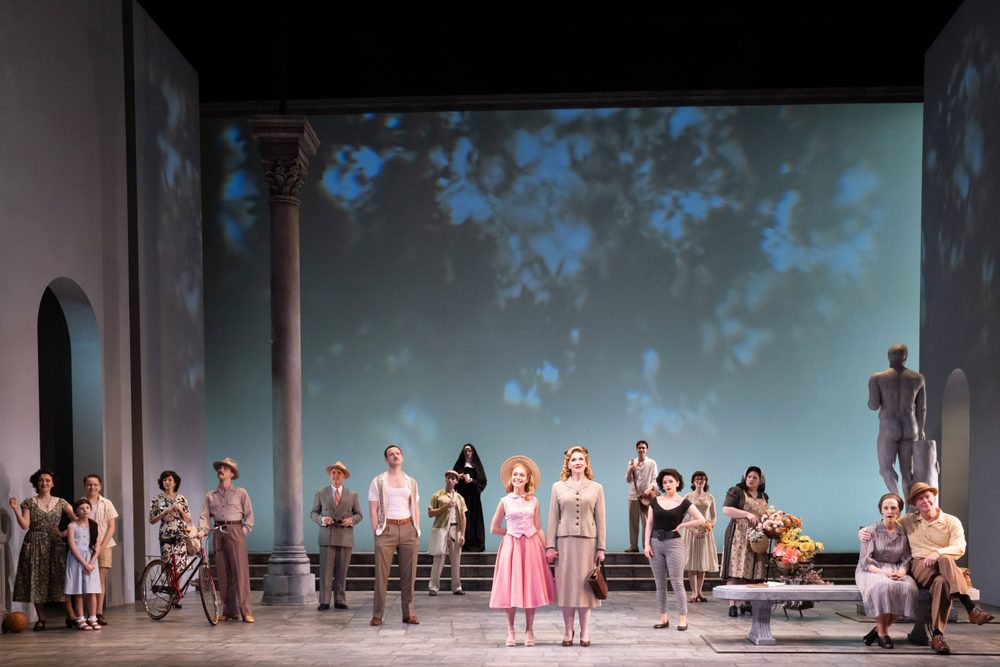
The cast of The Light in the Piazza; directed by Loretta Greco; photo by Julieta Cervantes.
Presented by The Huntington
Book by Craig Lucas
Music and lyrics by Adam Guettel
Based on the novel by Elizabeth Spencer
Directed by Loretta Greco
Music direction by Andrea Grody
Scenic design by Andrew Boyce
Lighting design by Christopher Akerlind
Costume design by Alex Jaeger
Featuring Emily Skinner, Sarah-Anne Martinez, Joshua Grosso, William Michals,
Rebecca Pitcher, Alexander Ross, Rebekah Rae Robles
May 9 – June 15, 2025
The Huntington Theatre
264 Huntington Ave. Boston, MA 02115
Review by Maegan Bergeron-Clearwood
BOSTON – When The Light in the Piazza premiered on Broadway two decades ago, it was lauded as a quaint but refreshing return to style, and Adam Guettel’s delicate, almost operatic score became an instant classic. Compared to contemporary 2000s box-office smashes like Spamalot and Avenue Q, this intimate love story favors pathos over spectacle, sincerity over irony – on the surface, it’s as old school as a 21st Century musical can get.
Classic as it may look and sound, however, The Light in the Piazza is a weird little musical. It examines the idea of love through a myriad of refractions: passion, to be sure, but also power, possessiveness, and loss. It frequently shatters the fourth wall and its own idyllic veneer. At times, it is disarmingly funny; at others, profoundly sad.
These oddities are highlighted in The Huntington Theatre’s fresh interpretation, directed by Loretta Greco. The production is utterly sincere, soaring with the story’s emotional heights and relishing in all the sensory bounties that the 1950s Florentine setting has to offer. Less successfully, but still to its credit, the production isn’t afraid to sink into the musical’s more nuanced, unsettling moments, resulting in an experience that feels grounded, even in its flights of fancy.
The titular light of the story comes from the star-crossed young lovers: Fabrizio, a Florence native, brand new to love (Joshua Grosso); and Clara, a bright young woman from the American south (Sarah-Anne Martinez), whose naivety is later revealed to be the result of either a developmental disability or her mother’s overprotectiveness (most likely a combination of both). Martinez and Grosso’s performances are uncomplicated but viscerally earnest, making their characters’ emotional compatibility clear from the start. Grosso delivers a particularly arresting number entirely in Italian, so expressive with his intonations and physicality that translation would be redundant.
Greco is tuned in to the lighthearted side of Craig Lucas’ book, sprinkling a generous number of gags and winks to the audience throughout. At best, this humor illuminates the absurdity of arbitrary social norms; at worst, it leans on gender and cultural stereotypes, most frequently with Fabrizio’s brother and sister-in-law (Alexander Ross and Rebekah Rae Robles), and sometimes stops a scene’s dramatic energy in its tracks.
Luckily, these dramatic moments are helmed by Emily Skinner as Clara’s mother, Margaret, whose fears and romantic disillusionments comprise the play’s central tension. Her excavation of Margaret’s psychological journey brings much-needed restraint to the production’s emotional landscape, which otherwise shines brightest during characters’ external-facing outbursts of desire or despair.
The musical’s portrayal of disability teeters on stereotype: Clara’s childlike positivity is explained by her developmental disability, but it’s also a tired trope, and her journey is ultimately more of a catalyst for her mother’s growth than her own. This is more a problem with the text than anything, but I wonder if these themes would feel weightier if the production were more tonally balanced.
Another star of this production, fittingly, is Christopher Akerlind’s lighting, complemented by Andrew Boyce’s scenic design. The visual design strips Florence’s shops, museums, and landscapes down to their foundational shapes and lines, using splashes of color, light, and movement to gesture toward shifts in tone and atmosphere. Much of the visual appeal comes from what isn’t seen: a shaft of golden light beckons from just offstage, or someone motions to an architectural relic just out of reach.
Altogether, this production is not unlike the paintings that Margaret admires so deeply – a feat of beauty captured inside a proscenium arch rather than a picture frame. The Light in the Piazza is a little strange, and The Huntington’s production a tad uneven, but all-in-all, it’s as moving as the city that inspired it.