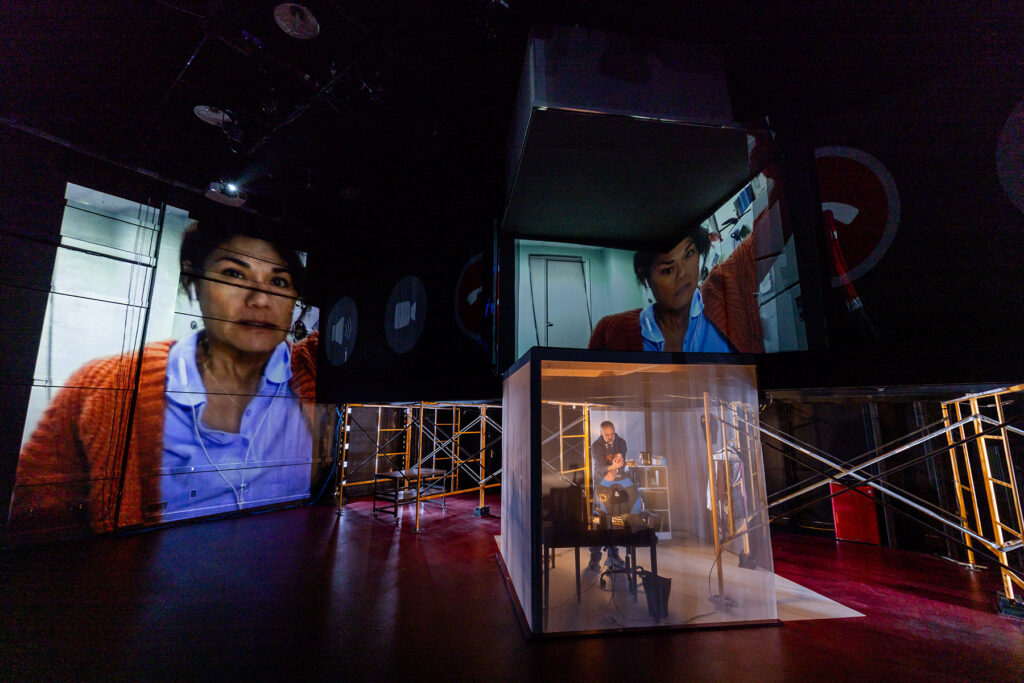
Celeste Oliva and Nael Nacer in The Moderate. Photo: Nile Scott Studios.
Presented by Central Square Theater
A Catalyst Collaborative@MIT Production
By Ken Urban
Directed by Jared Mezzocchi
February 5 – March 1, 2026
Central Square Theater
450 Massachusetts Avenue
Cambridge, MA 02139
Strobe and flashing lighting effects are used in this production.
Using the Motion Picture Association rating system, this production lands between R and NC-17 ratings for sexual content, violence, and mature themes including political terrorism and child abuse.
Article by Kitty Drexel
CAMBRIDGE, Mass. — Let’s begin with the end. In an interview with Playwright Ken Urban and Director and Multimedia Designer Jared Mezzocchi, I asked the duo what they hoped audiences would take away from their production of The Moderate (now playing at Central Square Theater). Urban said the play is a human story about a man struggling with his past. In doing so, he helps someone in the present. This is possible through Frank’s interactions online
Mezzocchi said he hopes audiences consider how their own internet use could be harmful and instead take a moment to reflect and look within themselves to find hope.
Hold on to Mezzocchi’s message of hope. You’ll need it.
Central Square Theater’s The Moderate is a swift departure from its usual, fluffier historical scripts about scientific advancement. It examines the internet’s darkest corners through the eyes of the social media moderators who save us from the internet’s most malicious netizens. The Moderate begins as a story about a guy who wants his family back. It blooms naturally into a psychological horror. These fictional content moderators witness the zenith and nadir of humanity’s behaviors. And lo, the internet is dark and full of horrors.
“It’s an ensemble-driven show that exemplifies and emphasizes isolation and loneliness. Even though there’s a group of people performing this story, we are only given access through one singular body in space who has no human connection until the very end.”
– Jared Mezzocchi in an interview on Feb. 3, 2026.
The play begins in 2020 during the COVID-19 lockdown. The public social sphere has crashed closed and forced people into their homes. Service jobs once outsourced to Asia returned to the U.S. with its more reliable internet infrastructure. In his home alone, Frank Bonner (Nael Nacer), a lonely man of few words, interviews with Martin (Greg Maraio) for an nebulously described internet gig over Zoom. Frank lost his service job at Kohl’s when we were ordered to shelter-in-place. Frank’s relationships with his estranged wife, Edyth (prodigal actor, Celeste Oliva, welcome back), and his teenage son have suffered due to Frank’s unemployment (among other reasons). So, Frank takes a job with Martin as a content moderator for the world’s largest social media company, which definitely isn’t Facebook. Frank feels grateful for the opportunity until the realities of his new career and the limits of its $15/hour pay settle in.
Not Facebook’s website says flagging is a tool that alerts its admins to potential violations of its community standards before they appear online. If the content is flagged, Frank and his colleagues are the folks who review it. You may recall that all social media during lockdown was a buzzing hive of unchecked human fear and desperation. Frank, his weary boss Martin, and activated social justice coworker Rayne (Jules Talbot, representing the queer community with whimsy and joy) witness a constant deluge of flagged content: same-sex couples, Blackface, and reproductive organs galore.
As his moderating takes an emotional and psychological toll, Frank stumbles upon the account of a boy (Sean Wendelken) who needs help. Against the advice of Martin and Rayne, Frank commits himself to giving help and opening himself to growth in the process.
To his credit, Urban presents Frank Bonner as a troubled but otherwise normal guy who’s found himself in unfamiliar territory. This is in no small part due to Nacer’s expertise. In lesser hands, Frank might be a broke loser to whom self-reflection is an ineffable concept. Nacer grants Frank just enough depth that Frank’s eventual final-act emotional growth spurt is believable.
In a scene between Frank and a troubled youth, Frank digs deep within himself to feel true empathy for a young stranger. Previously, Frank identified strongly with the youth’s problems. In this scene, we find that Frank’s concern is purely for the young man. While touching, this scene gives off “very special episode” vibes that are incongruent with the rest of the production. We aren’t given enough hints about Frank’s evolution into this selfless father figure. We know he’s a father; we know he’s capable of sympathy; but we’re surprised by his actions when he hasn’t been motivated into action before.
So, it’s entirely reasonable that his wife, Edyth, played with impeccable skepticism by Celeste Oliva, has wiped her hands of this unmoveable manchild. With a cold, silent marriage like theirs, we can’t blame Edyth for seeking strange comfort through Zoom dating.
Nacer is supported by strong performances from Maraio and Talbot. Their work pulls necessary empathy from their audience. They show us their characters’ brave faces in public Zoom meetings while expressing their characters’ raw off-camera grief. Extra kudos to Talbot for flying the queer, poly flag with dignity.
NETG does not critique youths still growing in their craft. Youngblood Wendelken should know his work is valuable to the production. There is a place for you in the Boston theatre community.
“It’s really important to be in Frank’s psychological spaces, to see the things that he is seeing. It reflects back to why the play is set during the pandemic. Our lives became like content moderators when we were at home (especially during the 2020 election). The flood of images we were inundated with on Facebook, Twitter, and other social media. We had to decide what was true, what was false.”
– Ken Urban in an interview.
To create the online and offline communities of The Moderate, Mezzocchi, Emery Frost, assistant projections designer, and Sibyl Wickersheimer, scenic designer, erected a bi-level set that functions as both a human terrarium and the screens for the show’s projected Zoom calls and social media content. Audience members are confronted with Frank (Nacer) tapping away at his keyboard from within a centerstage cube upon entering the theatre space. A live feed simultaneously projects a negative image of Nacer onto stageleft and right scrims mounted to the set’s second level. Video projection displays on the scrims and advances to the theater walls. What begins as a classic use of a theater blackbox quickly evolves into a visual spectacle that envelops the audience from all sides.
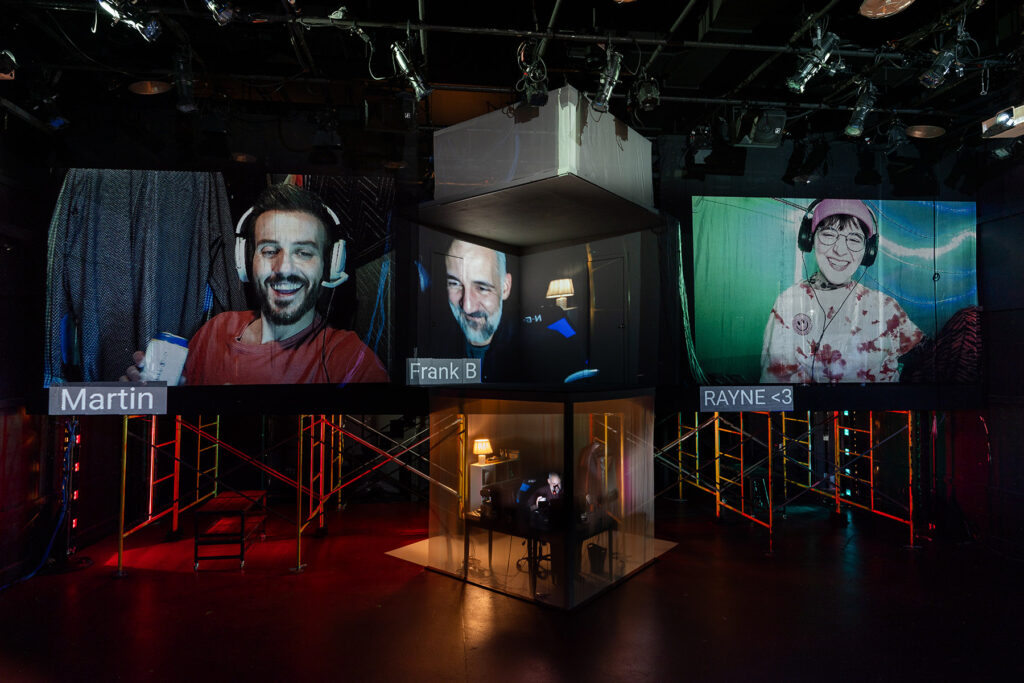
Greg Maraio, Nael Nacer, and Jules Talbot in The Moderate. Photo: Nile Scott Studios.
This is how we consume The Moderate. We are three places at once: in the world of the show, in the online world of the show, and in the Central Square Theater audience. These places expand and contract at the whim of the creators. We see what they want us to see, just like a social media algorithm, just like the moderators on Not Facebook. The Matrix has us. The Master Control Program has placed us on the Game Grid. Hack the planet.
Per the colloquial, the best parts of the internet have two things: Cats and Boobs. The Moderate, a show about the emotionally and physically traumatic parts of the internet, also has cats and boobs. But, because Urban and Mezzocchi don’t have the time to slowly introduce us to the internet’s worst content, they tear the band-aid off immediately. The fun parts of the internet still exist, but they are joined by blatant bigotry. And murder. And torture. And rape. And children. While the moderators do their work, shmoes like the rest of us rest safe in our homes, pretending the darknet and its horrors don’t exist.
Frank “is not an expert in the field. He’s a new user. I find that one of the most compelling elements of this piece. We very quickly saddle up with him, because none of us understands this topic. We watch him become desensitized, and we do as well.” – Jared Mezzocchi in an interview.
Urban and Mezzocchi represent the internet to fearsome effect. In true cultural form, we see and hear a range of triggering content we didn’t expect to see. We’re shown depressing dick picks* and racist memes. The sound design by Christian Frederickson and Susan Eyring puts unsavory tracks in our ears. Using a host of gutsy local actors, Urban and Mezzocchi approximate the horrible content posted online. It is fictional, and it is disturbing.
CST’s website says, “All photos and videos for The Moderate were sourced from publicly available internet content, private collections with express permission, or filmed by the creative team in a safe, controlled environment with professionally trained actors and, when applicable, a combat/violence choreographer.”
The multimedia, sound, and lighting design work together almost too well. Despite The Moderate’s content warnings, despite it being a work of fiction, this play caused fear responses in our audience on Wednesday night. My own date loudly urged me to look away from the stage during an intense section that alludes to grievous animal harm. They weren’t the only person to loudly voice their concern. Many patrons were concerned about what they might see in the moment. A decent person should be.
“There’s a kind of techno-utopian narrative that algorithms will eventually be so smart they can do everything, but I don’t think it’s so. The people I worked with in the field don’t think that. There will be someone who’ll need to be able to be like, this graphic image is documentation of the war crime, and so it should stay on social media… An algorithm can’t tell the difference.” – Ken Urban in an interview.
On the one hand, it’s impressive how believable The Moderate’s mediascape is. On the other, Western theatre has worked for decades to convince creators that it is unnecessary to traumatize an audience to tell a story well. Yes. Yet, this play tells the story of folks who brave Epstein’s Rape Island-level horrors** to keep our unconsenting eyes blissfully ignorant. Seeing what they see is mandatory to the production. But, how much traumatic content is enough to tell the story effectively?
Both Urban and Mezzocchi are protective of the moderators they’re representing, and of the story they tell in this play. Their playbill notes say that the work moderators do isn’t inherently traumatic. Be that as it may, they seem more concerned with authentic storytelling than preventing audience harm. In a perfect world, this play would do both.
We, the novice audience, flow through Frank’s moderation cue with him. Trauma is part of the late-stage capitalist, power-hungry, dopamine-deficient ecosphere afterall. Anyone who’s received an unsolicited dick pic knows that the internet is a creepy place with boundary issues. Trauma isn’t a glitch; it’s a feature. But there are ways to minimize trauma. I argue that this production doesn’t do enough of that. It does stoke empathy for Frank. It shows what social media moderation entails through immersive multimedia theatre craft. But it could better protect its audience members. Statistically, I, a survivor of sexual violence, am more likely to sit near a fellow survivor than not. We signed up for a theatrical experience, not a trip down PTSD Lane.
That being said, I urge all potential attendees to read CST’s content transparency statement. Many theaters post content warnings for their patrons. Sometimes those statements are stronger than the content in a production. Frequent theatregoers become inured to the warnings. This is not the case for The Moderate. Please heed CST’s warnings. They are there for your protection.
“To me, the internet is simply a pipeline to our personal sense of self.” – Jared Mezzocchi
Make no mistake, The Moderate is a well-told story with all the bells and whistles of a successfully immersive production. Its circumstances are fiction, but the stakes are real. Survivors of abuse walk among us. This is a great production with sturdy bones and plenty of flash. But this show isn’t for everyone. I advise patrons to be mindful of their mental health.
*Men, talk to your friends about posting their unsolicited dicks on social media. To coin the late, great Catherine O’Hara as Moira Rose in Schitt’s Creek, “What have I told you about putting your body on the internet? Never, never without proper lighting!”
**Donald Trump raped little girls, and he’s still the president. Vote the pedophile protectors out.