
From the “Masquerade” Facebook Page.
Masquerade NYC presented by LW Entertainment
Based on The Phantom of the Opera by Andrew Lloyd Webber
Loosely based on the novel by historical hottie Gaston Leroux
Lyrics by Charles Hart and Richard Stilgoe
Book by Richard Stilgoe and Andrew Lloyd Webber
Directed by Diane Paulus
Additional cast and crew credits
https://www.instagram.com/masqueradenyc
Now through February 1, 2026.
Performed at 218 W 57th Street, NY 10019
Critique by Kitty Drexel
10/01/2025 Update: The critique now contains personal photos.
NEW YORK: In March 2025, cryptic messages from The Phantom of the Opera popped up across the internet asking his fans if they missed him. We did. In June 2025, Masquerade established its presence on social media. On June 30, tickets became available on the MasqueradeNYC website. They sold out in hours. When I didn’t snag a ticket during the first sold-out sales event, I theorized the show’s instant popularity would inspire an extension. Producers are horny for cold, hard cash and won’t turn down more if it’s assured. It turns out I was right about my prediction. On July 9, an email advertising the production’s extension was sent to subscribers.
After paying an egregious amount for tickets in July, I added my name to the Phantom’s “visitor ledger” by buying a ticket for Sept. 17, 7:30 PM. I nearly wet myself with excitement planning my arrival at the not-so-secret venue on a public street, to speak the secret password for entrance into the Phantom’s lair, and to give myself over to the Music of the Night.
A little backstory. Like so many hormonal teens with only their sanitized high school theatre department shows as an outlet, I was obsessed with melodramatic musicals. We didn’t have the money at home for multi-cassette tape cast album recordings, so a family friend let me borrow her Cats cassettes. The first of many albums to play constantly in my childhood bedroom. My parents may have never forgiven her.
I played those tapes until their innards were bald, and only gave them back after my parents made me. It was a small skip and a jump to The Highlights of Phantom cassette album. I thought Andrew Lloyd Webber was high opera! I wanted to become Sarah Brightman! I wouldn’t think differently for at least 7 years when I started voice lessons with a Berklee alum voice teacher. My education expanded to include Mozart, Puccini, Sondheim, and Tesori, but my love for ALW’s Phantom has stood the test of time.
I count myself as one of the Phantom phandom’s unhinged but not completely drunk on the Kool-Aid denizens. I saw the NYC production at the Majestic Theater many years before it closed in 2023. I paid good money to see it at His Majesty’s Theatre in London (twice, on separate trips). I saw the disastrous 2004 Joel Schumacher movie in the theater four freaking times (What can I say, I was going through some stuff.), and still have three of the ticket stubs somewhere. I owned the Schumacher DVD until shame made me donate it. I continuously played that disastrous movie’s soundtrack CD (to my housemates’ horror) from when I awoke in the morning until I went to sleep at night for months.
During lockdown, I donated to a Broadway nonprofit to receive a Phantom mask. Multiple Phantom books and scores still adorn my library. I attend the touring production when it comes to Boston, even though the story never changes, and the choreography is reliably bad.
I’ve even flirted heavily with an infatuation with Love Never Dies, the unnecessary Phantom sequel, because I just can’t quit these characters. I own the DVD of the sequel… and the novel dramatization of the sequel. I’ve read Phantom and LND fanfic on AO3 and professional smut for Kindle. I even wrote a HowlRound critique about LND’s erasure of Coney Island’s disabled community based on the touring production. I see the Phantom universe’s blatant inconsistencies, and I don’t care.
She who doesn’t worship at the altar of at least one cult classic may cast the first stone.
All of this is to prove that I’ve not only rolled around in the burning compost heap that is ALW’s Phantom universe, I also regularly dive back in for my own unabashed jollies. There are no guilty pleasures here, only unabashed pleasures. It is possible to enjoy the finest theatre the world has to offer and to steep deliciously in the people’s entertainment. Mozart and Shakespeare wrote for the plebs, too.
Yet. I’m well aware that Phantom is not a good musical. ALW’s adaptation is poorly adapted, written, and scored. It is melodramatic and in appallingly bad taste. ALW hasn’t had an original idea he didn’t steal in decades. BUT. Its songs are hella catchy and make a good car or shower sing-along. Albeit stunted, the musical is emotionally and psychologically accessible to anyone who can buy a ticket. It shows us how love triumphs over untreated mental illness in an opera house (which, if you’ve ever sung opera, you know this is pure fantasy). The musicians onstage and in the pit are always of a superb caliber. Its technical stage elements astound even when its direction sucks unwashed, hairy bollocks.
I love Phantom for how it makes me feel; it gives all of my murky, dark and romantic sentiments an outlet. Mommy doesn’t see flaws; she sees potential.
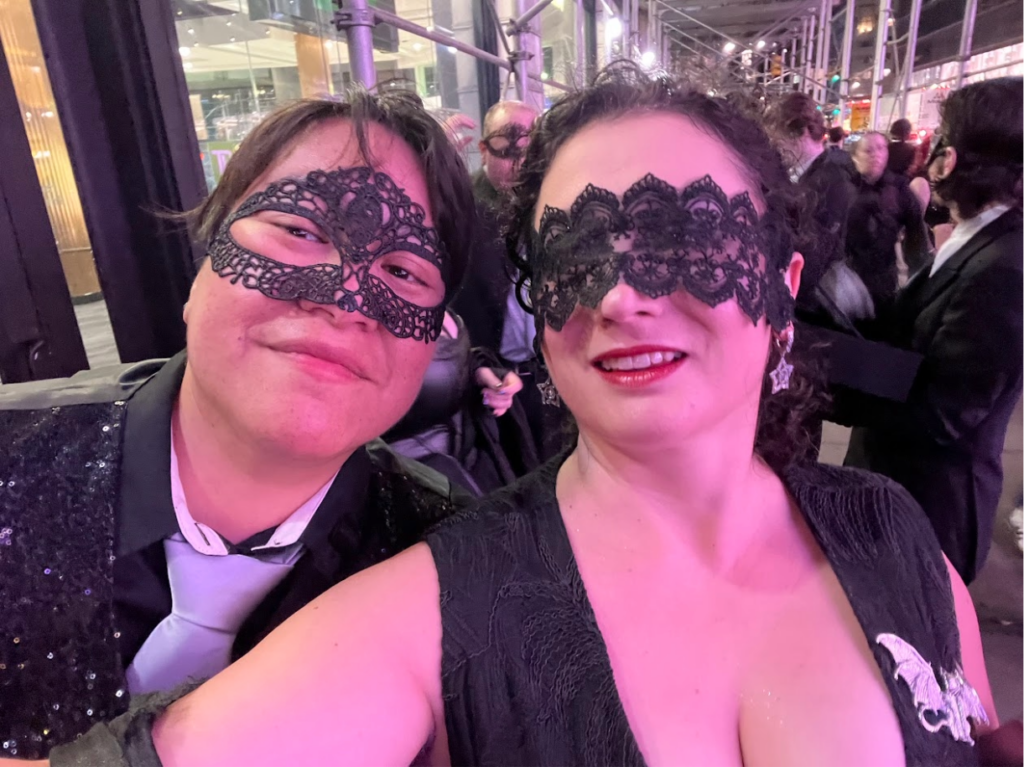
In line with hawt date, password given, waiting.
 The Masquerade website gives explicit instructions to its attendees. Its instructions read: “Hide your face” (wear a mask but not half mask like the Phantom), “Dress the part” (Black, white, or silver formal or cocktail attire is required), “Your Password is your ticket” (you must give a password to the attendant in line before the show), and “Do not be late.” In line, attendees learned that these instructions were mere guidelines. One patron wore jeans. Staff held the house an extra 15 minutes for late attendees. It appears even the Phantom knows enough to wait for and accommodate paying patrons.
After buying my tickets in July, I found a fancy dress giving lots of cleavage, bought train tickets, reserved a hotel room, invited my hawt date, and made a plan. As much as I love Phantom, I also love a dress code, a challenge, and a deadline. Masquerade or bust!
Fast forward several months later: My hawt date and I boarded an early morning Acela train on Sept. 17 from Boston to Penn Station. We had our slick outfits packed, our toiletries stowed, and our Masquerade password memorized (there are no physical tickets as there are no reserved seats) for the show that evening. We were prepared for over-the-top intrigue and hyperbolic murder.
Masquerade isn’t performed in a traditional theatre. Patrons are given an address and limited instructions. The production’s location sits down the street from Carnegie Hall and across from a Nordstrom. Even if you can’t find the exact street number, the long line of masked attendees in black, white, and silver down a red carpet gives it away. Theatre staff and security in black suits check bags, take passwords, and place stickers over cell phone cameras. Despite the secretive instructions given to ticket holders, it was obvious to anyone who’s ever attended a New York City theatre production from two blocks away that this was the line for Masquerade. I was worried we’d be late. I shouldn’t have been. The theatre always holds for five.
Once inside, we walked down a dark hallway so narrow that we and other patrons had to walk single-file to the coatroom. There, coatroom staff informed us we had to check all bags and purses. My date checked their crossbody cell phone bag, and I checked my tiny clutch. I didn’t have pockets, so checking my purse meant I checked my cell phone, lipstick, and ID, too. I felt like director Diane Paulus was amputating my right hand. Camera sticker or not, what are modern humans without their phones? It turned out that this was a boon and not the hassle we thought it would be. We’d need our hands to hold railings and seek out foreign entities in the haze. If we dropped something, it would take staff intervention to find it on the floor.
The ambient lighting for Masquerade is dark. The halls are dark; the performance spaces are dark; the stairs are dark and sometimes uneven; the bar is dark. It’s all purposefully lit to feel like we’re underground in the lair or backstage during an opera house performance. It’s so dark that the few lights hung in corners will blind a person momentarily if they come across it unawares. But, we patrons weren’t underground or backstage. We were wandering the halls of a two-story found performance space that was designed to be disconcerting to attendees. We are meant to rely on the theatre staff to guide us. Persons who do not enjoy enclosed spaces or touching strangers may want to skip this show.
The MasqueradeNYC website says that this production is accessible to disabled users, but I’m not convinced they considered disabled people when they designed it, only the limitations of the law. Persons with panic disorders, low visibility, or sensitivity to bright lights or loud noises will have a difficult time traversing the show’s pathways, even if these folks are granted a personal escort. The narrow walkways and several levels of stairs make using a mobility device difficult. There are escalators (used to fantastical effect during Christine’s journey to the Phantom’s lair), but they aren’t always on. There must be elevators, but they weren’t obvious.
Masquerade may be technically accessible and ADA compliant, but it felt to this disabled attendee that compliance was an afterthought and adhered to for legal reasons and not a planned part of the process. It’s like the difference between a conscientiously designed accessible restroom vs the singular “accessible” basement restroom that won’t even accommodate a standard wheelchair. You can’t sue, but you won’t be returning either.
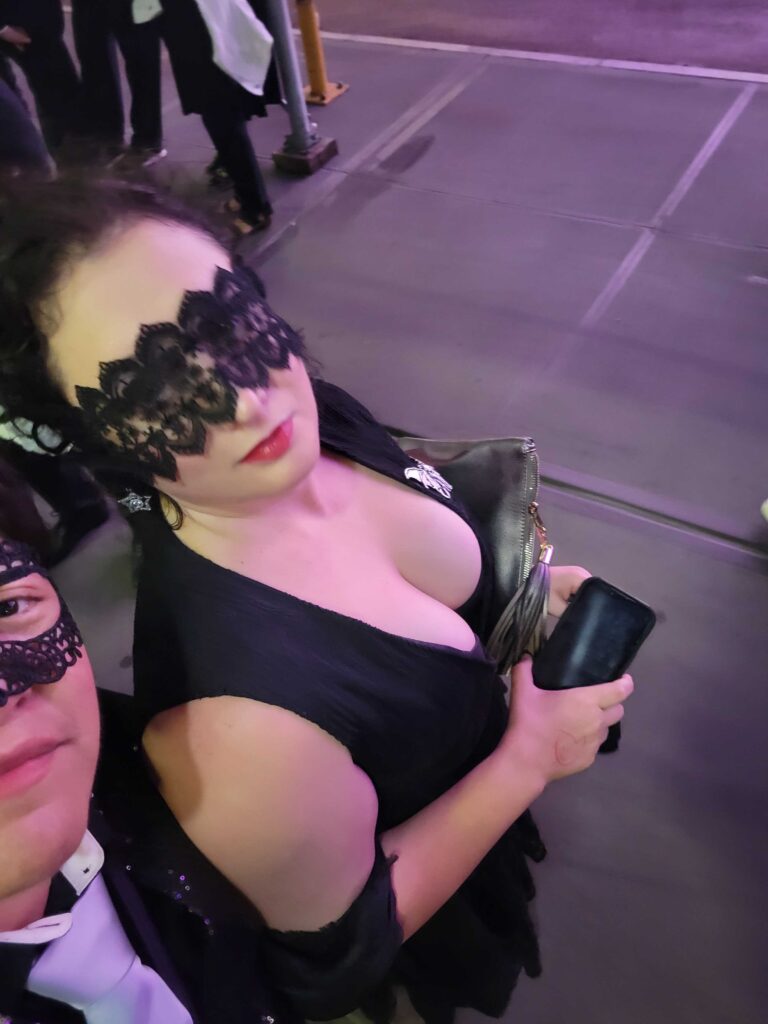
Excuse me, my mask is up here. My phone is down there.
Back to the show. Once we acclimated to the dark, we attendees trickled into a fancy waiting room and handed a glass of sparkling wine while a live violinist (Gustave Daaé, who is uncredited in the program) played the Phantom “Overture.” Some folks downed their beverage right away. We knew enough about fancy dress parties to understand this serving was intended for a toast.
And lo, this explains why Masquerade, with a few matinee exceptions, is 21+: alcohol. (One self-identifies as 21+ when purchasing tickets). A nonalcoholic option is available, but I imagine the show is kept 21+ to avoid liabilities. It’s too dark for staff to check IDs. They can’t accidentally serve alcohol to a minor if no minors are present.
When the time was right and Gustave Daaé finished his set, we were led through a side door – the first of many that evening – to a backstage room where Madame Giry (an under-utilized Betsy Morgan who commanded our attention and the room) joined us in a toast to the Opera House. Then she taught us some simple dance moves (think advanced Zumba) to the chorus of the ensemble song and dance number, “Masquerade,” in the next room. Friends, enemies, and distinguished Others, we were off.
For the next few hours, we would meet Meg (Kaley Ann Voorhees), Carlotta (a strikingly glamorous Santomi Hofmann), Piangi (Phumzile Sojola), Bouquet (Jacob Lacopo), Raoul (Paul Adam Schaefer, who is tall), Christine (Francesca Mehrotta, a fellow BoCo alum who performed her role with a brilliant, bell-like soprano and childlike doe eyes), and our grand host Erik, aka The Phantom of the Opera (Hugh Panaro, in glorious voice and murderous personage) in reordered, restaged, reinvented scenes from Andrew Lloyd Webber’s, The Phantom of the Opera.
The experience takes about 2.5 hours, give or take 40 minutes if you stay for cocktails at the Phantom’s decadently gloomy speakeasy at the end. It was both the best Phantom experience I’ve ever had and the cheesiest. It was the fantastical, wet, fever dream of my wildest PG-13 LARP imaginings and deeply, unimaginatively stupid. I laughed for the wrong reasons and cooed for the right ones. I’d never shell out this much money for a New York show again, but if I were already in the city, I’d kick my beloved sibling in the taint with steal tipped boots while my sickly mother watched for a ticket. I had an awesome time. If you love a heaping serving of touristy “what the fuck?” with your transcendent musical experience, this show is for you.
From that point on, we were firmly living in the world of Masquerade. The cast were their characters, we were honored opera house guests, and the theatre staff were opera house were as apparitions guiding us from between the realms. We all transcended time and place; it was an adult game of pretend, and everyone was invested to glorious and silly effect.
After the epic, immersive performance of “Masquerade,” we were ushered into a larger space and watched as musical’s narrative met the original show’s formal beginning: We meet Carlotta, see her begin “Think of Me” before scenery almost conks her head; Christine steps forward to replace Carlotta at Madame Giry’s insistence; oblivious himbo extraordinaire Raoul recognizes her; and the Phantom sings his titillating “Brava!” to Christine (and all of us with a Phantom kink swooned in response). The audience stood in the center of the room while the cast moved set pieces, sang, and showed us where to look. Between solos, the ensemble engaged us in snippets of dialogue. (Bouquet asked me if I’d heard of the Opera Ghost. I said yes. It was fun and a ‘lil sexy.)
When the Phantom whisked Christine away to his lair after her triumphant performance, we followed them down through a thick fog as they sang “The Phantom of the Opera.” When she passed out on a plush, round navy bed in his lair, we might have giggled at the sexual innuendo. But, as she imagined the Phantom in a brief scene depicting her sexual awakening, I laughed out loud as the Phantom pushed his head between two pillows (from backstage, behind the bed) so his face was cradled in satin next to her lounging body. It looked like the bed was pregnant and the Phantom’s head was crowning. Not hawt. I’m not going to spoil any more silliness, but this was the first of many moments when the direction team could’ve used the insights of one hormonal teenager… Or anyone with an active sex drive.
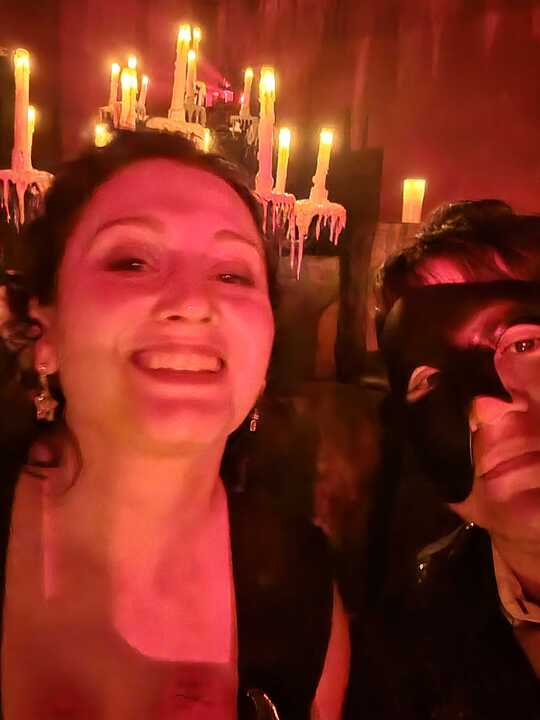
At the speakeasy, three drinks in.
To be serious for a moment, Diana Paulus’ adaptation of ALW’s Phantom uses all of the music and incorporates most of the scenes from the original stage version. It gets creative with some of the show’s trickiest environments, such as the Phantom’s lair, which exists down an aforementioned escalator and through a soup-like haze. Some of the musical’s backstage shenanigans occur in front of us out of necessity: Madam Giry scolds her ballet corps on the floor while the Opera House’s new managers, Firmin (Jeremy Stolle) and Andre (Raymond J Lee), chat with Carlotta on platforms above us. Later, when Bouquet and Phantom duel, the audience is seated on risers to watch the men leap between rafters high to simulate their confrontation high above the opera’s stage.
(Reader, this is when I started drinking in earnest, and my writing goes down a gently rolling hill. (I’d been drinking the entire time to write this review (and heavily (for me) after the performance). Please believe me when I say treat this heavily machinated musical with the severity it deserves, inebriation and all. I could’ve been far more sloshed and still been within the appropriate bounds of propriety for this particular show’s critique. Cough.))
Some scenes are out of order to accommodate Masquerade’s narrative, but the show is still understandable. Masquerade also includes new scenes not from the musical, which are borrowed from the dastardly Schumacher movie. The worst of which is Madam Giry’s solo, “Learn to Be Lonely,” which Minnie Driver sings with more charm than it deserves on the Schumacher movie’s soundtrack. Betsy Morgan sings it beautifully, like a lullaby to – I shit you not – the character entitled Boy in the Cage (Kody Jauron). Tell me you hate a character without telling me, Jeez. The kid has been through enough. Give him a name.
This character is named Boy in the Cage because we meet him during Giry’s carnival flashback, and he is wearing a burlap sack mask and trapped in a cage. It’s the scene from the movie depicting Giry’s introduction to an enslaved white child, the boy who becomes the titular Phantom. The carnival scene from the 2004 movie expands in Masquerade to include a fire breather, a human blockhead, contortionists, and a few other performers (Rawb Lane, Laura Lee Anderson, Anna Monoxide) led by the Barker (Chris Ryan). After some impressive feats by the carnival performers, Boy in the Cage is wheeled to the center by the Barker who asks us if we want to see the beast. It’s a rhetorical question; he was always going to show us.
After some acrobatics which were cool but not as cool as the firebreather, Boy in the Cage escapes with Giry. She sings “Learn to Be Lonely,” ALW’s weird-ass song about being your own best friend because no one loves an uggo, to the kid and abandons him in the basement of the opera house. There’s a whole male loneliness epidemic, and Giry is out there doing the Lord’s* work by enforcing it. The rest of Masquerade follows ALW’s original musical faithfully to the end with some fun narrative spins that I won’t spoil.
As fun as Masquerade is to ridicule, its technical elements are top-notch. The show’s scenic design is crafted to deliver gothic dungeon romance. In every corner, there’s a niche displaying opera house set pieces, props and costumes. The Phantom’s lair has sheet music, personal affects, drying flowers and nicknacks. Even the bar is beset with electric candelabras and other aesthetic choices reminiscent of an underground tortured-man cave. You could forget that the outside world existed for a short while. – But not in the chapel. That area looks like someone got fired before they were finished dressing the set.
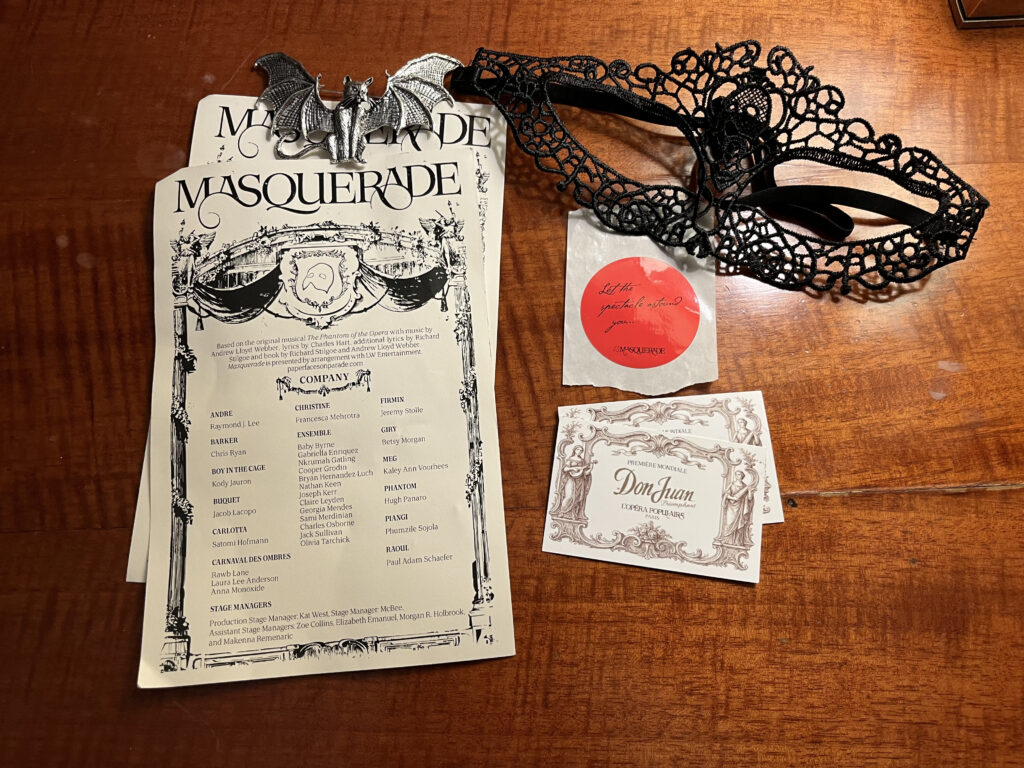
Souvenirs: my winged cat brooch, a “Masquerade” mask, a camera sticker, tickets to “Don Juan Triumphant,” and playbills for our entry time.
Pee before you go. There are obvious bathrooms before the show and directly after. Otherwise, the production is fast-paced, and there isn’t a proper intermission to find a bathroom.
After all of this, the good, the bad, the odd, and the cheesy, I’d totally pay money to see this show again… If I had an extra $275, a free trip to NYC, and no bills to pay. The best part of the experience for me was being physically taken by the hand by the Phantom (Panaro) and led by our deeply flawed, marginally unattractive by today’s standards hero from one scene into another. For one unforgettable moment, I was Christine. It was brief, but still a dream come true. Heaving bosoms and all. I may forget all other aspects of the production, but the moment Erik came to my side, looked me in the eye, took my hand, and swiftly walked me out the open door I will remember forever. He could have walked off a cliff, and I… wouldn’t have followed him over, but I’d at least think about it. I think about it real hard. (Hey-O! That’s what I said.)
Masquerade NYC implies that this production is a trial run for other locations, should the NYC tryout prove successful (aka fiscally lucrative and popular on social media). Gird your loins and tighten your masks, a London location may be imminent if Phantom ever closes in the West End. Or if Cameron Mackintosh loosens the rights to produce Phantom in London, other locations. Keep your fingers, your legs, and anything else crossed.
*God? Satan? Of the Rings? Who knows.