Beyoncé Martinez and Rachel Hall. Photo by Annielly Camargo.
Presented by Company One in collaboration with Front Porch Arts Collective
and the City of Boston Office of Arts and Culture
A new play by B. Elle Borders
Directed by Summer L. Williams
Dramaturgy by afrikah selah & Ilana M Brownstein
Music by Allyssa Jones
July 18 – August 9, 2025
The Strand Theatre
543 Columbia Rd
Dorchester, MA 02125
Critique by Kitty Drexel
“Until we know who we are and where we’ve been, we cannot know where we’re going.”
– B. Elle Borders in “Stories As Conduit: An Interview with The Meeting Tree Playwright B. Elle Borders” by afrikah selah.
DORCHESTER, Mass. — Elle Borders’ The Meeting Tree is a collaboration between Company One and the Front Porch Arts Collective. These two companies have such similar missions of community building that this joint production is bound to succeed. The play runs through August 9 at Dorchester’s Strand Theatre.
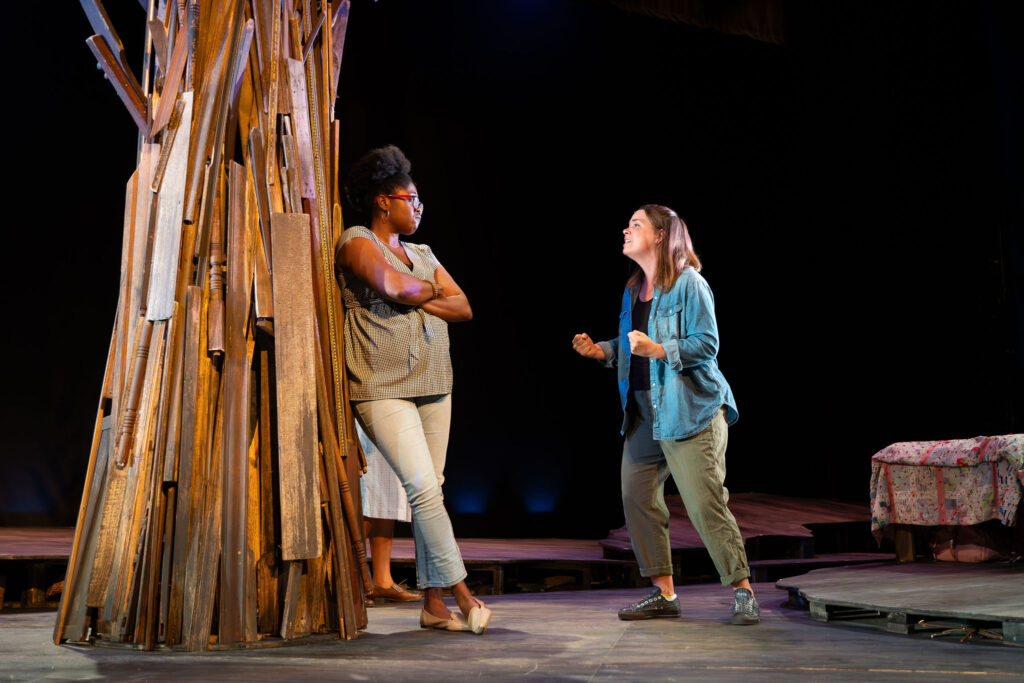
The Meeting Tree tells the story of Black lawyer Sofia Langton (Anjie Parker, is here to kick ass and take names. She’s all out of names.), who describes herself as pregnant, haunted, and feeling crazy enough to disrupt the peace of Alison Browning (Sarah Elizabeth Bedard), a white environmentalist currently occupying the Alabama farm where Sofia’s ancestors were once enslaved. Sofia is determined to find proof that the farm was left to her grandmother, Dixie Mae Montclair (Beyoncé Martinez), and to mend the wound that fractured her family tree before Sofia brings her unborn baby into the world.
The Meeting Tree is told through three generations of Black and white women bound together by an over-sexed patriarch who helped himself to the bodies of the women in his household. But this play isn’t about a slave-owning rapist. It’s about the women who survived and led their daughters into the future. Despite their impoverished circumstances in the deep South, Katherine “Kitty” Montclair (Jacqui Parker, a calm during the storm) raised Dixie Mae with love, kindness, and family lore. Simultaneously, Elizabeth “Grand-mere” Montclair (Alex Alexander, the storm) raised her granddaughter, Tessie Montclair (Rachel Hall), with impatience at an arm’s distance. In turn, Dixie Mae raised her granddaughter, Sofia, with love and more family lore. Tessie’s rebellious spirit paved the way for her niece, Alison Browning’s, freedom.
The white women lived in a big house at the front of the farm. The Black women lived in a cabin behind the farm. When it came time to discuss the actions of the man who bound them together, the second and fourth generations of each family met at a pecan tree between the homes. It’s at this tall, aged tree of nooks and crannies designed by Cristina Todesco where Dixie and Tessie, two girls craving friendship and some wholesome trouble, meet for the first time. It’s also where the sixth generation living in our current timeline, Sofia and Alison, finally resolve the family drama between them.
Playwright B. Elle Borders unfolds the character relationships and the events of the play more naturally and with greater panache than I do here. In fact, The Meeting Tree is a perfect 75-minute play that packs significant national historical lore and modern race relations, such as the continued generational impact of slavery on split family trees, as its core themes. It does this while showing its audience the very real racist blind spots between white feminists and intersectional feminists: Alison karens herself out by calling the cops on Sofia for arguing in Alison’s vicinity. Tessie invites Dixie into her white home at a time when that could get a Black girl murdered… or worse.
Anjie Parker and Sarah Elizabeth Bedard. Photo by Annielly Camargo.
As we speak, the current billionaire, white supremacist Presidential Administration is dismantling federally funded resources that keep many American citizens out of abject poverty. In light of cruel and unusual human rights violations (such as forcing detainees into holding rooms without beds that smell like feces), the rest of this article is a condensed list of The Meeting Tree’s awesomeness.
- The Meeting Tree has Fried Green Tomatoes vibes.
- Amanda Mujica, costume designer, allows the play’s characters to travel through time. We know their relationship to the land based on their shoes: mental vs physical labor, appearance vs function. It’s subtle unless you know what to look for.
- With director Williams’ guidance, the cast tells one Hell of a story of an absorbing story.
- To the amazement of this critic, Martinez used her prop glasses to transform child Dixie into Grandma Dixie. Upon placing the glasses on her nose, Martinez shifted her shoulders and settled into her body to age 40+ years before our eyes. It was a beautiful, blink-and-you-miss-it display of physical acting technique using a simple prop. Brava!
- Bedard plays Alison as a Karen who is thoroughly unaware of her biases. It’s hilarious because it’s so true. That can’t be easy for Bedard to play, or for the Black members of the cast to witness. Thank you for your resiliency.
- The Meeting Tree discusses the arbitrary rules of racism, white guilt and entitlement, and intergenerational trauma caused by all three. Some moments are hard to watch because history shows how it all ends: not well. Take care of yourself.
- This play is the perfect length and cast size to tour schools or to pitch to elementary and high schools as educational material.
For more on the intended social impact of this play, please check out the thoughtful, thorough dramaturgy of afrikah selah and Ilana M Brownstein. There is an intimate interview conducted by selah with the playwright in the playbill, a play timeline with historical context, a Montclair family tree, and explanations of the C1 and Boston Public Library narrative resources available to patrons to construct their own family story. Company One, per its mission statement, seeks to “amplify the essential need to face our uncomfortable, shared American histories — to build common ground, foster solidarity, and cultivate restorative practices for a vibrant, more just future.” These resources do that work and more.