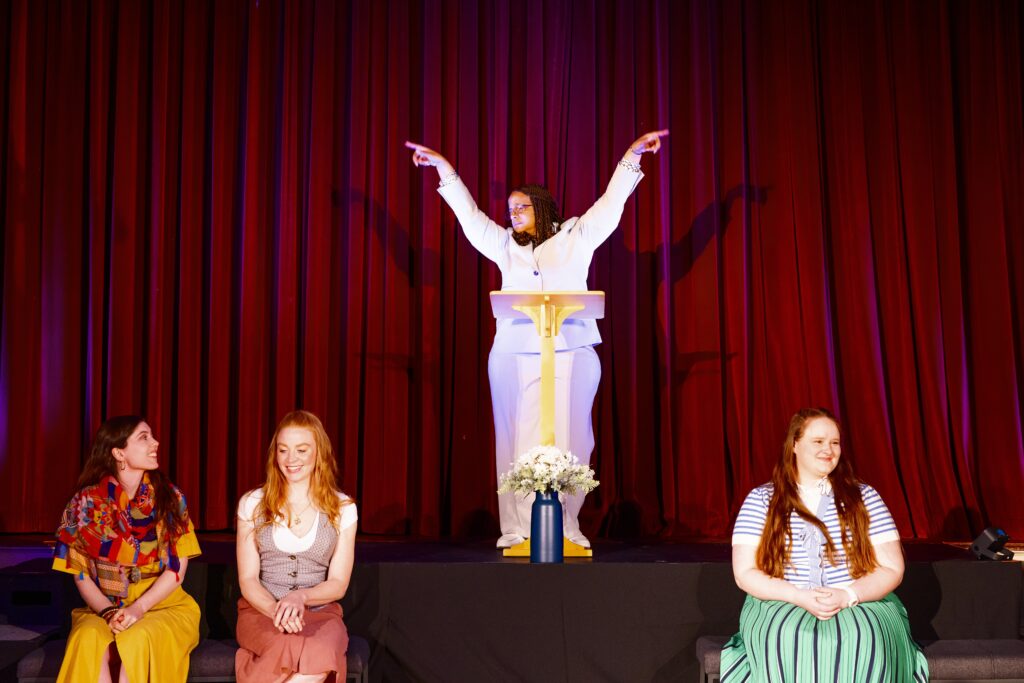
The cast. Photo by Jason Grow.
Presented by Lanes Coven Theater Company
By Young Jean Lee
Directed by Justin Genna
Featuring: Alex Highsmith, Lily Narbonne, Cheryl D. Singleton, Hannah Young
April 24 – May 10
American Legion Post 3
8 Washington Street
Gloucester, MA 01930
Review by Maegan Clearwood
GLOUCESTER, Mass. – Church opens in emptiness: a lone voice carries over the audiences’ heads from behind, a familiar diatribe about ego and earthly trivialities. The American Legion hall is dark, a lectern ironically unoccupied as the disembodied sermon goes on and on and on. But Church ends in light, sound, frenetic movement – a smorgasbord for the senses, worlds apart from the solemnity of its beginning.
Young Jean Lee’s experience (“play” isn’t quite the right word), produced by Lanes Coven Theater Company, is 80 minutes straight of one subversion after another. Lee latches onto a trope of Evangelical Christianity; she plays it honestly, unironically, passionately, and then mashes it up with a heaping dose of absurdism and song; and by the end, the trope is utterly unrecognizable from its point of origin.
Sometimes this formula illuminates layers of spiritual profundity, buried beneath familiar Evangelical talking points; other times, the result is just plain weird.
This Lanes Coven production, directed by Justin Genna, seeks truth in every word of this twisty-turny script. Even as Reverend Alex (played by Alex Highsmith) testifies about her sinful days of multicolor drug-filled benders, she is utterly sincere, encouraging the audience to empathize with this bizarre spiritual awakening. When she, Reverend Hannah (Hannah Young) and Reverend Lily (Lily Narbonne) break into frenzied dance, even their most awkward poses appear filled with spirit.
The production is staged at The American Legion in Gloucester, adding another degree of verisimilitude. It feels like the kind of space that a small, scrappy congregation would borrow for services: spacious, but not grand; clean, but lived-in.
Lanes Coven goes notably off-script by casting a woman to play Reverend José, the fourth (and presumed leader) of the group. Typically, the ensemble’s gender imbalance speaks to another truth about Evangelical religion. Even as Reverend José preaches liberal values and points out patriarchal norms, the visual messaging is clear: men still get the final word.
In Lanes Coven’s production, this leading role is played by Cheryl D. Singleton. I appreciate the impetus behind this subversive casting choice, and it’s undeniably powerful to see four women in positions of religious authority. I do wonder what elements of storytelling were lost in this translation, however. When Reverends Hannah, Lily, and Alex dance barefoot, pastel skirts and long hair twirling around them, Reverend José sways in the center, stoic in her gray suit; the imagery is striking, but it doesn’t tell a story about power.
Lee developed the play in 2007 as a way to process her own upbringing in the evangelical church. Two decades later, evangelical Christianity has a chokehold in American politics: real, tangible, dangerous power. There’s political meat on this play’s bones, and I’m curious what this production could have looked like if it acknowledged these weightier implications.
Then again, I understand the desire for facilitating an idealized spiritual experience, something that transports audiences beyond the here-and-now. I’m not frustrated with Lanes Coven’s choice, but I’m curious about this missed potential.
Singleton embodies the role of Reverend José with quiet gravitas, rather than fire and brimstone. As a theoretical congregant, I liked this choice; as an audience member, however, I craved louder, bolder religious fervor that contrasted more with the other three reverends.
As a whole, the production isn’t afraid of being quiet. The first half of the play is heavy with sermons, only to pivot towards a full-blown concert at the end (helmed by a four-person band, uncredited, and supported by impeccable production design). The production leans into this tonal contrast, so that by the end, the sound and lights are almost overwhelming. I would have liked a touch more theatricality earlier on, to stay engaged during the minutes-long sermons — then again, what’s more realistic than getting a bit restless in church?
Like much of Lee’s work, Church is immersive, verging on performance art. It invites open-ended response and revels in the unexpected, so no one audience member’s experience will be the same. You kinda just have to be there.