Photo credit: Winslow Townson, courtesy of the BSO
Presented by Boston Symphony Orchestra in collaboration with Boston Lyric Opera
Music by Samuel Barber
Libretto by Gian Carlo Menotti
Conducted by Andris Nelsons
Staging coordination by Alexandra Dietrich
Tanglewood Festival Chorus: Betsy Burleigh, guest choral conductor
Boston Lyric Opera Chorus: Brett Hodgdon, chorus director
Boston Symphony Hall
Thursday, January 8, 2026
Saturday, January 10, 2026
301 Massachusetts Avenue
Boston, MA 02115
Online Playbill
Sung in English with supertitles
Critique by Kitty Drexel
BOSTON — This critique discusses the BLO & BSO concert production of Vanessa currently at Symphony Hall. As you read, please keep in mind several truths: The Corporation for Public Broadcasting Board, the private, nonprofit corporation created by Congress to steward the federal government’s investment in public broadcasting, voted to dissolve on January 5 after 58 years of American public service.
The President and his Secretary of War (lol) illegally kidnapped the Venezuelan President and his wife for oil, and Instagram hits.
A trained ICE mercenary murdered unarmed citizen Renee Nicole Good in Minnesota on January 7 when Good began driving her civilian vehicle away from an enforcement operation.
These things are not normal. Life under these circumstances, whether you agree with the media’s portrayal of them or not, is not normal.
During these unprecedented times under fascism, the BLO and the BSO are commended for their elegant production of Barber and Menotti’s Vanessa, a 1958 Pulitzer Prize-winning opera by two gay men, one an Italian immigrant. It was composed at a time when it was unthinkable (and frequently illegal) to be out, and Italians weren’t entirely white. Vanessa was a necessary distraction from the impending fall of democracy.
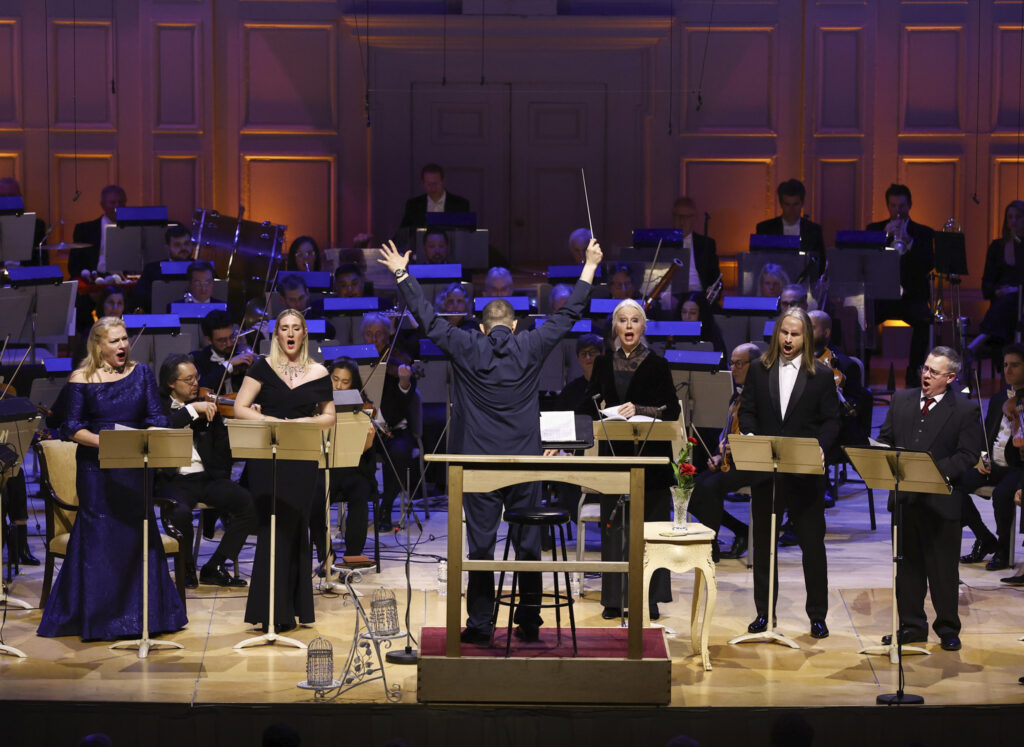
Vanessa’s story of gothic romance leads its audience on a multi-generational journey of powerless women, jilted lovers, unscrupulous courtship rituals, and even a dire chase across the countryside. It’s Great Expectations meets Wuthering Heights, but set in America. In it, Vanessa (Jennifer Holloway, whose powerful soprano voice communicated intense sincerity through the opera’s alternatively dire and hopeful moments) sits through a winter storm in her lonely mansion while she waits for the man she once loved to return to her, Anatol. After 20 years, she thinks her waiting is finally over. With Vanessa are her niece Erika (Samantha Hankey, who plays her role equal parts sweet and dire with a voice rife with passion) and her mother, the Old Baroness (Anne Sofie von Otter in indomitable form and voice).
A man arrives, but it is not Vanessa’s love. It is his son, conveniently also named Anatol (Ganson Salmon, whose voice is vibrant despite his reduced affect). Vanessa’s shock overwhelms her, and she runs away, bringing the Baroness with her. Erika is left alone with the young stranger, even though both maternal figures should know better. Anatol plies her with alcohol, and he coerces Erika, who has not been taught about men’s audacity, into spending the night with him. Coercion is rape.
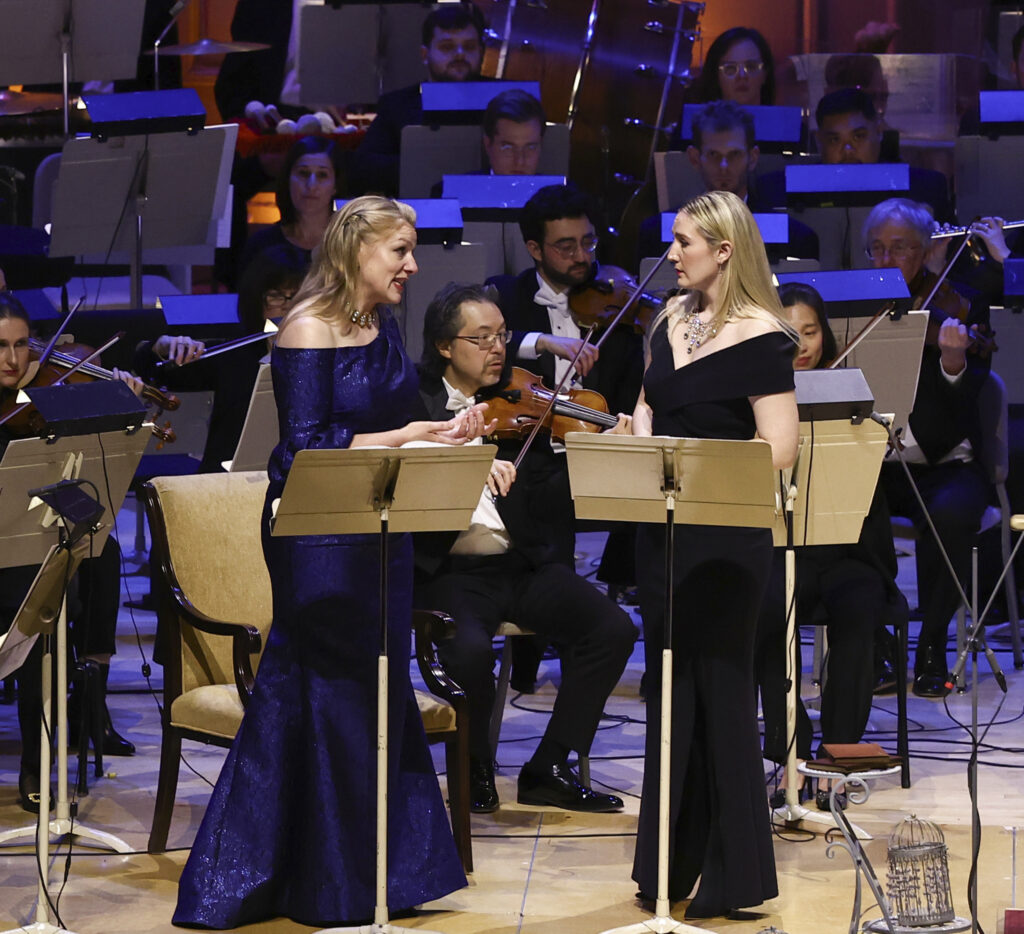
Flawless voices, flawless dressers. Holloway and Hankey are gorgeous. Photo credit: Winslow Townson, courtesy of the BSO.
Time passes. Erika admits to the Baroness that Anatol has asked her to marry him after their night of drunken fumbling. Erika said no because she thinks, despite never having a boyfriend, that she’s incapable of love. Thus begins a strange love triangle between Vanessa, Erika, and Anatol, a hustler so determined to marry into their family that he doesn’t care who he marries. (Given enough incentive, this desperate tramp would propose to the Baroness’s purebred puppy. Forget the “whole man.” Time to throw the whole lineage out.)
Patrick Carfizzi plays the irreverent Doctor, whose performance brings necessary levity to the production. Wei Wu plays the Major Domo. Alexandra Dietrich plays the silent role of Clara, a servant, and is credited as the staging coordinator. The cast is joined by both the BLO Opera Chorus and the Tanglewood Festival Chorus.
The lighting design supported the action on stage and in the orchestrations. As Erika and Anatol get to know each other, the walls of Symphony Hall were lit in rosy pink and blue. A willow tree gobo filled the stage with a dappled green during “Under the Willow Tree.” Act 2 began with red and blue lighting that looked like a sunset. These touches were frequently subtle but made big differences in how the audience received the performance.
Vanessa is performed as a concert with minimal props; it is not fully-staged like many of the BLO’s other productions. This may deter some audience members. In Barber, Menotti, and the BLO’s defence, Barber orchestrates much of the opera’s action into his score. We hear blustering winter winds, the loneliness of a long, dark night, and a church’s bells, among other things. This may not satisfy all attendees, but hopefully it satisfies folks on the fence and Barber/Menotti fans.
Opera singers are infamously proud of their volume control. As they should. We heard their gentle pianissimos and booming fortes effortlessly but unequally cut through the air of Symphony Hall. It is 2026. Opera’s audience has always been mature, and some audience members wear hearing aids. So, when opera singers are mic-ed, it is for the comfort of the many attendees who can mostly hear the opera but still need assistance comprehending what they hear: the differences between vocalists, where sound is coming from, etc.
Thursday’s performance used hanging mics. The orchestra, being significantly more powerful than individual vocalists, was easy to hear. While we could hear all of the soloists on Thursday evening, stage left consistently sounded lovely from our seats in the audience right. Stage right was fuzzy from our seats. Let the audience hear you. Let your stalwart technicians mic you.
Not everyone can join the nightly Boston protests. Creating art that speaks against the coercive and manipulative behaviors of unscrupulous men, such as the characters in Vanessa, is a protest. Protest is one of the ways we tell our government that we disagree with its politics. Voting is another. Please also vote. As we see from the characters in Vanessa, your silence will not save you.
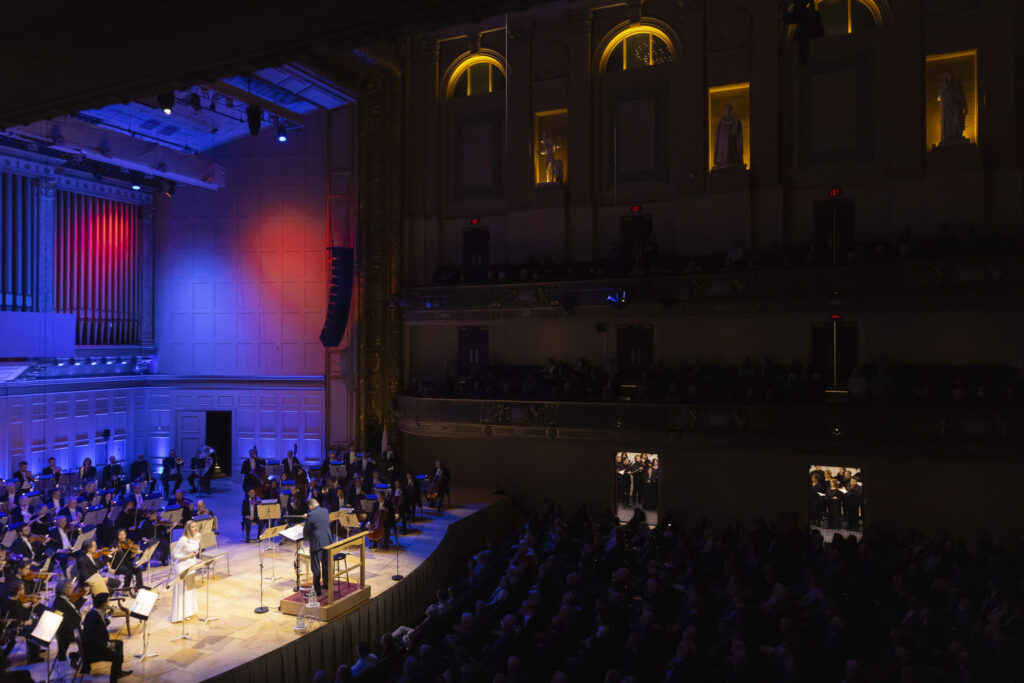
Photo credit: Winslow Townson, courtesy of the BSO. This photo is so cool.