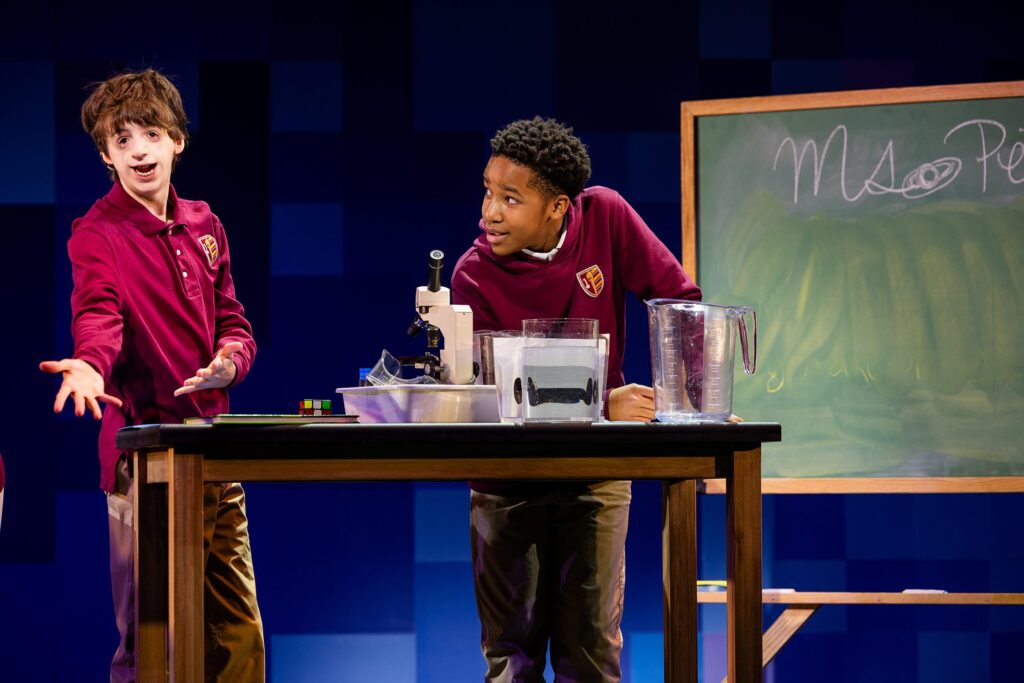
Garrett McNally and Donovan Louis Bazemore in Wonder. Photo: Hawver and Hall
Presented by American Repertory Theater
Based on the novel “Wonder” by R.J. Palacio and the Lionsgate and Mandeville film Wonder
Book by Sarah Ruhl
Music and Lyrics by A Great Big World (Ian Axel and Chad King)
Directed by Taibi Magar
Scenic design by Matt Saunders
Featuring: Melvin Abston, Kaylin Hedges, Alison Luff, Garrett McNally, Javier Muñoz, Nathan Salstone, Max Voehl
December 17th, 2025 – February 8th, 2026
Tickets
Loeb Drama Center
64 Brattle Street, Cambridge, MA 02138
Online playbill
Review by Maegan Clearwood
This production depicts bullying and contains fog, haze, strobe, and flashing lights. Recommended for ages 9+.
CAMBRIDGE, Mass. — With the debut of Wonder: The Musical, the A.R.T. was simultaneously presented with a monumental opportunity and an obstacle. The source material, R.J. Palacio’s 2012 book of the same name, has been lauded as a groundbreaking story of empathy through its first-person portrayal of Auggie, a preteen boy with a facial difference. A Google search for reviews brings up words like “uplifting,” “heart-rending,” and “inspirational.”
These very terms that are used to praise the novel are, however, at the root of frequent critique from members of the disability* rights community. Stories about disability far too often rehash tired tropes, portraying disabled characters as “objects of inspiration or charity,” as Professor Ari D. Ne’eman noted in a Harvard School of Public Health panel about the musical, rather than complex people in their own right. These tropes point to the fact that such stories are about disabled people, but not by or for them. (Editor’s note: We in the disabled community call this Inspiration Porn, a term coined by comedian and activist Stella Young. Check out her 2014 TEDx Talk. )
More troublingly, the 2017 film adaptation cast Jacob Tremblay, a young actor who does not share Auggie’s condition, in the leading role, using prosthetics to simulate his facial difference. Rather than explain why this casting choice is problematic, I direct readers to this article by Lauren Barack.
Having read Palacio’s book in advance of seeing this production, I wholeheartedly agree with critiques from the disability community. I also recognize the book’s strengths: Palacio does a remarkable job of diving into a character’s inner world and exploring how their lived experiences shape their thoughts, worldviews, and behaviors. Auggie’s perspective makes up the majority of the book: He describes the difficult transition from homeschooling (he has been in and out of operating rooms his whole life) to middle school, made all the more difficult by how his peers perceive and treat him. Other chapters delve into the minds of other kids in Auggie’s orbit, but we always return to Auggie.
So the A.R.T. faces a dilemma: How can we adapt this story in a way that subverts the source material’s flaws, while also holding true to the narrative spark that makes the novel so beloved?
Wonder: The Musical, with a book by Sarah Ruhl, music and lyrics by A Great Big World (Ian Axel and Chad King), and direction by Taibi Magar, largely misses the mark, even falling prey to tropes that the source material managed to avoid.
Wonder: The Musical improves on the film adaptation by casting actors with facial differences in the role of Auggie. Garrett McNally and Max Voehl rotate the role (McNally performed the night of my attendance), and it was refreshing to see Auggie’s story told by people who identify with his lived experiences. I hope that McNally and Voehl have future opportunities to perform in roles that do not revolve around their facial differences.
Unfortunately, these performers are not the leads in their own story. Auggie’s vibrant internal world, given so much room in Palacio’s novel, is crowded out in this musical adaptation, pushed to the background in favor of other characters’ subplots and solos.
In the novel, it’s fun to bounce from one perspective to the next, but this nonlinearity doesn’t translate to a live medium that necessitates more externalization. In place of separate chapters, the musical gives separate songs to virtually every character in Auggie’s orbit. Some of these diversions make sense, but do we need a whole song from the perspective of Auggie’s sister’s best friend, or a duet between his sister and her boyfriend?
The novel is frequently criticized for not giving Auggie enough agency, and the musical missed an opportunity for a radical dramaturgical revision, one that truly centers Auggie’s story and character development.
These many, many character sidebars also impact the runtime. The musical clocks in at over two hours, at least half an hour too long for its target family audience. These two hours feel even longer due to the lack of a clear narrative focus (the plot leads up to not one, not two, not three, but four major school events in act two).
Credit where it’s due, the musical does try to give Auggie time in the spotlight, but the attempt unfortunately backfires. Auggie’s inner world is personified by an imaginary friend, Moon Boy, who not only reflects Auggie’s love of space but is also a mouthpiece for his innermost anxieties. Moon Boy is played by Nathan Salstone, decked out in a puffy space suit, and he enters the narrative seemingly at random, such that I forgot he existed for scenes at a time.
I understand the impulse to write Moon Boy into the musical. Dramaturgically, he serves as an inner narrator. Practically, he takes some of the performance load off of McNally and Voehl, who would otherwise be singing through an unreasonably taxing role for their age.
Functionally, however, Moon Boy adds a new disability trope into the mix: infantilization.
For one thing, his existence gives the impression that Auggie can’t vocalize his own feelings. In my performance, McNally doesn’t get the chance to really sing until the act two climax, and he has a bold, resonant voice; I regret not being able to hear it more.
For another, giving preteen Auggie an imaginary friend makes him seem younger, less emotionally mature than he actually is (in the book, Auggie is socially immature compared to his peers, but this is supported by his backstory, and serves as a challenge that he ultimately overcomes – no imaginary friend necessary).
None of this is helped by Salstone’s performance, which is full of far too much childish wonder for a play about a middle schooler. This speaks to a broader performance issue, particularly with the adult actors: Their choices are shiny and over-the-top, like something out of a “Disney Channel: Very Special” episode.
The production design is as overcrowded as the script. The stage floor rotates; colorful pixels are embedded into the set; an actor and spaceship fly in from above. Scenic designer Matt Saunders’ work is impeccable, and the designers create a fun visual language based on Auggie’s love of space, blending seamlessly into the more mundane world of English class and family dinners. But overall, this spectacle feels more like a barrage of shiny and loud stuff, rather than intentional storytelling choices.
In general, Wonder: The Musical doesn’t take its young audience seriously. Axel and King’s lyrics are predictable and trite: “You are beautiful,” his mother (Alison Luff) sings, “Each and every one of your scars tells a story of a boy who’s strong and brave.” The music also feels like something out of a Disney show: poppy and fun, but not especially memorable. The musical’s thesis is “choose kindness,” an overly simplistic anti-bullying platitude that its middle school audience members surely know isn’t going to work.
In the HSPH panel, Ne’eman adds that he wishes Auggie had more “agency or interiority or narrative arc,” instead of primarily “experiencing cruelty.” And this is my biggest issue with both the novel and musical: at every turn, Auggie is harmed by those around him; at every turn, other people learn lessons at his expense, and at every turn, he forgives them.
“You truly are a wonder, Auggie,” his mother says in the musical’s final moments. But Auggie shouldn’t need to be wonderful, or nice, or smart to be treated with dignity and respect. He certainly needs more than kindness, which in one song is exemplified as smiling at a stranger to brighten their day.
I wish Wonder: The Musical took this opportunity to model accountability for its smart young audiences. It does the bare minimum by casting an appropriate actor for the lead role and advocating for acceptance, but Auggie – and kids in the audience who relate to his story – deserve more.
*Neither the book nor the musical describes Auggie as disabled. For a nuanced discussion of this word’s omission from the novel, I recommend Mike Moody’s essay. Because Auggie does not use this word to describe himself, I will not directly use it about him in this review; I do, however, think that the framework of disability justice and representation is important when discussing this story.