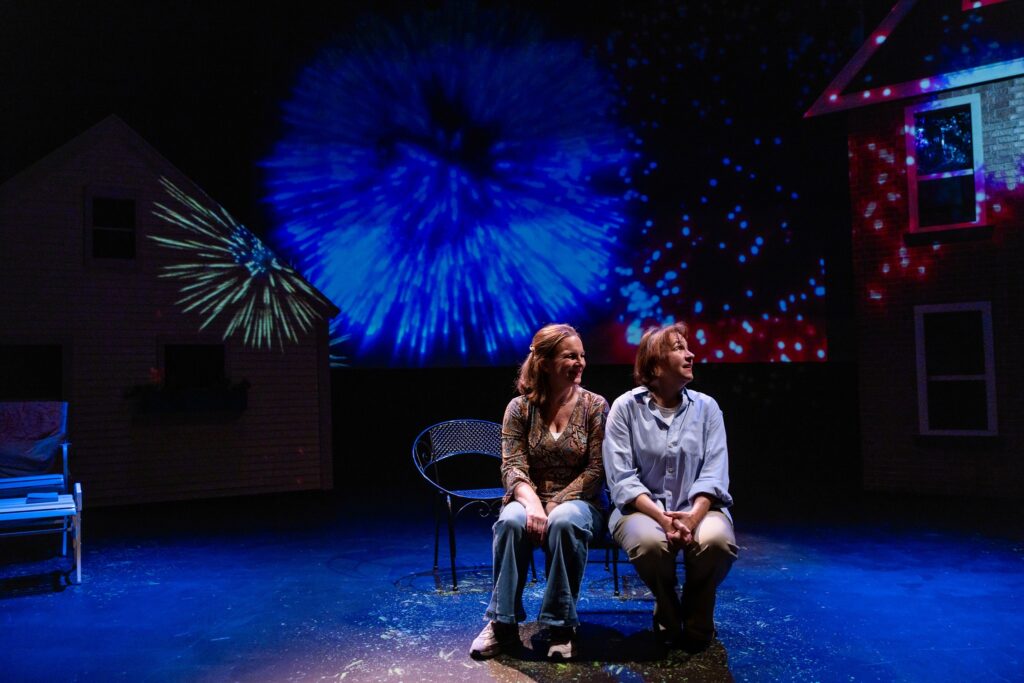
Laura Latreille, Lee Mikeska Gardner; Photo by Nile Scott Studios.
Presented by Central Square Theater
By David Auburn
Directed by Paula Plum
Featuring: Lee Mikeska Gardner, Laura Latreille
November 6 – 30th, 2025
Central Square Theater
450 Massachusetts Avenue
Cambridge, MA 02139
Critique by Maegan Bergeron-Clearwood
CAMBRIDGE, Mass — Summer, 1976 is an intimate play. It is literally small, with a cast of two, a runtime of just 90 minutes, and a cozy little set that brings the actors practically nose-to-nose with the audience. But more interestingly, it is a story about yearning: two women stumble headfirst into an unexpected friendship, underestimating how hungry they are for deep, heart-opening vulnerability. They also underestimate how terrifying that kind of connection can be.
David Auburn’s play transports us to Ohio during the American bicentennial. Offstage, the women’s liberation movement is in full swing. Onstage, at Central Square Theatre, we could be anywhere, anytime. The set (Kristin Loeffler) features two brightly colored dollhouse-like facades to indicate where different scenes take place, but nothing onstage screams 1970s, and the costumes (Sydney Hovasse) allude to a bit of hippy inspiration without throwing the audience back in time.
Summer, 1976 is much more concerned with memory than nostalgia. Diana (Lee Mikeska Gardner) and Alice (Laura Latreille) recount their summer of friendship to the audience through a series of shared memories, some of which are crystal-clear, others of which are clouded by hindsight or regret. Diana is an artist and single mother: particular, self-assured, and as Alice describes her, a bit of a snob. Alice is a stay-at-home mother, married to an ambitious young academic: funny, free-spirited, and unsure of herself.
Both women are far lonelier than they are willing to admit.
The play is grounded in time and place, to be sure. References to ‘70s politics and pop culture abound, as evidenced by the knowing chuckles from the largely boomer audience I was a part of the other night. But as a millennial, I didn’t find this cloying or alienating, as I expected I might. I credit the actors here, who recounted these anecdotes as if from memory, rather than as winks to the audience.
I also credit Auburn’s script, which cares so deeply about the internal world of these two women. Throughout the play, they reenact moments of intimacy and conflict: Diana helping Alice find a ‘statement piece’ to pull her chaotic living room together; Alice accompanying Diana through a debilitating migraine episode; a conversation of truth-telling that goes a bit too far for comfort.
But they also give voice to the anxieties and doubts that go unspoken during these kinds of tender, exploratory relationships. Does she really care? Did I say something stupid? I hesitate to write too much about Auburn’s approach to memory, because some of the play’s strongest moments are its most surprising. Suffice to say that this play resists the notion of a singular, factual truth.
Director Paula Plum does a commendable job keeping the production light on its feet, propelling the story from joke to joke but knowing when to linger in a more tender moment. Gardner and Latreille have striking chemistry, both with each other and with the audience. It took me a few scenes to lock into the pacing and tone, but once I was hooked, I was hooked.
Although the set looks like something out of a storybook, the lighting (Deb Sullivan) and projections (Justin LaHue) transport the story into dreamlike, even otherworldly places. Diana and Alice’s homes are set against the same expansive sky: sometimes a cloudless summer afternoon, perfect for sunbathing or sharing a joint; other times a deep purple night lit up by fireflies, set to the sounds of laughter and dangerously honest conversation. Unnecessary transitions (groovy projections and music) occasionally interrupt the pacing, but the production otherwise feels seamless.
Ultimately, Summer, 1976 is a love story. In a remarkably modest amount of time, it luxuriates in blissful, sunshiny moments, but it also isn’t afraid to plumb the darker corners that memory would rather forget. It is honest in a way that left me shaken, even frightened, but also, a little bit more open.