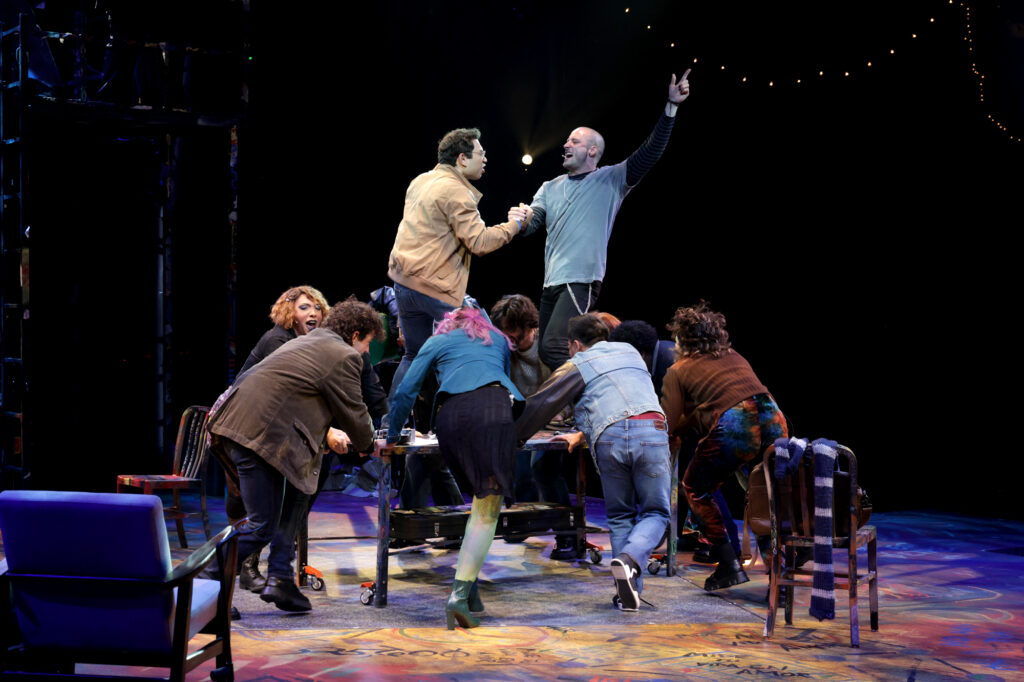
Aaron Alcaraz (Mark Cohen) and Austin Turner (Roger Davis) with the cast of “Rent.” Photos © Paul Lyden
Presented by North Shore Music Theatre
Book, Music, and Lyrics by Jonathan Larson
Direction and Choreography by Marcos Santana
Music direction by Robert L Rucinski
Musical Arrangements by Steve Skinner
Original Concept/Additional Lyrics by Billy Aronson
September 16 – September 28, 2025
North Shore Music Theatre
54 Dunham Rd.
Beverly, MA 01915
Critique by Craig Idlebrook
BEVERLY, Mass. — When I first heard that North Shore Music Theatre was staging a production of Rent, I was a bit surprised. After all, the theatre is more well-known for crowd-pleasing musicals that will appeal to an older audience than for edgy, newer shows like those I first saw in college. Then it hit me. Rent has long ago passed the realm of edgy or new, and I had just gotten my AARP card in the mail.
Rent first burst onto Broadway in 1996 and stunned many theatergoers with its frank and humane depictions of the LGBTQ+ community, the AIDs epidemic, and those struggling with addiction. Set in a decaying New York City in 1989, the rock musical refused to allow its characters to be afterschool special-shallow, either as heroes or as cautionary tales. They were complicated, flawed, and lovely. The play’s beating heart was its depiction of the power of found family among non-conformists.
This would be the third time I’d seen Rent. The last production I saw, about a decade ago in New York City, felt as if it was going through the motions to please a crowd. I wondered if this production would have anything left to say to me.
Happily, yes. North Shore’s Rent is infused with fresh energy and feels unburdened with the legacy of the show. Despite a few production flaws, the performers, most of whom were not alive when the show first opened, are largely successful in making the characters they inhabit their own. This allows the show’s pulsating soundtrack to carry the audience away to a sad and joyous time in the young lives of a community yearning to create a better world.
Aaron Alcaraz stands out for not standing out as the deceptively understated Mark Cohen, a documentarian who too often hides behind his camera rather than feeling emotions. Alcaraz infuses Mark with a perfect level of cheekiness, no more so than when Mark is explaining to Joanne Jefferson (Kat Rodriguez), the woman who is now dating his ex-girlfriend, the pitfalls of dating said ex-girlfriend.
Alcaraz’s Mark acts as the perfect foil for Mark’s roommate, Roger Davis (Austin Turner), a musician in recovery from heroin use. Roger is burdened by an HIV diagnosis and the guilt of his ex-girlfriend’s suicide, and Turner brings the right level of darkness to a character teetering on the cliff edge of nihilism.
Mimi Marquez (Didi Romero), a dancer and a chaos junkie, barges into Roger’s life and won’t take no for an answer, but she is struggling with her own addiction. Romero makes strong choices with her depiction of Mimi, emphasizing a New Yorker toughness in her portrayal. This helps explain how Mimi holds her own against Roger’s angry shell as he tries to push the world away.
In this, she is mirrored by Rodriguez’s depiction of Joanne, a take-no-prisoners lawyer who also must deal with her own chaos monkey of a romantic partner in Maureen Johnson (Cate Hayman), a performance artist who too often forgets she’s in a monogamous relationship. Joanne stays firmly grounded so Maureen can soar, but the two pull at each other in a way that drives each mad with desire and frustration.
These strong relationships help to paper over a few flaws of the production. A third couple that usually anchors the script fails to fully connect in this production (I suspect that one of those two performers may have been a little under the weather). More importantly, the stage design, though fleshed out and wonderfully grimy, is a bit too low for good sight lines. And unfortunately, director and choreographer Marcos Santana adds to the visual confusion by failing to adequately block scenes for a performance in the round. As such, I often only saw the back of several key performers during some of the best songs.
There also are a few other blocking quirks that pulled me out of the show, the chief one being that one character puts a small stack of wood on top of a wood stove that had been “lit” in the previous scene without first checking if the stove was “cold”. But here I may be showing that I no longer am a young bohemian who would be shouting for wine and beer after an avant-garde performance by a friend, but a grey-bearded dad. I appreciate this production whisking me away to a time when the act of creation mattered more to me than fire safety.