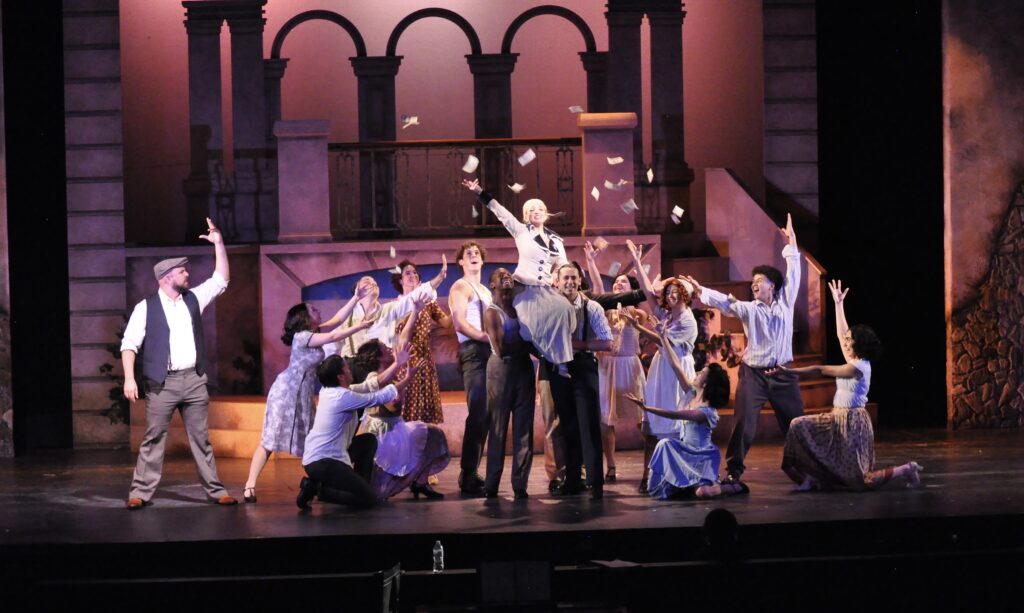
The cast of “Evita.”
Presented by Reagle Music Theatre of Greater Boston
Lyrics by Tim Rice
Music by Andrew Lloyd Webber
Direction and choreography – Rachel Bertone
Musical Direction – Dan Rodriguez
Scenic Design – Cameron McEachearn
Lighting Design and Production Design – Baron Pugh
Costume and Wig Design – Ellie De Lucia
Sound Design – Sebastian Nixon
Online Playbill
July 11 – 20, 2025
Robinson Theatre
617 Lexington Street
Waltham, MA 02452
Critique by Craig Idlebrook
2 hours, 15 minutes with a 15-minute intermission
WALTHAM, Mass. — The musical Evita is having a moment. It is an interesting time for a resurgence of a play about a populist Argentine icon, when the world appears buffeted by the populist and authoritarian actions of some world leaders.
The play, which started its Broadway run in 1979, is seeing a viral resurgence, thanks to a Rachel Zegler-led production in London that has taken some of its act outside the theater for the masses to enjoy. One would think that Eva Perón, the titular Argentine historical figure, would have appreciated the streetside stagecraft.
Reagle Music Theatre of Greater Boston’s current production of Evita is largely successful, but at times it searches for its footing. In the first act, it appears to come closer to illuminating the farcical aspects of Tim Rice’s and Andrew Lloyd Webber’s book and score than the tragedy. In the second, the production does better at melding both tragedy and farce to earn the story’s poignant ending.
By its nature, the musical Evita is as ambitious as its titular character. It is set in the chaos of post-WWII Argentina, right after the country had three different leaders in three years. Enter Eva Perón (Isabella Bria Lopez), an actress who captivates Argentine crowds and helps propel her husband, Juan Perón (Ryan Mardesich), to power. The play attempts to understand what drives Eva as she meteorically climbs and then falls from power and grace. The book and score are imperfect, being overly English for the subject matter and sometimes opaque in their choices.
(As an aside, I have never understood why Eva sings “Don’t Cry for Me, Argentina” the first time, and I have been listening to the song since 1979.)
Despite the chaotic subject matter and choices, Lloyd Webber and Rice somehow succeed in connecting generations of theatergoers with this flawed historical protagonist and proto-feminist icon. This production, by and large, does the same.
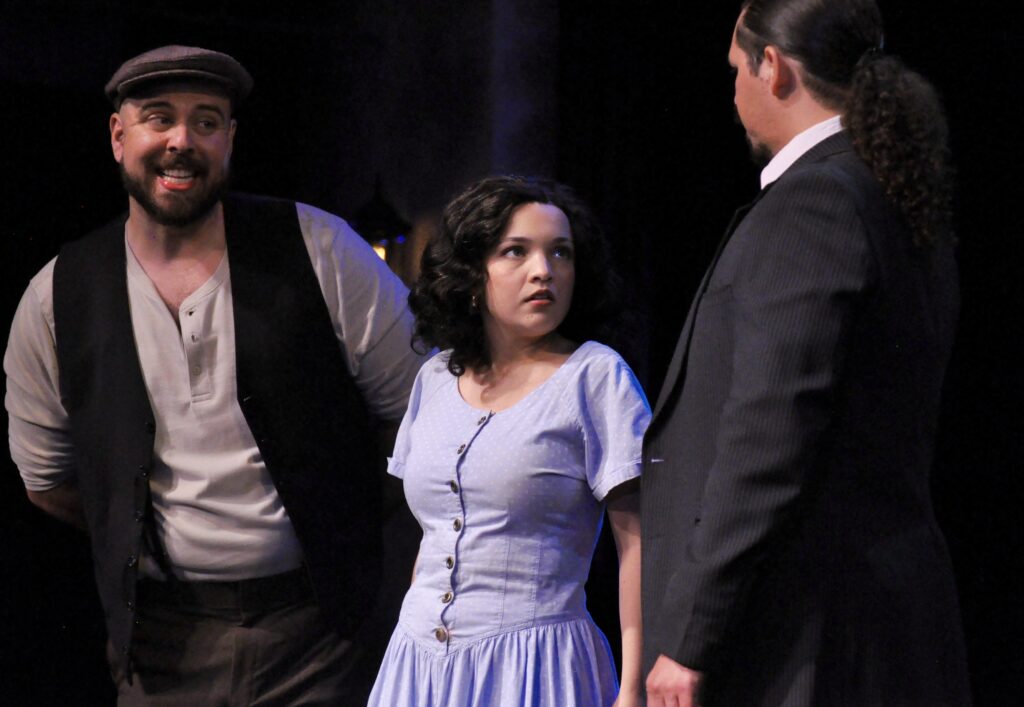
Eddie Noel Rodríguez as Che Guevara, Isabella Bria Lopez as Eva Perón, Ricardo Ricky Holguin as Magaldi
The principal cast generally gives strong performances that work well with the source material. Bria Lopez boldly chooses to portray Eva as an unstoppable force from the beginning, giving her a mask of bravado that is difficult for the other characters to penetrate until the poignant final moments of the play. It is this choice that propelled the strong second act, but also bogged down the first. Meanwhile, Eddie Noel Rodriguez captivated as Che, a revolutionary character who also serves as a narrator, and often pierces Eva’s political stagecraft with his cynical observations. Noel Rodriguez’s Che brought unworldly calm and poise to the frenetic action on stage, while also hinting in his jester’s role at the reservoir of passion he, too, felt for Argentina. Not to be overlooked, Ricardo “Ricky” Holguin stole scenes as Magaldi, an oily lothario crooner who first brings Eva to Buenos Aires.
Some production limitations pull viewers from this world, especially early in the first act: a supposed reel of film that is interrupted is unmistakably digital, and Eva’s coffin looks small enough and light enough to fit a child. Also, while Ellie De Lucia is largely successful in crafting striking period garb for the cast, the wigs she works with look distractingly cheap. Also, Ryan Mardesich’s portrayal of Juan Perón is given the task of being much more authoritarian than charismatic, which makes the audience wonder why he ever came to power, even with Eva’s help. It also weakens the important connection between Juan and Eva, a secondary but important storyline.
Even as the production struggles with some aspects of the staging, however, it succeeds consistently in bringing the energy to this sweeping musical, helping us to reconnect with this singular figure in history.