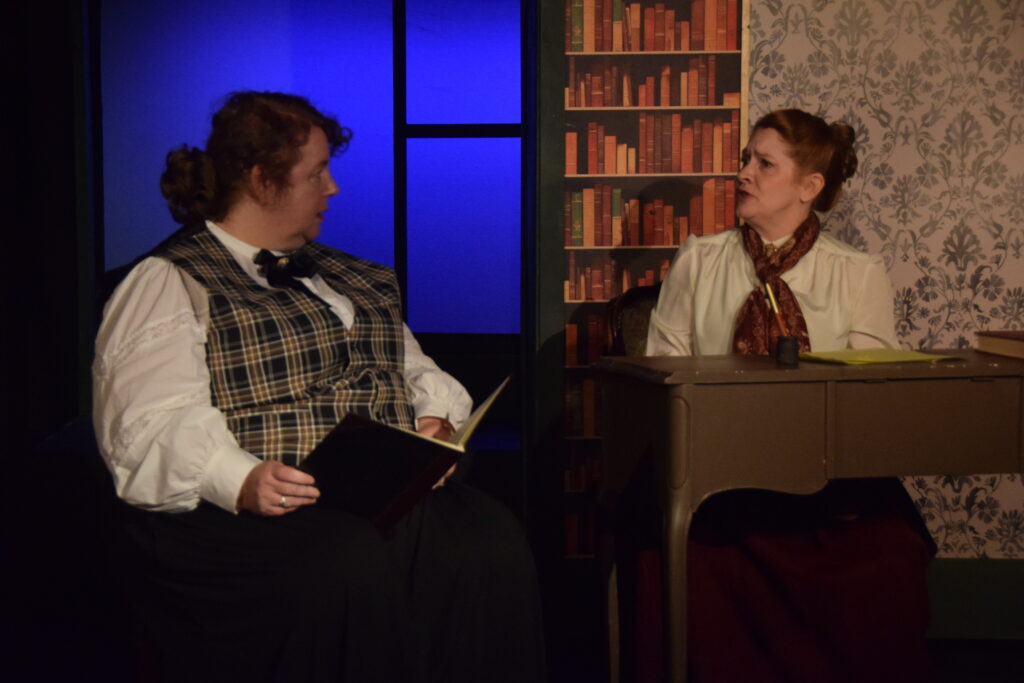
Karen Dervin as Dean Welsh and Linnea Lyerly as Woolley; Photo by Brian Higgins.
Presented by The Treehouse Collective
By Bryna Turner
Directed by Lisa Tierney
Lighting design by Dan Clawson
Set design by Britt Ambruson
Featuring: Linnea Lyerly, Heidi White, Karen Dervin, Anneke Salvadori, Hannah Young, Lena Vani
Abbott Memorial Theatre at Hovey Players
9 Spring Street
Waltham, MA 02451
June 13 – 29, 2025
Accessibility Note: There are a total of 13 steps to get downstairs to the theatre, with no elevator access.
Review by Maegan Bergeron-Clearwood
WALTHAM – The most radical element of Bull in a China Shop is emblemized by its earliest visuals. Two women in early 20th century garb lounge on a bed together, tangled in each other’s arms. Everything is perfectly mundane: they discuss personal and professional dreams; they quarrel; they kiss. And they do explain their queerness to the audience. They simply exist in their historical moment, no excuses necessary.
Bull in a China Shop by Bryna Turner isn’t a perfect play, but it fits neatly into The Treehouse Collective’s ethos. Their seasons largely feature contemporary works that give voice to ahead-of-their-time trailblazers (particularly women and queer folks, although I hope their team will add some more racial diversity to their season selection in the future) whose stories have otherwise been silenced by the patriarchal, heteronormative archival machine.
In just 90 minutes, Bull in a China Shop traces the decades-long relationship between two women: Mary Wooley (played by Linnea Lyerly), president of Mt. Holyoke College who shepherded the institution into a more progressive era of women’s education during the early 20th century; and Jeannette Marks (Heidi White), a former student of Wooley’s and a radical thinker, writer, and educator in her own right. Together, they wrestle with a breadth of political, personal, and philosophical topics: patriarchy, power dynamics, women’s suffrage, feminist pedagogy, institutional hierarchy, love, infatuation, and more.
Many of these topics are alarmingly resonant in our current political moment, but few of them are given room to breathe, which is particularly frustrating for such an intimate, character-driven play. Wooley and Marks discuss what their views on the suffrage movement are, for instance, but never delve into why they are personally motivated to act on these ideals. Much is stated, but little is explored.
Tonally, the play is uneven, ricocheting between snappy, debate-style dialogue and lush, florid monologues. Turner sprinkles modern lingo into the dialogue, almost always in the form of the f-bomb. With some more dramaturgical finesse, these stylistic add-ons could give the play some girl-bossy, 21st century flair, but they end up feeling tacked on and clunky.
The play is structured as a series of brief, rapid-fire vignettes, and director Lisa Tierney stages the seemingly infinite number of scene changes with elegance. Britt Ambruson’s scenic design gives the postage stamp-sized playing space an impressive degree of dimensionality, offering levels, corners, and shapes for different locations to emerge through. Dan Clawson’s lighting design is glowy and warm, frequently punctuating the scenes with freeze-frame silhouettes.
The overall effect is dreamy; it feels as if we are watching the women’s stories through a soft, sepia-toned camera lens.
While aesthetically lovely, the production design and direction are at odds with the text’s playful style. The play is described as “fast-paced comedy” on Treehouse’s website, but the pacing and tone lean overwhelmingly dramatic.
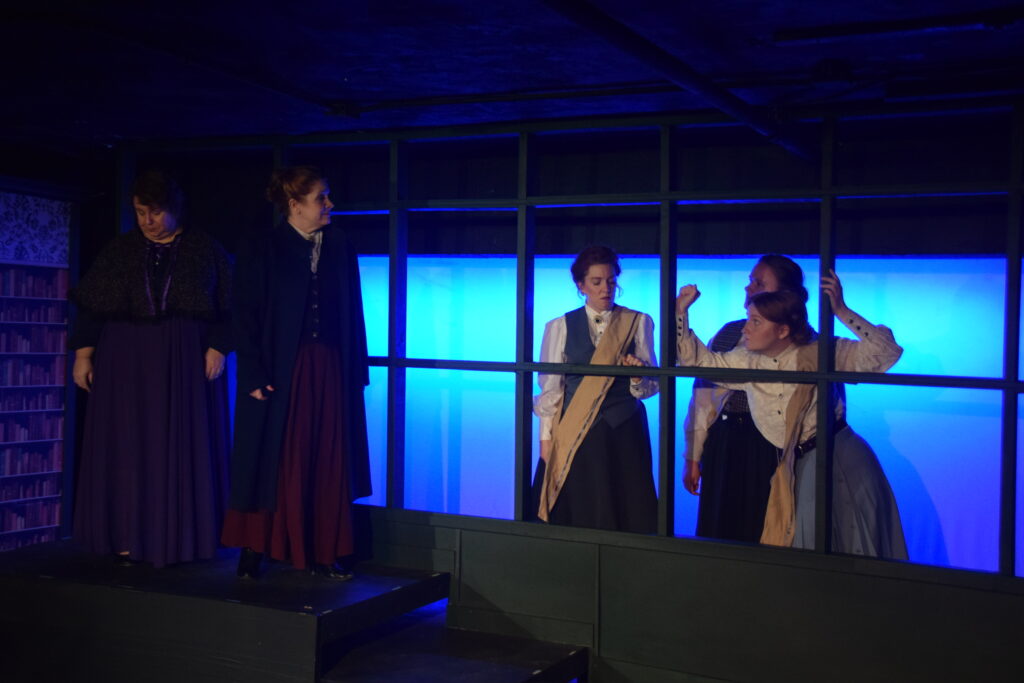
The ensemble; Photo by Brian Higgins.
This tonal mismatch is evident with the performances as well. Lyerly and White embody Wooley and Marks with stateliness and passion, and are they most successful during the play’s quieter, interstitial moments, such as the aforementioned bedroom scene. Unfortunately, they fail to deliver the silly, witty energy that Turner is attempting to achieve.
Luckily, the side characters bring some much-needed zest. Karen Dervin plays Dean Welsh, an old-school administrator who represents the conservative backlash that Wooley faces from academic stakeholders; to the play’s detriment, Welsh delivers these counterarguments secondhand, so we never see Wooley in meaningful, active debate with this collective antagonist. Still, Dervin is fun to watch, imbuing her interactions with Wooley with one giant, exasperated sigh.
Hannah Young plays Felicity, Marks’ roommate and a philosophy professor at the college. More than anyone, she sinks her teeth into the play’s farcical side, chewing on her lines and relishing in the text’s weirder flourishes. Anneke Salvador rounds out the cast as Pearl, Marks’ student and leader of the campus’ Wooley-Marks shipping fan club. She delivers the play’s standout moment: a monologue of existential desperation, infatuation, and despair, successfully threading the needle between comedy and sincerity.
Treehouse’s production of Bull in a China Shop has lots of potential to be a queer feminist rallying cry, but it fails to play to the text’s strengths. Still, there are enough moments of quiet revolutionary power to make it a solid addition to Boston theatre’s Pride month programming.