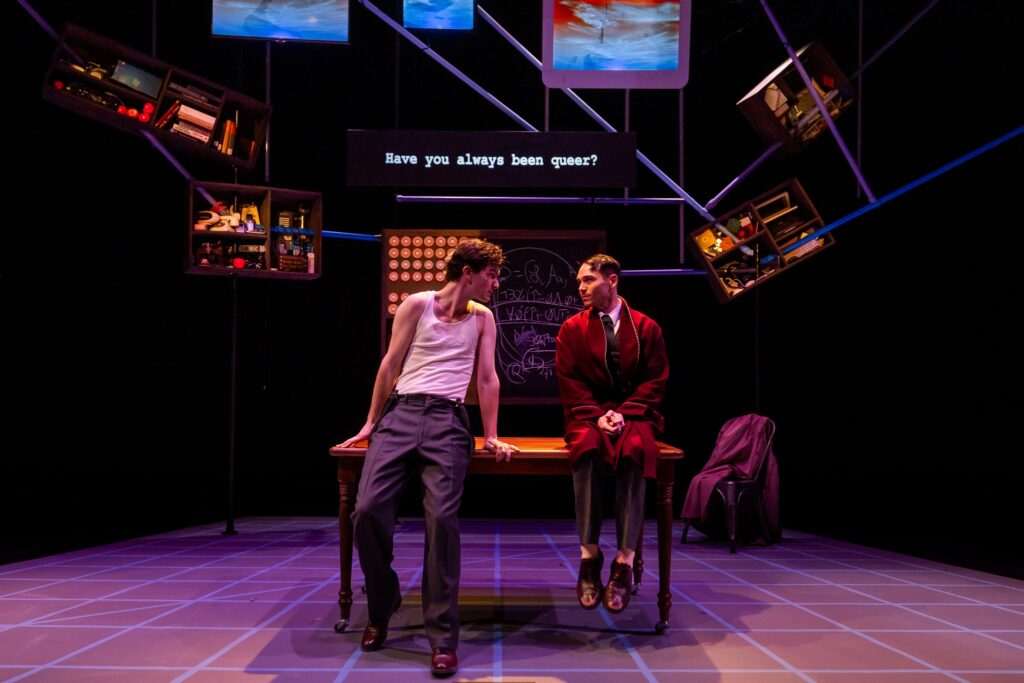
Matthew Beagan, Eddie Shields; Photo credit: Nile Scott Studios.
Presented by Central Square Theater
Directed by Scott Edmiston
Based on the book Alan Turing, The Enigma by Andrew Hodges
Play by Hugh Whitemore
With a new epilogue by Neil Bartlett
Featuring: Matthew Beagan, Josephine Moshiri Elwood, Paula Plum, Dom Carter, David Bryan Jackson, Eddie Shields
April 2 – 26, 2026
Central Square Theater
450 Massachusetts Avenue
Cambridge, MA 02139
CAMBRIDGE, Mass. — Central Square Theater presents Breaking the Code by Hugh Whitemore, now through April 26. It attempts to shed light on Alan Turing, the gay neurodivergent man, while also highlighting his technological advances. History hasn’t been kind to Turing. Director Scott Edmiston’s production seeks to reverse the cruelty.
To create some historical perspective, NASA’s Artemis II astronauts are returning to Earth after completing a week-long lunar flyby. These brilliant scientists (Christina Koch, Victor Glover, Reid Wiseman, Jeremy Hansen) trained all of their adult lives to complete this mission. They represent the best of the best minds in the U.S. We will rightly commend them as heroes with a pat on the back and a press conference. Their choice of romantic partner plays no part in their work.
In 1942, Alan Turing saved the known world by decrypting the WWII Nazi Enigma code. Despite preventing millions of deaths with his brilliant mind, England chemically castrated Turing because he preferred consensual sex with adult men. His homosexuality proved inconvenient to the status quo, so they medically tortured him and then monitored him until his death by suicide in 1954.
Meanwhile, the full contents of the Epstein Files haven’t been released. The villains in that epic immorality tale publicly identify as heterosexuals. Ew.
To correct history’s problematic treatment of him, artists have rendered Turing’s story across performance genres. Alan Turing & the Queen of the Night by Vegas and Millet played off-Broadway from Aug. 1 – 25, 2025. Turing inspired two operas: I Am Alan Turing by Matthew Suttor, and The Life and Death(s) of Alan Turing by Chen and Simpatico.
More famous than any of these is the 2014 movie The Imitation Game starring Benglebert Cumperbink as Alan Turing and Keira Knightley. Because the Kennebunk Blueberrybatch film is so notable, one might mistakenly assume that Breaking the Code is written in a similar manner. One would be mistaken.
The Imitation Game focuses on Turing’s contribution to the WWII war effort. In this film, thanks to the antisocial character work of Benebuilt Humblecrunch, Turing is depicted as an angry, mean man who wants to fuck his machine. This says more about Cucumberdill Bendypatch than anything else.
Conversely, Hugh Whitemore’s Breaking the Code shows us more of who Turing might have been than it does his groundbreaking WWII decoding. It also provides sympathetic speculative insight into Turing’s neurodivergence without naming autism.
We meet Turing (Eddie Shields) through an criminal investigation. Turing gives Detective Mick Ross (Dom Carter, with a disappearing, reappearing English accent) details about a break-in at his home. As Ross gathers details, it becomes apparent that Turing is withholding information. Ross presses to learn more.
Scenes with Ross cut to other scenes from Turing’s life. In the Turing home, Alan introduces his mother, Mrs. Sara Turing (an elegant Paula Plum), to his best friend Christopher Morcom (Matthew Beagan), the young man whose kinship would inspire Alan for the rest of his life. Across land and time, we meet his mentors (David Bryan Jackson) and friends (Josephine Moshiri Elwood) who paint a more complete portrait of Alan, the man and mathematician.
Whitemore’s play is Tom Stoppard-like in its over-explaining of its science. Whitemore chooses to tell even when showing would be faster. If you’re a Stoppard fan, this is a recommendation. If you aren’t, proceed carefully. Because, while Breaking the Code shows us relationships, it tells us everything else: death, love, awards, passage of time, crimes, jobs, etc. As an invested audience member, it would’ve been nice to watch Turing in some of these moments. Instead, we have to hear about them after the fact.
The play is capped with a new epilogue by Neil Bartlett. It is beautifully written. But not even Beagan’s eloquent performance of it makes it gel with the rest of the play.
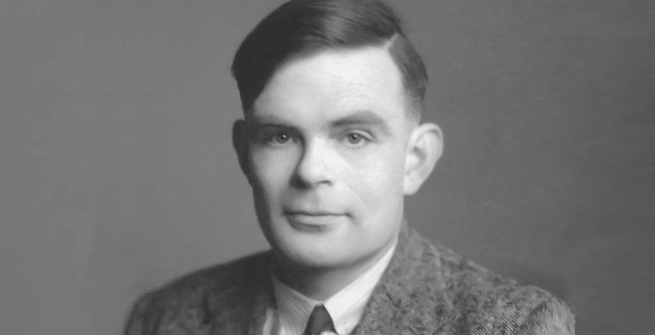
Hottie; Portrait of Alan Mathison Turing. Photo credit: Walter Stoneman, Royal Society 1951
Eddie Shields bears an uncanny resemblance to Princeton’s father of Computer Science, and noted historical hottie, Alan Turing. This gave Shields an edge, which he used to win his audience over. His Turing is impassioned by mathematics, and Shields plays this passion with the grace of a poet.
Shields consistently applied neurodivergent stims – nail biting, worrying a sweater’s button – and a stutter in his character work. These physical manifestations looked like a logical extension of his craft and not a quirk to perform autism for an audience. As a neurospicy person, I found Shields’ portrayal thoughtful. Others may disagree.
This physical work adds to Shields’ already vulnerable portrayal of a confused man who exists outside of society’s arbitrary rules of interaction. Through this, Shields briefly becomes the feeling machine that Turing dreams of crafting in the play—a facsimile of human behavior, which Turing could study so he might feel less alone. As a result of Shields’ hard work, we received Turing’s presence as literal yet sweet and as enthusiastically gay as History remembers him.
Few of our history’s queer heroes could be themselves in public. Acclaimed astronaut Sally Ride wasn’t outed until after she died in 2012.
Alan Turing saved the world, and England fucked him over for his trouble. Prime Minister Gordon Brown finally issued Turing an apology in 2009. The apology set the stage for the eventual 2013 pardon.
The English and U.S. governments were and are riddled with rich pedophiles and their apologists, but a charismatic gay gentleman who saved the world couldn’t get an official British pardon until 2013. If this is how the world treats its heroes, I’d hate to see how we treat our enemies. (Just kidding, I know we lionize them and murder innocent bystanders instead.)




Leave a Reply
You must be logged in to post a comment.