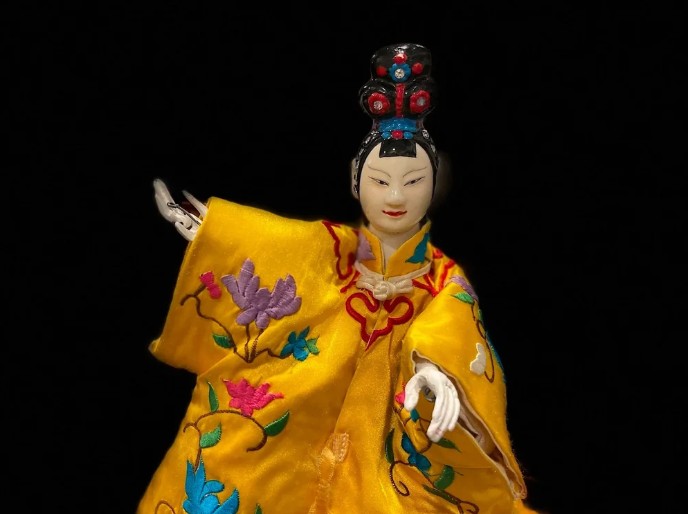
Photo via Puppet Showplace website. Puppet by Li Chuan- tsain.
Presented by Galapagos Puppets
Puppeteering by Madeleine Beresford & Margaret Moody
Music performed by Jimmy Zhao and Iris Zhao
Bu Dai Xi puppets made by Li Chuan- tsain of I Wan Jan Troupe, Taiwan
Script by Li Tien-lu of I Wan Jan
February 14–17, 2026
Puppet Showplace Theater
32 Station Street
Brookline, MA 02445
Running time: approximately 60 minutes, no intermission
Article by Diana Lu
BROOKLINE, Mass. – The Fiery Mountain and Its Princess: A Monkey King Tale, presented by Galapagos Puppets, is a rare experience of cultural legacy as a living, breathing, and playful entity. The show, performed in the traditional Taiwanese puppetry style “bu dai xi”, combined masterful yet slapstick hand puppetry, improvised riffing off of Classical Chinese music in a fantasical and famous story told in the intimate, child-friendly environment of Brookline’s Puppet Showplace Theater. Watching it, you realize that culture isn’t about artifacts painstakingly preserved. It is a relational and embodied experience to be enjoyed, connected with, and paid forward.
Written by master puppeteer Li Tien-Lu, Fiery Mountain’s libretto is a condensed dramatization of one episode from Journey to the West, a 16th‑century Chinese novel regarded as one of the Four Great Classical Novels of Chinese literature. The entire novel is a mythologization of Buddhist monk Xuanzang’s 7th century pilgrimage to India. In this episode, the path for the monk and his disciples, including the trickster demigod Monkey King, is blocked by a great mountain fire. Monkey King must use all his powers of trickery, transmutation, and persuasion to put out the flames.
Written by master puppeteer Li Tien-Lu, Fiery Mountain’s libretto is a condensed dramatization of one episode from Journey to the West, a 16th‑century Chinese novel regarded as one of the Four Great Classical Novels of Chinese literature. The entire novel is a mythologization of Buddhist monk Xuanzang’s 7th century pilgrimage to India. In this episode, the path for the monk and his disciples, including the trickster demigod Monkey King, is blocked by a great mountain fire. Monkey King must use all his powers of trickery, transmutation, and persuasion to put out the flames.
The plot is undeniably confusing: Characters appear abruptly. Motivations are only partially explained. Magical objects enter and exit the story with minimal exposition. But this is faithful to the source material. Cause and effect operate according to a logic shaped by the expectations of its culture and time. The script also assumes interior literacy, relying on shared knowledge about humor, hierarchy, morality, and the other episodes of the novel that are usually not spelled out for an audience raised within that tradition.
What Galapagos Puppets elegantly humanizes unfamiliar moments without changing the plot or over-explaining. Through gesture, timing, and expression, the performers convey the emotional reality and humor that animates characters in ways that remain true to the culture’s own storytelling voice. In doing so, it maintains focus on the story’s rich and unvarnished humanity. The princess who started the fire to punish Monkey King does so because she is a petty and vindictive mom. Monkey King is at once a charming genius, yet absurdly forgetful and lazy. Their flaws propel the show’s humor and narrative arc. And we all know people like that.
That humanity was recognized immediately by the audience. The performance played to a standing-room-only crowd that included many young children, and the children were enraptured. They laughed, they screamed. Some narrated the story back as events unfolded.
Madeleine Beresford and Margaret Moody, who studied with Li Tien‑Lu in Taiwan, are true disciples of their craft. Their technical mastery included a fight sequence where puppets wielded tiny swords and body‑length staff, swooping through the air with effortless grace. Combined with their perfect pronunciation of Mandarin, I can infer that they were fully immersed during their time in Taiwan in a relational and not colonial way, and this really brought the show to life.
The music, improvised on traditional Chinese instruments by Jimmy Zhao and Iris Zhao, was inspired by traditional Chinese songs, which heightened the show’s aliveness. The onstage musicians put music to each gesture and fed off the energy in the room. This gave the performance an unmatched vibrancy and underscored how deeply the show’s cultural logic was embedded in sound as well as motion.
For me, this was all profoundly affirming. In a society that exoticizes or denies Asian interiority under orientalist frameworks, seeing this very Chinese story represented with such matter-of-factness and accepted by a diverse crowd felt like this part of me was finally acknowledged and allowed to exist.
This production feels like the inverse of a museum visit. Museums often present culture as objects: statues behind glass, scrolls stripped from context, artifacts acquired through systems of extraction and theft. In contrast, The Fiery Mountain and Its Princess presents culture in motion: alive, participatory, among and a part of us. And the fact that Brookline’s children can experience Taiwanese bu dai xi—a unique regional performing art that would even be rare in mainland China—adds a layer of significance to the experience.
Yet neither Puppet Showplace nor Galapagos announces the show’s cultural significance with self‑importance. It simply is. That quiet care allows the viewer to be human alongside it, to laugh, to gasp, and to recognize ourselves in each other. The show gave its viewers a kind of intergenerational abundance, in which culture, humor, and shared humanity are passed from one place to another, one generation to the next. That is a rare and vital gift.




Leave a Reply
You must be logged in to post a comment.