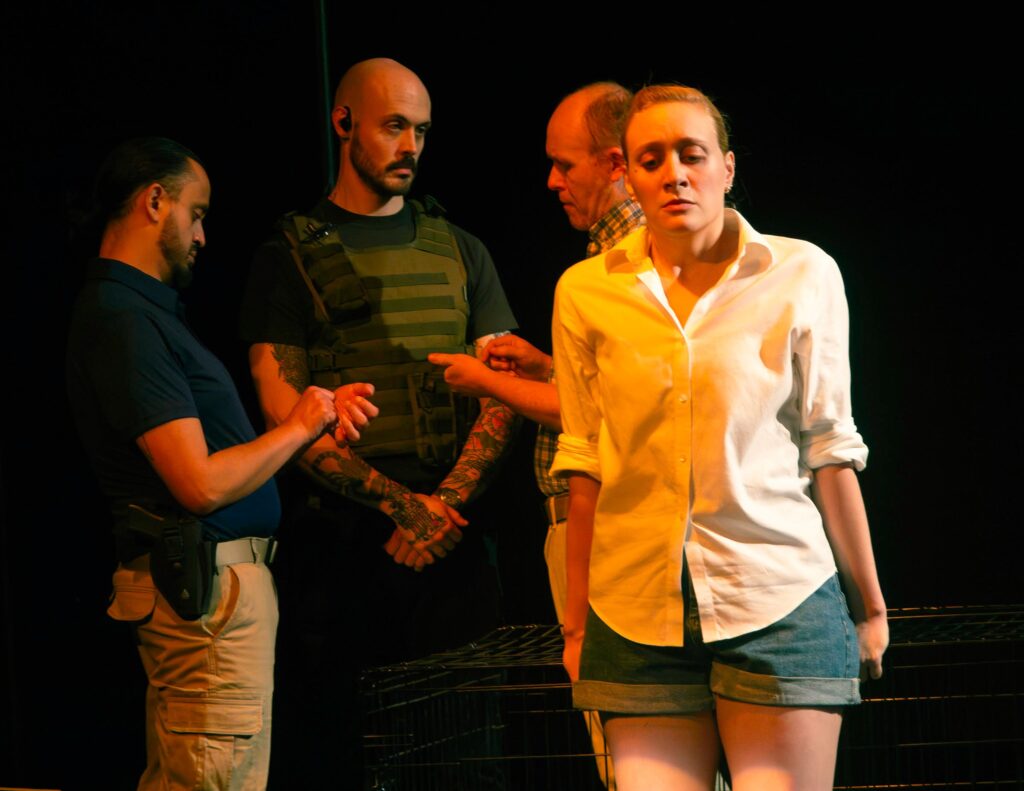
The cast. Photo via Apollinaire Theatre Company.
Presented by Apollinaire Theatre Company
By Tina Satter
Based on the original FBI Verbatim transcript is HERE.
Directed by Danielle Fauteux Jacques
Scenic & Sound Design: Joseph Lark-Riley
Lighting Design: Danielle Fauteux Jacques
Stage Manager: Kaleb Perez-Albuerne
Assistant Stage Managers: Miguel Dominguez, Laura Hubbard
Featuring: Parker Jennings, Brooks Reeves, Cristhian Mancinas-Garcia, Bradley Belanger
Dec. 12, 2025-Jan. 11, 2026
Chelsea Theatre Works
189 Winnisimmet Street
Chelsea, MA 02150
Is This A Room on The Culture Show Podcast
FBI Verbatim transcript is HERE.
Approximately 75 minutes with no intermission.
Content warning: Flashes of light, high tension, The Fed
Article by Kitty Drexel
“I sincerely apologize and take full responsibility for my actions. In particular, I want to apologize to my family.” – Reality Winner to Chief U.S. District Court Judge J. Randal Hall at her federal trial in Augusta, GA in 2017.
CHELSEA, Mass. — On June 3, 2017, Reality Winner, a linguist contractor for the National Security Agency, was questioned by the Federal Bureau of Investigation in Augusta, Georgia, regarding her part in the leak of a classified document to The Intercept. Their conversation was recorded in accordance with FBI protocol. The leaked document was a classified report about Russian interference in the 2016 presidential election.
On August 23 of that year, Winner was convicted and sentenced to five years and three months in a federal prison under the Espionage Act of 1917. At the time, it was the longest federal prison sentence ever imposed for classified leaks to the news media.
On Sept. 24, 2021, playwright Tina Satter’s play Is This A Room?, an adaptation of the FBI transcript of Winner’s interrogation, went into preview performances at the Lyceum Theatre in New York following a sold-out run off-Broadway at the Vineyard Theatre. In 2023, Satter turned her play into a feature-length film starring white supremacist Sydney Sweeney. It premiered at the 2023 Berlin International Film Festival and was recently released on Max.
Winner was released from prison in June 2021 to a halfway house for good behavior. Winner’s memoir, I Am Not Your Enemy, was published on Sept. 16, 2025. Copies are available at your local library.
Today, Is This A Room is presented by Apollinaire Theatre Company in Chelsea, MA. On Thursday, Dec. 18, the cast of Is This A Room? met with me over Zoom to discuss their work on their production running at Chelsea Theatre Works. I attended their production on Dec. 20. This article combines their interview and a review of the Dec. 20 performance.
“I want to honor that the original intent of this release of the transcript was to make a 25-year-old woman look bad. I think that is an incredibly interesting place to start, because we then turn it into this piece of theater that becomes heart-driven. [REDACTED] It turns into a piece of theater – which it was never intended to be.” – Jennings in an interview with NETG
Satter’s play adapts the 2017 FBI Verbatim transcript of Reality Winner’s interrogation for the stage. In both, Winner (Parker Jennings) is confronted outside of her home in Augusta, GA, by two FBI agents, Special Agent Justin C. Garrick (Brooks Reeves) and Special Agent R. Wallace Taylor (Cristhian Mancinas-Garcia), as she is unpacking groceries from her car. A third man, known in the transcript and in the play as Unknown Male (Bradley Belanger), is present in the transcript dialogue.
As the agents question Winner, we learn that she is someone many folks would consider an ideal American: a veteran who has served and continues to serve her country; an animal rescue activist, a gun owner, a taxpayer, and a CrossFit enthusiast. The agents’ unrelenting barrage of invasive questions corners Winner psychologically and physically. The interrogation begins outside Winner’s home and works its way inside. It ends in a stuffy back room where Winner keeps her unused dog crates. It is there that Winner learns the hard way that the vindictive billionaire politicians running the U.S. have different rules for moderate-income citizens than they do themselves.
“It’s really hard to go back to the actual transcript text, and it being a transcript, it’s available for everybody. [REDACTED] We’re trying to be faithful to the real event.” – Mancinas-Garcia in an interview with NETG
Is This A Room? is a psychological horror. Unlike fictional plays about a reality (heh) in which morally corrupt politicians govern with unchecked power, the events of this play are real. Winner’s interrogation and conviction are U.S. history. Garrick and Wallace Taylor use emotional terrorism techniques to weasel the truth out of Winner. They are representative of typical FBI interrogation tactics. Legal but immoral actions such as these continue to play out across the U.S. mediascape.
“This is a woman who is terrified, a woman who is cornered. Through our exploration, I think we found some really interesting power and gender dynamics that make it tick as a play.” – Jennings in an interview with NETG
This is unadulterated American history. Which is why it is so disheartening yet heroic that Reeves, Mancinas-Garcia, and Belanger play their roles as government lapdogs with such malicious conviction. They play men who, like ICE agents today, are merely doing a job. The actors deliver conversational dialogue about rescue pups and CrossFit regimens while impressing upon the audience and each other the lethal severity of their work. They put away perishable groceries but carry holstered (prop) guns on their person. Reeves and Mancinas-Garcia play a wicked game of goofy-cop/bad-cop in an attempt to win Winner’s trust. Their casual dialogue cannot disguise their potential for immediate physical violence should their emotional violence prove inadequate. It’s stifling.
“She was speaking at the Boston Public Library on a panel because of her recently released memoir. I went to see her speak because I was a curious actor. [REDACTED] I took the mic, and I was like, [REDACTED] I’m playing you. [REDACTED] How would you like to be portrayed? How do you want your story to be told on stage? And she gave me this really beautiful answer: ‘Without any harm to yourself, I want you to be in survival mode, because that’s what I was. I was in survival mode.” – Jennings in an interview with NETG
This caged violence makes watching Reality Winner’s struggle play out onstage harrowing to perceive. Winner was one woman against three adult men. She had no advocate or observers. Even in routine procedures, such circumstances can find a woman assaulted, dead, or worse. The agents could have easily overwhelmed and killed her. Recordings can be doctored. Winner had good reason to be terrified of the agents and for her immediate future. We choose the bear in the best of times. This was not a better time.
“This is a woman who is terrified, and this is a woman who is cornered. [REDACTED] I think we found there’s some really interesting power dynamics, gender dynamics, all these things that make it tick as a play. I want to honor that the original intent of this release of the transcript was to make a 25-year-old woman look bad.” – Jennings in an interview with NETG.
To many (certainly this geek), Reality Winner is a patriot. She seized an opportunity to reveal objective truths about the 2016 election while putting her own freedom in jeopardy. The character in Tina Satter’s play tries to remain calm in the FBI’s presence but remains on edge: A moment she never thought would come has finally occurred. She’s been caught. Life as she knew it has ended forever.
There is no dramatic realism quite as real as a verbatim transcript. Jennings performs it as if her life depends on it because Winner’s life did. In yellow Converse sneakers, a white button-down shirt, jorts, and a braid in her hair, Jennings pays homage to Winner’s patriotic sacrifice with a jarring performance. She puts on Winner’s brave face like a mask that could slip at any moment. It’s fitting because Winner is justifiably terrified of the FBI agents. Jennings slips into and out of this terror with natural aplomb.
“That clash of right and wrong – two different versions of two different people thinking they’re right for different reasons. [REDACTED] In 2025, I think everybody leaves the theater applying it to something they heard on the news yesterday.” – Belanger in an interview with NETG
The show contains minimal props: a dog cage, a stuffed dog, and the aforementioned prop guns. The cast mimes all other props: their cellphones, grocery bags, a notebook, a door key, dog and cat leashes. Thus, the production relies heavily on its actors and design elements to determine its time, place, and environmental tension. It’s a tour de force ensemble that begins with Jennings, includes her trusting castmates, as well as the immersive creative design: sound design by Joseph Lark-Riley and the lighting design by Danielle Fauteux Jacques.
Lark-Riley’s soundscape introduces unseen characters into the narrative by telling us that additional cars have arrived, adding to our anxiety. The slamming of car doors tells us how many unseen agents are circling Winner’s home. An ice cream truck jingle could be another FBI vehicle, or it could be normal traffic on a hot June day in Georgia. We know Winner’s in deep shit when an ominous, deep tone begins pulsing through the speakers. The pulse evolves into a triplet rhythm; it’s reminiscent of a palpitating heart. A clanging is added to the pulse; it comes in waves like the human fear response. Winner is panicking, and now the audience is, too.
“The balances of justice are so biased towards old white men. This 25-year-old woman who they made it an example of, like she was made an example by handing this like super long sentence for what she had done. Then you see what’s happening now to the current (Trump) administration. [REDACTED] All the corrupt and shady things that they’re doing, and it’s just a note on this on the 9 PM news. But for this woman, it was basically career-ending.” – Mancinas-Garcia in an interview with NETG
Like the sound design, Jacques’ lighting design supplies us with information like hits from a dealer. We know the sun is high in the sky when the play begins because the stage lights hit the cast head-on. As they move through Winner’s house to question her in a storage room, the lights fade appropriately. Against a curtain set behind the audience, squares of light imitate windows inside Winner’s home. We are removed from her world, and yet we are a part of it.
The production’s most poignant sound and lighting design elements occur in the script’s most vague moments. The FBI Verbatim transcript still contains redacted names, locations, and otherwise classified information. Rather than skip over or replace redacted facts with unknown truths, playwright Satter and the Apollinaire cast embrace the redactions. They have become part of the show’s legacy and now U.S. history. In this production, the stage lights go out, a blue light flashes, and a tone dominates our ears. It looks and sounds like the onset of a migraine. It’s a visceral manifestation of the fear our government wants us to feel when we resist. It drives anxiety into the audience. Hopefully, it drives us to empathize with Reality Winner, too.
“When Danielle (Fauteux Jacques) chooses scripts, she thinks about what is happening now. [REDACTED] Of the six shows that I’ve directed here, three of them have been about the rise of fascism. This is a subject we have been eagle-eyed about for a very long time. [REDACTED] There’s a reason why we like to have receptions after the shows here at Apollinaire. It’s partly because a lot of the shows are to stimulate conversation, to stimulate feedback, and to get different perspectives.” – Reeves in an interview with NETG
One of the play’s most shocking moments comes near the end of the performance. It’s quiet, unassuming, and is introduced nonchalantly by Special Agents Garrick and Wallace Taylor. From the beginning, Garrick tells Winner he has a search warrant signed by a judge. He asks her if she’d like to see it. She says yes. We don’t see him present it, but he does explain it to her in detail. The signed warrant notes what is allowed in the search and what items are allowed for seizure. FBI agents may search her residence, her car, and her person. He tells her he has a signed copy she may keep.
Why is this section so shocking? It’s because even now, right before Christmas 2025, ICE agents are illegally entering homes, workplaces, religious institutions, and educational facilities to detain legal and illegal citizens of the U.S. ICE agents do not offer a signed judicial warrant. They are not explaining why a person is being detained or what their rights are. These government mercenaries are knowingly and illegally detaining legal citizens – many with paperwork, passports, visas, etc. – declaring them illegal aliens, and deporting them without access to a lawyer or due process.
Federal agents interrogated Reality Winner in front of her home without restraining her. She was given due process in a federal court – as is her right and the right of any non-citizen on U.S. soil. ICE is choosing to detain and deport citizens and non-citizens. The cruelty is a choice. As we go into the new year, let’s make better choices. Make the art you want to see in the world. Empathize with those who suffer. Practice self-sacrifice by flicking a deserving fascist in the ‘nads. Happy Kwanzannukahdad, friends and enemies!