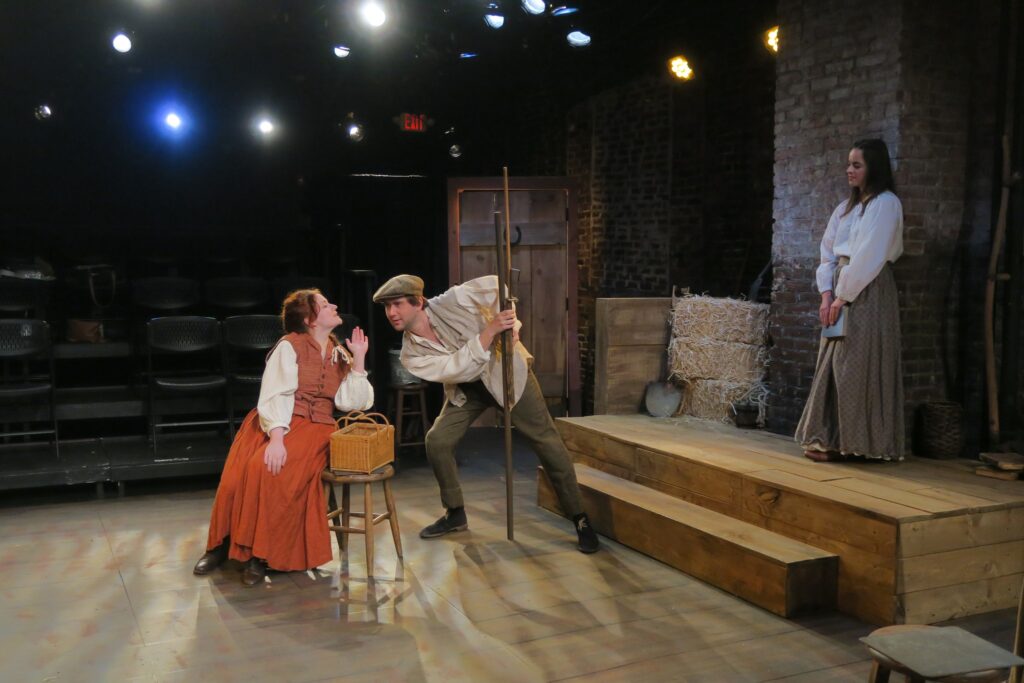
Image via the Longwood Players Facebook page.
Presented by The Longwood Players
By Brian Friel
Directed by Rose Carlson
Produced by Michael Tricca and Kaitlyn Chantry
Set Design by Jessica Algard
Dialect coaching by Mark Hessler
Featuring: Matthew Feldman, Dasha Artemchuk, Jimmy Jack, Via Gould, David Kleinman, Melinda Kalanzis, Anthony Mullin, Raj Bhuva, Carlos Fruzzetti, Gabriel O. Pagán-González
May 8 – 16
Chelsea Theatre Works
189 Winnisimmet St, Chelsea, MA 02150
Review by Maegan Clearwood
CHELSEA— In 1833, the villagers of Baile Beag are content: they teach each other Latin and Greek, go about their farmwork and household chores, host dances and celebrate christenings. This peaceability is tempered, however, by a palpable unease. The villagers whisper about looming political violence, about phantom sweet potato smells – they are haunted, not by Ireland’s past, but by its future.
Brien Friel wrote Translations in 1980, at the height of The Troubles in Northern Ireland. The play is about a parallel political tipping point: Britain set out to erode Gaelic culture and language by a) replacing community hedge-schools with English-speaking national schools and b) anglicizing traditional place names through an imperialist mapping project.
The play spoke volumes when it premiered in Derry, Northern Ireland over 40 years ago. Today, The Longwood Players smartly brings it alive for a 2026 American audience. Translations is a soft-spoken play, but its themes — colonialism, migration, the violence of cultural erasure — resonate loudly. Listen, the production begs, and act while you still can.
Director Rose Carlson orchestrates a magnificent series of performances from the 10-person ensemble. The production is fluid, buzzing with life, and I found myself grieving this fictional village as a facsimile for so many real-world communities that have been ravaged by imperialist violence.
The hedge-school (set design by Jessica Algard) is comprised of small touches, each of which tells a story about the community members who brought it to life: books piled up in Jimmy Jack’s favorite reading nook; hay and pitchforks alluding to the school’s former status as a barn; small trinkets left as payment from local farmworkers. It’s a remarkable little world to get lost in.
Although the play is written in English, the Irish and British characters still fail to understand each other. This clever playwriting choice not only serves as a potent metaphor for broader social discordance, but also results in riveting, poetically circuitous character interactions. For this production, dialect coach Mark Hessler did superb work with the actors, whose accents are necessary for making Friel’s literary device work.
There’s a restless aliveness to this production’s staging: characters constantly engage in side tasks and conversations, using every inch and detail of the stage. For one example, during an important conversation between two other characters, Doalty (played by a boisterous, delightful David Kleinman) washed his hands in a bucket inches away from my seat in the risers.
Details like this, combined with the actors’ Irish accents, may make it hard for audiences to process the detail-rich dialogue – but I found this issue surprisingly unbothersome. I appreciated the verisimilitude of this busy, socially intricate village world, and my inability to understand every word felt metaphorically appropriate.
It helps that the actors are so immersed in what they’re saying. Typically, at this point in my review, I would highlight a few standout performances, but I struggle with Translations, because the ensemble is so evenly adept – so I will name everyone. Matthew Feldman and Raj Bhuva bring pathos and stakes as the brothers Manus and Owen respectively; Via Gould and Gabriel O. Pagán-González pull off an unexpectedly moving love scene couched in this melancholy play as Maire and Lieutenant Yolland; and Dasha Artemchuk, Mark Hessler, David Kleinman, Melinda Kalanzis, Anthony Mullin, and Carlos Fruzzetti fill out the rest of the village, bringing the world to life through quirks, foibles, and tiny interactions that feel surprisingly real.
Friel falls into the literary trap of using identity traits – particularly disability – as broader thematic metaphors. The characters of Sarah and Jimmy Jack, for instance, come across as symbols instead of people, which perhaps wouldn’t be so jarring if the rest of the villagers weren’t so fleshed out.
Otherwise, Translations is remarkable. It continues to speak truth across language, geography, culture, and time. At points, the play is a funeral dirge for the past. But when it ends on a question mark, the characters poised to (perhaps) act, it is also a call to action for audiences today: Once we heed the warning signs of state violence, what are we going to do to protect our communities?