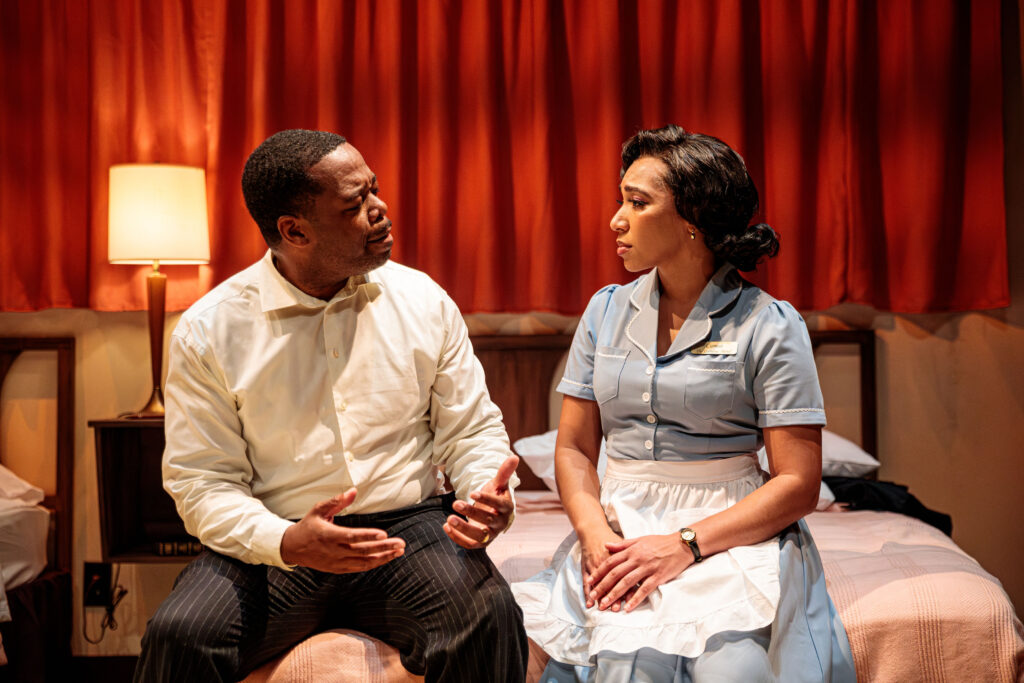
Dominic Carter as Dr. Martin Luther King, Jr; Photo by Benjamin Rose Photography.
Presented by The Front Porch Arts Collective in collaboration with The Suffolk University Modern Theatre
Written by Katori Hall
Directed by Maurice Emmanuel Parent
Assistant Directed by Kayla Sessoms
September 19 – October 12, 2025
The Suffolk University Modern Theatre
525 Washington Street
Boston, MA 02111
Digital Program: Link
Runtime: 90 minutes with no intermission
Review by Helen Ganley
“Never meet your heroes, because they’re sure to disappoint you.”
BOSTON — This Proust quote drips with cynicism, suggesting that if we become too familiar with those we admire, they’ll inevitably fall short of our expectations. I disagree. Heroism isn’t about being untouchable; it’s precisely the fact that they are human, flaws and all, who nonetheless achieve something extraordinary that makes them heroic in my eyes.
The Front Porch Arts Collective’s production of “The Mountaintop” challenges this very notion. Written by Katori Hall, the two-character play reimagines Dr. Martin Luther King Jr.’s final night at the Lorraine Motel in Memphis, Tennessee, on April 3, 1968. There, he engages in a flirtatious yet profound conversation with a motel maid named Camae, one that blends the ordinary with the spiritual. The play premiered in London in 2009 before transferring to the West End, where it won the Olivier Award for Best New Play. Its Broadway debut came in 2011 at the Bernard B. Jacobs Theatre, starring Samuel L. Jackson as Dr. King and Angela Bassett as Camae. With its mix of realism and magical elements, The Mountaintop offers a moving meditation on mortality, legacy, and the unfinished work of justice.
The show’s mid-point turn loses me somewhat, as the magical realism pulls me away from the tenderness at its core. Moreover, given when the play was written, its vision of the future culminates in 2008 with President Obama’s election, framed as a triumph in the racial justice movement. While the closing message of “picking up the baton” remains powerful, it struggles under the weight of the 17 years since the play’s conception and the turmoil of the present moment. Still, the acting more than compensates for some of the script’s shortcomings.
Dominic Carter, as Dr. King, first appears entering his motel room—removing his coat and shoes, using the restroom, and ordering a cup of coffee. Kiera Prusmack’s Camae delivers the tray, speaking freely about her first day on the job. Prusmack embodies Camae’s flippancy, glibness, and effortless ease. She carries herself with pristine composure, each moment on stage strikingly precise, like a still pulled from a film. Over time, she carefully layers her performance. Beginning flirtatious and starstruck, she gushes over King’s accomplishments. When pressed on her personal philosophies, she hops atop the bed and transforms from free-spirited wild child to world-weary preacher, spitting rhetoric that directly challenges King’s beliefs. Midway through, she pivots again, her high-energy diatribes melting into grounded wisdom as she recounts a child’s prayer with a quavering, poignant tenderness.
Carter provides a striking contrast with his emotionally volatile Dr. King. By this point in his life, King had endured countless death threats, bombings, arrests, and attacks, and Carter channels that accumulated trauma. A moment of playful swagger is shattered by a crack of thunder; instantly, he collapses to the floor, paranoid and tearing apart the room in search of bugs or wiretaps. He imbues King with nuance, portraying him in all his facets: flirtatious lady’s man, paranoid preacher, devoted husband and father, and, as he impassionedly pleads, “just a man.”
The production’s technical elements are equally strong. Ben Lieberson’s scenic design conjures the motel room with precision, complete with a window animated by sheets of rain and bursts of snow. Joshua Jackson’s sound design punctuates the night with rumbles of thunder, paired seamlessly with Brian Lilienthal’s lightning strikes.
As Dr. King himself wrote in his 1958 article Advice for Living: “People fail to get along with each other because they fear each other.” Fear is the great equalizer—at our cores, even when nothing else connects us, we all know fear. Yet by overcoming it, and by recognizing our shared humanity, perhaps we can continue climbing toward the summit of equality.