Credit: Benjamin Rose Photography
Presented by Speakeasy Stage Company
By Max Wolf Friedrich
Directed by Marianna Bassham
Jan 16 – Feb 7, 2026
Stanford Calderwood Pavilion at the Boston Center for the Arts
539 Tremont St
Boston, MA 02116
Critique by Helen Ganley
Approximate run time: 1 hour 20 minutes with no intermission.
This production contains strong language, gun use, and discussions of trauma, violence, and abuse. Distressing sounds are used and were ethically sourced. Strobing effects and red and green flashing lights are also used.
BOSTON — “Everyone needs therapy.” As a 24-year-old woman living in Boston, it’s a phrase you hear tossed around constantly. It might be invoked while unpacking a friend’s toxic ex, a coworker’s strained family dynamics, or a roommate’s own internal battles. The phrase carries an easy confidence that there is a place for these stories to go, a person trained to receive them, and a clean separation between the one who speaks and the one who listens.
Job unsettles that assumption. Its patient is a content moderator, professionally tasked with absorbing the internet’s most disturbing images so others don’t have to encounter them. If therapy depends on the idea that pain can be transferred without consequence, Job asks what happens when both people in the room are already doing that work for a living. What begins as a therapeutic exchange becomes a hall of mirrors, where emotional labor reflects endlessly back on itself.
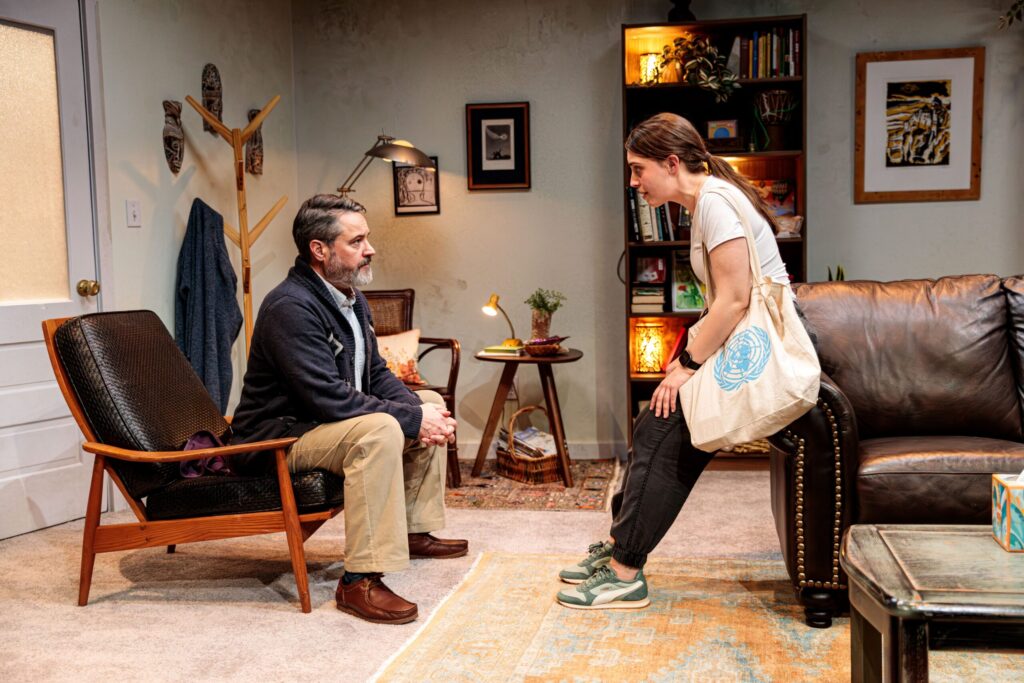
When the lights rise on a therapist’s office, 29-year-old Jane (Josephine Moshiri Elwood) is holding her therapist, Loyd (Dennis Trainor Jr.), at gunpoint. The proceeding 80 minutes are as much a hostage negotiation as a therapy session—Jane has suffered a mental breakdown at work and needs a doctor’s approval to return, while Loyd appears torn between trying to get out alive and helping the young woman in front of him.
Jane is caged—desperately wanting to return to work, in turn caging the therapist who has the authority to send her back. Elwood is astounding: she paces, frenzied, as she (poorly) attempts to diffuse her chaotic first impression, occasionally settling into a seat as she grows more comfortable, only to hop up and flash across the room in another fit of entropy. As she ramps up into sprawling monologues, her fear and anguish are evident in every syllable.
Trainor Jr. is the foundation she plays against—confident (while still afraid of his armed patient), reflective, and patient. His consistency is comforting, so when it breaks, in fits of yelling and tears, it creates immediate tension in the audience. The duo play off one another, the energy palpably transferring between them. If one takes an action, the other responds, no matter how small or intricate the gesture.
Peyton Tavares’s scenic design, combined with Emme Shaw’s props design, creates a space that truly feels like a real therapist’s office. This backdrop allows for moments where reality bends, where we enter the mind of either Jane or Loyd and see the world crashing down around them. Amanda E. Fallon’s lighting design sputters the lights in and out, while Lee Schuna’s sound design adds the thrum of white noise and pulse-pounding heartbeats to each moment.
Job, at its core, diffuses and blurs divides—Gen Z and Boomers, online and offline, power and burden. It leaves you with questions and insights, and a burning desire to both know and do more.