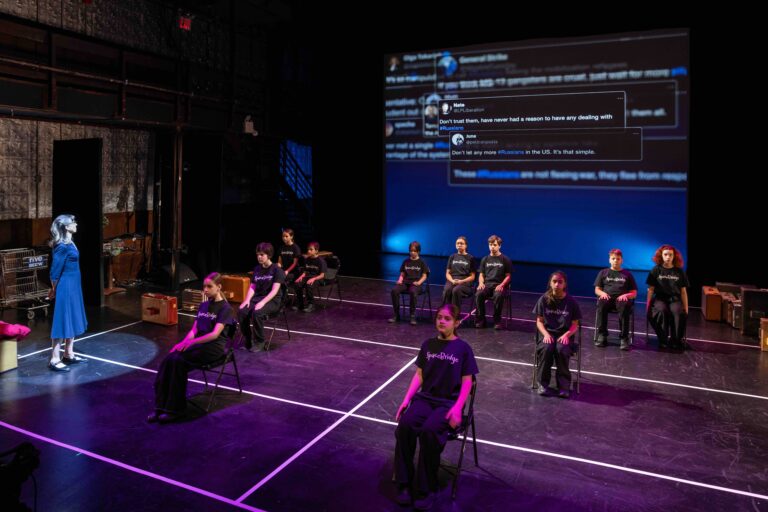
The ensemble. Photo by Walter Wlodarczyk.
Presented by ArtsEmerson
Produced by Visual Echo & Irina Kruzhilina
Conceived and directed by Irina Kruzhilina
Written by Irina Kruzhilina and Clark Young
Cinematography by Aleksei Postnikov
Featuring Ellen Lauren, Alisa Shaverdova, Anastasia Skorobogach, Anna Skorobogach, Arina Skorobogach, Artem Skorobogach, Leon Ladia, Lily Borzenko, Mark Savin, Mars Markelov, Sasha Boikova, Sonia Tsatskina, Adele Nigrini, Alexis Edel, Drake Malave, Henry MacDowell, Isaac Stinson, Maisie Pickar, Nate Hatter, Sabine Gutenberg, Silas MacLean and Zora Graves
November 21 – 23, 2025
559 Washington St, Boston, MA 02111
Emerson Paramount Center
Tickets here
Review by Maegan Clearwood
Recommended for ages 12+
BOSTON — If you’ve seen documentary theatre before, then nothing in SpaceBridge will surprise you: live movement is interspersed with statistics, news reports, and recorded interviews, split into chapters and stitched together with a framing device. The multimedia production elements are flashy and sophisticated, as one would expect from a piece spearheaded by Irina Kruzhilina, who, among other credits, co-founded the MFA program of the New School and is a resident artist at LaMaMa.
But the true power of SpaceBridge comes from the storytellers themselves: 11 young Russian refugees, children of antiwar activists currently living in New York City shelters while seeking political asylum. With their eight American friends, they present the output of an intensive workshop program, telling story after story of fear, grief, compassion, and hope.
SpaceBridge is split into 10 chapters: the first few recount the perils of fleeing Russia; the middle comprises a playful guide to navigating life as refugees in New York; and the final few include powerful, if heavy-handed, commentary about our current political crisis. The piece is narrated by an adult version (played by Ellen Lauren) of the real-life Samantha Smith, who in the 1980s was dubbed “America’s Youngest Peace Ambassador” for attempting to build relational bridges with children in the Soviet Union. Although this character provides a metatheatrical throughline, there is no driving internal momentum behind the narrative; as a result, SpaceBridge plods instead of builds, a common pitfall for documentary theatre.
In her artist note, Kruzhilina says she wrestled with “whether the challenges faced by displaced Russian youth deserve awareness at a time when Ukrainian children are being orphaned.” While I was watching this piece, my mind wandered towards the plight of Sudanese and Palestinean children, as well as children here in the U.S. (primarily from Latin American countries) who are being displaced and traumatized by ICE detentions. These meanderings point to the urgent need for more stories about child refugees, and indeed, Kruzhilina states on her website that she hopes to use this storytelling curriculum on a global scale.
Kruzhilina, who herself fled Russia in 1999, chose to continue this workshop with young refugees out of a desire to engender empathy. “They [Soviet children] are just like us,” says the character of Smith in the first chapter of SpaceBridge. “They want peace, too.”
This “just like us” approach to empathy is powerful, but at times flattening. Again and again, I wondered about where the proverbial (and literal) spotlight is being directed; about whose stories are and aren’t being told.
Any theatrical production that heavily features young actors is likely to send me into a mental spiral about ethics, and SpaceBridge is no exception. I am not interested in arguing whether the piece ultimately is or is not ethical; clearly, this production comes from a place of good intentions, as evidenced by Kruzhilina’s goals and the ensemble’s outpourings of love for each other.
But I do wonder what it means to put children’s trauma onstage for hundreds to see, over and over again. SpaceBridge projects video recordings onstage (cinematography by Aleksei Postnikov), some of which are quite harrowing, meaning that the ensemble members are not only retelling but also rewatching their stories with every performance. No content warning is listed on the ArtsEmerson website, but the production is recommended for ages 12 and up, and I wonder what it means to produce a piece of theatre by and about children that is not for children.
I wonder about the program, which lists the 19 children’s names under “ensemble” rather than “devisors” or “writers.”
I wonder about the portrayal of Samantha Smith, who died in a plane crash at the age of 13. Lauren is the only adult onstage. She reimagines Smith at 53 years old, but her hair and clothes are overtly girlish, her demeanor childishly bright-eyed. She is used to shepherd the young ensemble from one chapter to the next, but Smith isn’t given any dimension or growth. At times, the juxtaposition between Lauren’s adult body and Smith’s youthful persona is surreally devastating, but I wonder what it means to use this child’s tragedy as a framing device.
Again, the young performers are the heartbeat of SpaceBridge. Their ability to speak, move, and breathe as one speaks to the level of dedication and heart that they have poured into this piece. They are given the most agency during the middle chapters, which are awkwardly paced but fun: highlights include a cooking show vis-à-vis stage magic and a guide to navigating Manhattan vis-à-vis musical. These segments are indicative of a workshop process that emphasized theatrical play alongside narrative grief.
SpaceBridge is impeccably produced. My many wonderings point towards the fact that, ultimately, these types of stories are urgent and powerful – but who should be performing, facilitating, and seeing them? I’m still wondering. It sounds like Kruzhilina is still wondering as well, and I’m curious about where this ongoing project will lead her team next.